







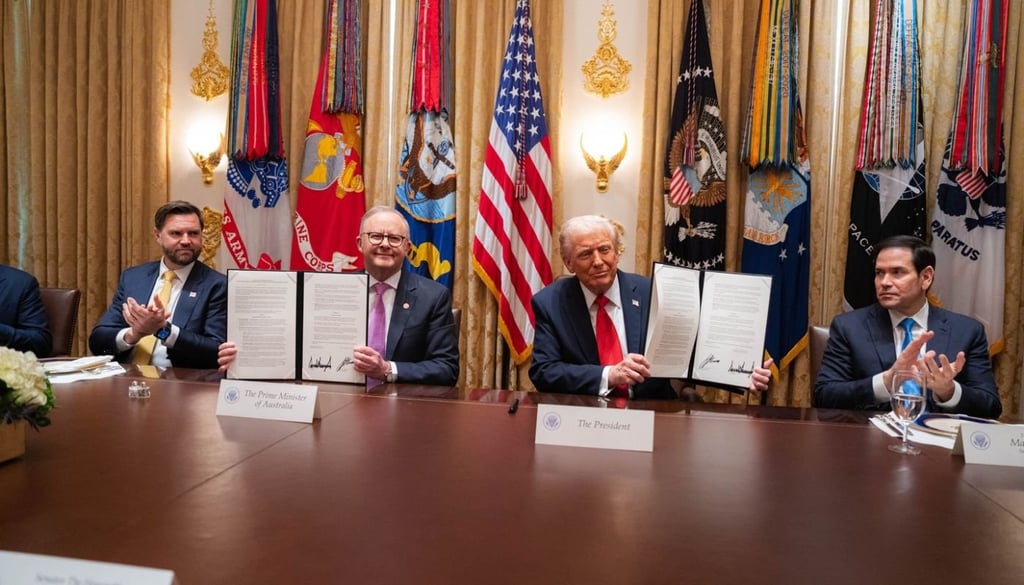
The United States and Australia have signed a major agreement aimed at securing supplies of rare earths and critical minerals, a move designed to reduce reliance on China, which currently dominates the global market for these vital resources.
The new framework, signed by President Donald Trump and Prime Minister Anthony Albanese at the White House, outlines plans for both countries to invest heavily in mining and processing projects while strengthening their joint control over supply chains crucial to defense and advanced technology industries.
Rare earths play a vital role in many modern technologies. In smartphones and computers, elements like neodymium are used in tiny magnets, while yttrium and europium are key materials in touchscreens. AI relies on high-performance data centers, GPUs, and neural network accelerators, all of which depend on rare earths for key components.
According to the White House press release, the United States-Australia Framework for Securing Supply in the Mining and Processing of Critical Minerals and Rare Earths seeks to “accelerate development of diversified, liquid, fair markets for critical minerals and rare earths.”
Under the agreement, both countries will provide at least $1 billion each in financing within six months to support projects expected to deliver critical minerals for domestic use. The document also outlines commitments to streamline mining permits, promote recycling technologies, and prevent foreign takeovers of key mineral assets on national security grounds.
$8.5 billion pipeline and new investments
Prime Minister Albanese said the partnership would unlock a pipeline of $8.5 billion worth of “ready-to-go” projects that would expand Australia’s mining and processing capacity.
The US Export-Import Bank (EXIM) also announced over $2.2 billion in letters of interest to support Australian critical mineral ventures, including Arafura Rare Earths, Northern Minerals, Latrobe Magnesium, and Sunrise Energy Metals.
The investments span essential minerals for defense systems, renewable energy, and high-tech manufacturing, from rare earths used in electric motors to gallium, a metal used in semiconductors and radar systems.
President Trump hailed the deal as a turning point for America’s mineral independence. “In about a year from now, we’ll have so much critical mineral and rare earths that you won’t know what to do with them,” he told reporters.
Why rare earths matter
The deal comes as Beijing tightens export controls on rare earth minerals. China currently controls about 70% of global mining and 90% of processing, according to the US Geological Survey (USGS) data.
By comparison, the USGS says the US produced 45,000 tons of rare earths last year, while Australia produced 13,000 tons — both far below China’s 270,000 tons.
Beyond mining, the agreement underscores a broader strategic push by Washington to secure key resources driving the AI and chip industries. The US relies heavily on rare earths to manufacture advanced microchips used in machine learning, data centers, and defense systems, areas where supply disruptions could have far-reaching consequences. By diversifying its sources, the US aims to protect its tech sector from geopolitical risks.
The partnership also deepens strategic ties between the US and Australia, complementing existing defense agreements such as AUKUS. Both nations hope the deal will encourage private investment and spark a wave of industrial activity that can match China’s scale in the long term.
China was also in the news, and not in a good way, when the Netherlands seized control of Chinese-owned chipmaker Nexperia.