






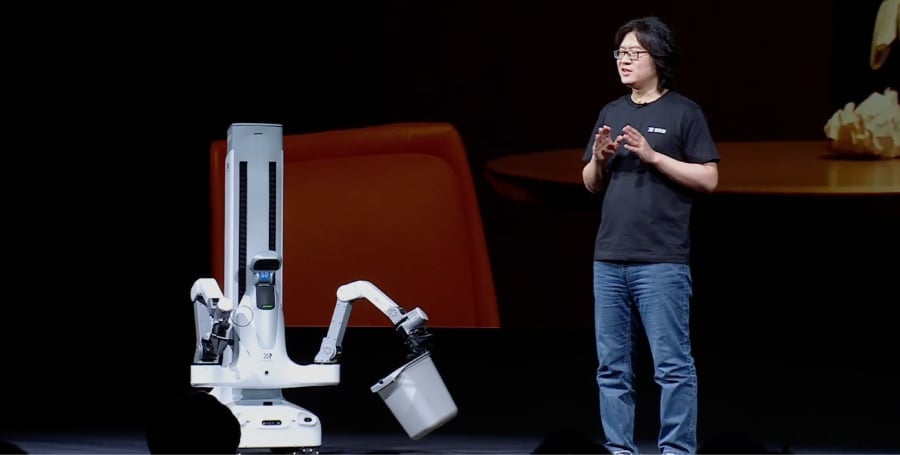


A robot that can run a marathon is impressive. One that can clean your kitchen without stopping halfway is a different challenge.
X Square Robot’s new Wall-B is stepping into that test to handle everyday household chores. Early results, however, suggest the real challenge isn’t about movement but consistency.
Wall-B was unveiled this week in Beijing and was shown picking up litter and arranging flowers instead of performing staged tricks. The company plans to place the robot in real homes within 35 days, even as early feedback suggests slow performance and occasional mistakes.
From demos to domestic work
Reuters reported that Wall-B’s debut focused on simple, controlled tasks like picking up trash and arranging objects. The demonstration showed how robots are shifting away from impressing on stage and into working in everyday settings.
Robb Report also noted that these tasks, while basic, are harder for robots than running or dancing because they require a more complex understanding of the surrounding environment.
CEO Qian Wang said the limitation is no longer physical hardware. “The hardware is largely there, but the brain hasn’t caught up,” he said.
Why simple chores remain difficult
Household work requires a level of precision that current systems still struggle to achieve. Small errors can quickly lead to failure in tasks that seem routine to humans.
“But when we manipulate things with our hands, if we are off by 0.1 millimeters, the whole task may fail,” Wang told Reuters.
Unlike repetitive actions such as running, domestic tasks vary from moment to moment. Objects move, lighting changes, and each interaction introduces new variables that machines must process in real time.
To improve performance, X Square developed a system that combines perception, language, and physical prediction into a single model, according to its official release. The company said it designed the approach to help robots operate in unstructured environments where tasks are rarely repeated.
As Wang puts it, “In factories, they repeat the same action 10,000 times. In a home, they may need to perform 10,000 different actions, each in a different context. The real challenge is not repetition, but whether a robot can execute new, untrained actions in an unstructured environment.”
Big ambitions, early deployment
Backed by Alibaba, ByteDance, Xiaomi, and Meituan, X Square is already moving toward real-world testing. The company said it plans to deploy Wall-B systems in everyday homes within 35 days, an aggressive timeline that reflects growing pressure to demonstrate real utility.
Reuters reported that the company has also begun a limited rollout in Shenzhen through a service that pairs human cleaners with robots. A three-hour session costs 149 yuan, and the machines have already been in more than 50 households.
Early feedback suggests the robots remain slow and occasionally unreliable. Wang said the machines may pause mid-task or make placement errors, with remote human intervention stepping in when needed.
Even so, the potential market remains a key driver. Wang estimated that household labor accounts for roughly 20% of GDP, positioning it as a significant opportunity if automation becomes practical.
For now, Wall-B shows where the industry is heading, not where it has arrived. Robots may be improving in controlled settings, but everyday chores are still proving difficult to get right.
Humanoid robots may be grabbing headlines as the next big AI frontier, but Stanford’s latest AI Index found they still fail roughly 88% of household tasks.