






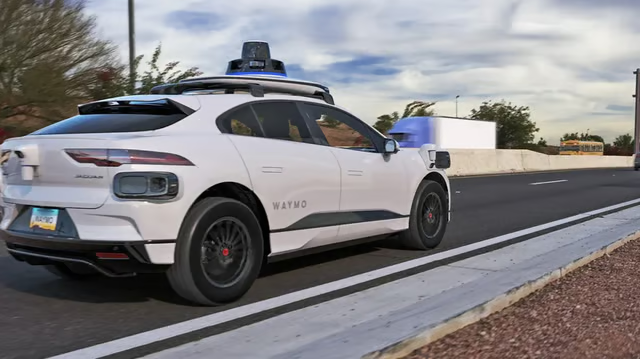


Waymo has temporarily restricted its robotaxis from operating on highways after a series of incidents involving construction zones.
The Alphabet-owned autonomous vehicle company filed a voluntary software recall with the National Highway Traffic Safety Administration after 13 reported incidents in Phoenix and the San Francisco Bay Area during April and May. Until a software update is deployed, affected vehicles will avoid highway routes.
Customers taking Waymo rides during this time will see their routes diverted from highways, which may increase total ride times. People in San Francisco and Los Angeles had already complained before Waymo gained highway approval about the time it takes for robotaxis to get across the city compared to a normal taxi.
According to Business Insider, the recall affects 3,871 vehicles using Waymo’s fifth-generation automated driving system.
“We voluntarily restricted freeway operations last month while making improvements, proactively notified state and federal regulators, and decided to file a voluntary software recall with NHTSA," said a Waymo representative to TechCrunch.
This is not the first instance of Waymo having significant knowledge gaps. During a blackout in San Francisco, its cars had to be pulled from the road because drivers did not know how to operate without proper traffic signals. It has also pulled cars over issues with driving on flooded roads and failing to recognize school buses.
While Waymo has consistently published rider safety metrics and research showing that its cars cause far fewer crashes than humans do, these types of recalls tend to stick more than statistics.
A critical time for Waymo
The highway restriction comes at a critical time for Waymo, as it plans to expand to more than 20 cities by the end of this year, including its first non-US launches in London and Tokyo. It has also started rolling out its newest robotaxi model, the Ojai, manufactured by Chinese automaker Geely, which is seen as the company’s first robotaxi built for scale.
If Waymo is unable to operate on highways for an extended period, this could eat into its daily active riders, as many commuters may be turned off by longer rides.
Waymo recently received a much higher valuation of $110 billion in a funding round, more than double what it received a year earlier. Part of this increase was due to Waymo’s position as the leader in the self-driving market, and the apparent sophistication of its autonomous driving system.
While this setback is unlikely to deter Waymo or investors, these issues seem to be occurring at a more regular rate as Waymo expands. Waymo has reportedly driven 170 million miles autonomously so far, a figure that has ramped up significantly over the past two years. If the robotaxis are being pulled each month for a new issue, it may start to affect customer confidence and interest in the technology.
Even with the setback, Waymo is still in a very strong position, with Tesla, Uber, and other rivals not at the same level of scale or consumer interest. Waymo has not said when it expects to resume operating on highways.
Also read: Baidu’s robotaxi failure in Wuhan raised fresh questions about how autonomous vehicles handle unexpected road risks.