






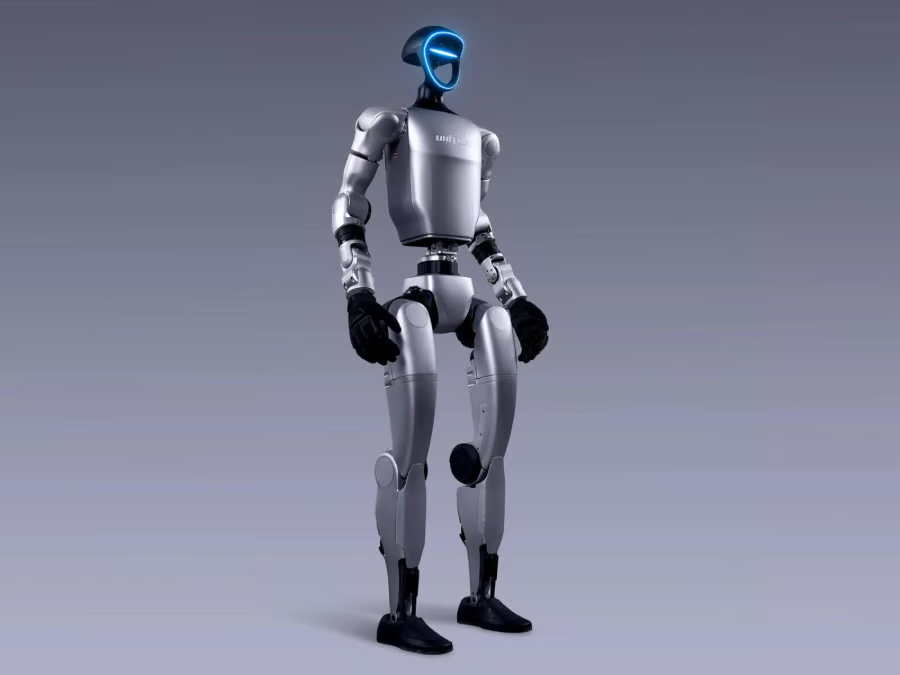


Unitree Robotics is preparing to cash in on China's humanoid robot boom just as one of the world's largest technology markets is becoming harder for many foreign-made connected robots to enter.
The Hangzhou-based robot maker has priced its initial public offering on Shanghai's STAR Market at an implied valuation of approximately 62.4 billion yuan, or about $8.7 billion. The offering positions Unitree to become the first "embodied intelligence" company to list on China's domestic A-share market.
According to Reuters, the main source for this report, Unitree exceeded earlier valuation estimates that ranged from roughly $6 billion to $7 billion. The offering also comes as the US Federal Communications Commission (FCC) has adopted new restrictions affecting future approvals for certain foreign-produced connected robots, adding another geopolitical dimension to one of China's most prominent emerging robotics companies.
The result is a revealing split-screen for the robotics industry. Investors are valuing Unitree as one of China's most important emerging technology companies, while US regulators are increasingly scrutinizing connected robotic systems through the lens of cybersecurity and national security.
- Unitree's IPO puts a price on China's robot ambitions
- Low prices helped Unitree escape the lab
- The FCC is treating connected robots as security risks
- Robots present a new kind of cybersecurity challenge
- The restrictions could complicate Unitree's global expansion
- Unitree's listing is bigger than one robot maker
Unitree's IPO puts a price on China's robot ambitions
Unitree plans to issue approximately 40.45 million shares, representing 10% of the company after the offering, according to its prospectus, as reported by the Global Times.
The company intends to direct much of the proceeds toward robot research, manufacturing, and product development. Planned investments include 2.02 billion yuan for intelligent robot model research and development, 1.11 billion yuan for robot body development, and 624 million yuan for a new manufacturing base.
Those spending plans show that Unitree is not pitching itself merely as a hardware vendor. It is trying to build an integrated robotics platform spanning physical machines, AI models, and large-scale manufacturing.
That vision is supported by rapidly changing revenue figures. Humanoid robots contributed just 1.88% of Unitree's revenue in 2023. By 2025, the category generated 868 million yuan and accounted for more than half of the company's revenue.
Unitree also said it shipped more than 5,500 humanoid robots in 2025, which its prospectus described as the highest volume globally. The company reported total 2025 revenue of 1.7 billion yuan and adjusted net profit of approximately 590 million yuan.
For the first half of 2026, Unitree projected revenue growth of between 35.62% and 45.41% year over year, reflecting stronger demand for embodied AI systems.
Earlier reporting from The Next Web estimated Unitree could debut with a valuation above 50 billion yuan. Reuters later reported that the company ultimately priced the offering at an implied valuation of approximately 62.4 billion yuan.
Low prices helped Unitree escape the lab
Unitree's influence extends beyond its balance sheet.
The company gained global attention by selling quadruped and humanoid robots at prices far below many Western competitors. That strategy helped move advanced robots out of tightly controlled research laboratories and into universities, developer communities, demonstrations, and experimental commercial settings.
Lower prices have also made Unitree hardware attractive to AI researchers looking for physical platforms on which to test new AI models.
This matters because the humanoid robotics race is no longer only about building machines that can walk. Developers are increasingly trying to pair advanced AI models with robots capable of interpreting their surroundings, following complex instructions, and manipulating physical objects.
Companies that build large developer ecosystems could gain long-term advantages as robotics platforms mature, much as smartphone and cloud ecosystems did over the past two decades.
The FCC is treating connected robots as security risks
As Chinese investors weigh Unitree's growth prospects, US regulators are applying a different calculation.
The FCC has added certain foreign-produced advanced robotic devices to its Covered List, preventing affected new products from receiving the equipment authorization generally required to be marketed or imported into the US. The restrictions cover connected mobile robots, including humanoid, bipedal, and quadrupedal systems, as well as certain network-connected power inverters, according to reporting on the FCC's action by Nextgov.
Rather than targeting a single company, the restrictions apply to qualifying foreign-produced devices. Existing products are not automatically removed from the market, but future models would generally require a national security determination before they could receive FCC authorization.
Robots present a new kind of cybersecurity challenge
The security concerns stem from what modern robots can see, hear, store, and transmit.
Internet-connected humanoid robots can include cameras, microphones, mapping sensors, wireless communications hardware, and cloud-connected software. In workplaces or homes, those systems may collect detailed information about buildings, manufacturing environments, infrastructure, or the people around them.
US regulators have raised concerns that compromised connected robots could become mobile surveillance platforms or that vulnerabilities in their software could expose sensitive environments or enable unauthorized remote access.
Those concerns extend debates that have already affected telecommunications equipment, drones, and surveillance cameras. Unlike those technologies, however, robots can physically move through workplaces, warehouses, factories, and other sensitive environments.
For enterprise buyers, robotics procurement may increasingly require the same type of security reviews already common for networking equipment and other connected infrastructure.
The restrictions could complicate Unitree's global expansion
Unitree's IPO reflects strong investor confidence, but evolving regulatory policies could complicate its international expansion.
The United States remains an important market for robotics research, AI development, and commercial adoption. If foreign-produced connected robots face additional regulatory hurdles, companies like Unitree could encounter greater challenges reaching some American customers and research organizations.
At the same time, the restrictions may reinforce Unitree's focus on China's domestic market. Beijing has designated humanoid robotics as a strategic industry, and Chinese manufacturers, universities, and automakers continue investing heavily in embodied AI.
The broader supply chain remains deeply interconnected. Many robotics companies, including US firms, continue to rely on components, batteries, sensors, motors, and manufacturing capacity linked to China.
Unitree's listing is bigger than one robot maker
Unitree's IPO pricing offers one of the clearest signals yet that investors see significant long-term potential in humanoid robotics.
Its nearly $9 billion valuation reflects growing investor confidence in the commercial potential of embodied AI, even if widespread deployment across industries is still in its early stages.
At the same time, the FCC's actions illustrate that future success in robotics may depend not only on engineering advances but also on cybersecurity requirements, regulatory approvals, and geopolitical competition.
Unitree may soon have the capital of a public company and the status of a national technology champion. Whether it ultimately becomes a truly global robotics leader will depend on both continued technological progress and an increasingly complex regulatory landscape.
Related reading: Unitree isn't alone in China's humanoid robotics push. Read our coverage of how BYD is entering the race with its first humanoid robot and what it means for the broader APAC robotics market.