






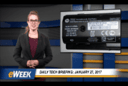


Today’s topics include HPI’s recall of more than 100,000 notebook PCs with batteries that could overheat, how much Apple iPhone production slowed in 2016, Google’s report on why it blocked 1.7 billion online ads in 2016 and Sophos’ new Phish Threat attack simulator to help educate users on phishing risks.
Samsung isn’t the only major IT device maker that’s been having trouble with too-hot-to-handle batteries. Hewlett-Packard Inc., has determined that the lithium-ion batteries used in many of its notebook PCs are fire hazards.
On Jan. 24, HPI recalled about 101,000 notebooks so it could replace the suspect batteries. The company said that the batteries can overheat, posing fire and burn hazards. It is requiring owners to replace them immediately.
“Consumers should immediately stop using the recalled batteries, remove them from the notebook computers and contact HP for a free replacement battery,” HPI said in a media advisory. “Until a replacement battery is received, consumers should use the notebook computer by plugging it into AC power only.”
Research firm TrendForce reported Jan. 25 that global smartphone production volume for 2016 grew 4.7 percent annually to reach 1.36 billion units. Apple iPhone production fell by 11.5 percent.
Samsung, with 23 percent market share, continued to top the annual global ranking despite the discontinuation of Galaxy Note7 smartphone because of defective batteries.
Samsung mobile device production declined 3.3 percent compared to its 2015 total, mainly because Galaxy Note7 phones were recalled after batteries in a significant number of units overheated, burned or even exploded.
Apple is No. 2 with a 15.3 percent share. Chinese brands Huawei, OPPO and Vivo, respectively, occupied the last three spots in the global market share top five.
Google makes billions of dollars from web advertising. But the company has long claimed it does not hesitate to take down ads that it considers misleading, harmful or inappropriate.
New figures and data released by the company provided more detail. In 2016, Google blocked 1.7 billion ads for violating the company’s policies. That represented double the number of ads Google blocked the previous year.
About 68 million of the ads that Google blocked last year were related to bogus or illegal health care products—up sharply from the 12.5 million ads that were dropped in 2015. Another 80 million were taken down for misleading users with false information in order to drive more clicks.
Security vendor Sophos announced the official launch of its Phish Threat attack simulator on Jan. 25 to help improve end-user and organizational readiness for phishing attacks. Sophos didn’t build the Phish Threat technology on its own, rather the platform was acquired from privately-held security consultancy Silent Break Security in November 2016. Phish Threat enables organizations to simulate phishing attacks to test user responses.
Brady Bloxham, creator of Phish Threat, told eWEEK that while there are other phishing test platforms on the market, but in his view, they don’t always reflect the evolving threat landscape.
Now as part of Sophos, Phish Threat benefits from the Sophos Central platform, which is an effort to provide a consolidated view of security devices and controls across an organization.