







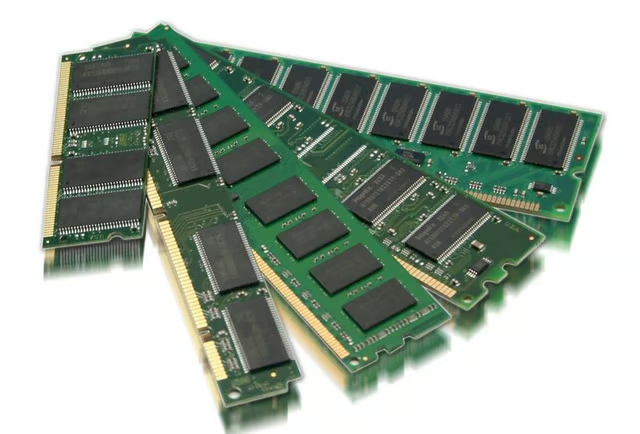
With more demand in the markets for real-time or near real-time performance in enterprise and mobile applications, DRAM (dynamic random access memory) is now becoming a hotter commodity, and market prices are soon going to show it.
DRAM is used in virtually all smartphones, laptops and tablet PCs to handle hot data and in most servers for in-memory-based applications. In-memory servers such as SAP’s HANA and Oracle’s Database In-Memory run their entire application in DRAM.
DRAMeXchange, a division of market analyst TrendForce, reported July 5 that DRAM prices — which had been in decline from October 2014 to June 2016 — have leveled off and will be going up during the coming months.
Over the last two years, the average contract price of 4GB DDR3 plunged 62 percent, from $32.75 to $12.50. DRAMeXchange expects DRAM contract prices to rebound up in the third quarter, with the increases ranging from about 4 percent to 8 percent, due to a tightening of supply because of a downturn in sales of laptop PCs and other factors.
According to Avril Wu, DRAMeXchange research director, demand from mobile and server applications will be the main driving force that help raise average contract prices in the DRAM market during the third quarter. But PC demand remains in a slump, and the Windows 10 licensing scheme, which sets fees according to system specs, further discourages PC vendors from increasing the memory content per box for their products.
The effects of tight supply in the NAND flash market also will contribute to the rebound of DRAM prices in the coming months, Wu said. Strong demand for solid-state disks have raised flash prices, and NAND flash and DRAM work together in virtually all connected devices.
Another factor is that Samsung’s memory fab in Xian, China, suffered a sudden power outage on June 18. Since this accident cut out a day’s worth of NAND flash and DRAM supply for memory module makers, spot prices for both products jumped across the board.
In other DRAM news, Micron recorded a loss in its third fiscal quarter from March to May and said it is planning to cut 2,400 jobs.
At the same time, however, Micron continues to search for various forms of partnerships within the DRAM industry. Last year, Chinese technology conglomerate Tsinghua Unigroup tried to acquire Micron for $23 billion, but the deal was blocked by the Committee on Foreign Investment in the U.S. (CFIUS).
There are reports that China’s semiconductor sector is again gathering forces to make another offering to Micron concerning other non-DRAM products. Such a deal would not come in conflict with Micron’s plan to acquire Inotera. On the other hand, another U.S.-based semiconductor company has been recently reported to be in talks with Micron as well.
DRAM is a type of random-access memory that stores each bit of data (1 or 0) in a separate capacitor within an integrated circuit. Since even non-conducting transistors always leak a small amount, the capacitors will slowly discharge, and the information eventually fades unless the capacitor charge is refreshed periodically.
Because of this refresh requirement, it is a dynamic memory as opposed to static random-access memory (SRAM) and other static types of memory. Unlike flash memory, DRAM is volatile memory, since it loses its data quickly when power is removed.