






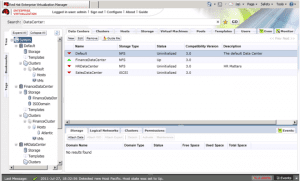

[WP_IMAGE]Red Hat Enterprise Virtualization 3.0 was released today with many of the changes from version 2.2 focused on improving management features.The open source, KVM-based (Kernel Virtual Mode) Red Hat Enterprise Virtualization 3.0 hangs its hat, so to speak, on lower license costs and SPEC benchmarks that show it has an advantage over
“
proprietary
”
(read VMware) systems. KVM is also a part of the Linux kernel although Xen based hypervisor technologies, for example Citrix XenServer, have a large following in the open source community. I
’
ll be setting up a Red Hat Enterprise Virtualization test environment over the coming week. In the meantime, a quick look at the Technical Notes clearly show that most of the work in this version focused on management features.This make sense. As I noted in my eWEEK review
“
As Microsoft readies Windows Server 8, and the operating systems enhanced Hyper-V virtualization capabilities for release, the days will soon be gone when VMware is the single star that dominates center stage. Savvy IT managers will need to call on players, some old and many new, to successfully manage these evolving and maturing datacenter virtualization platforms.Further setting the stage for multi-hypervisor management, Red Hat Enterprise Virtualization Manager 3.0, now with a REST API that enables full access to Red Hat virtual hosts and guest virtual machines, including high availability, live migration, storage management and system scheduling.
”
Ensuring that Red Hat Enterprise Virtualization can be managed in concert with other VMware and Microsoft Hyper-V is critical for IT datacenter managers. For cost savings to extend beyond lower license fees it is critical that multiple hypervisor platforms can be managed with as few IT resources as possible. This means using tools that can hook into the hypervisor to provide inventory, performance and dependency information in a single management console.It looks like Red Hat has taken a significant step in this direction.