







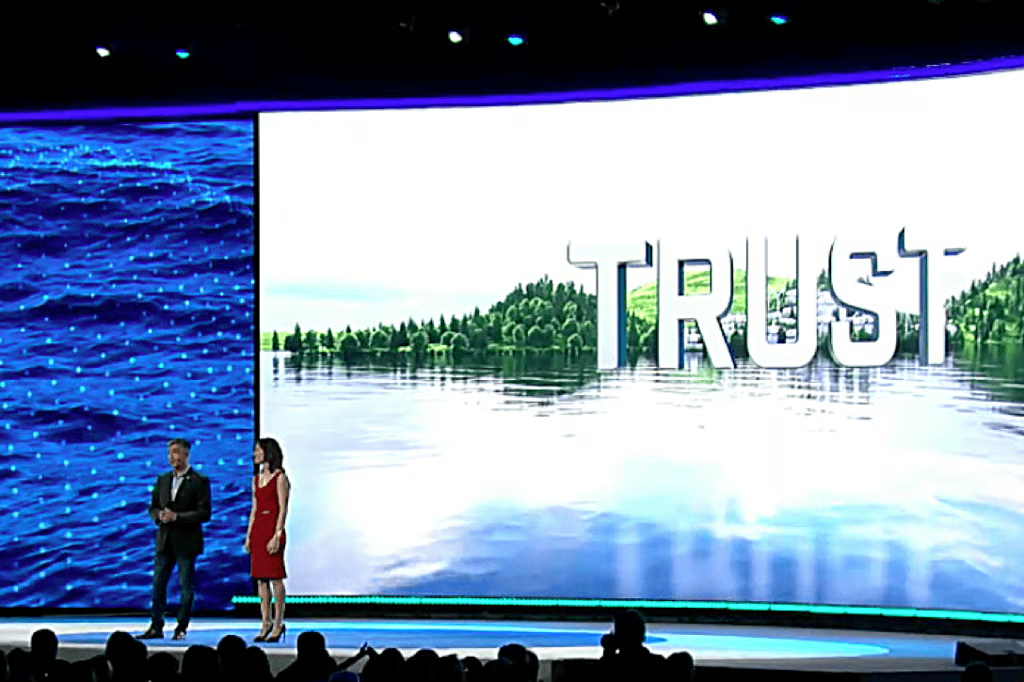
SAN FRANCISCO— Often RSA Conference keynotes detail new technologies or outline existing challenges. At the RSA Conference 2019 here, RSA Security took a different approach this year—predicting a possible future that could be less than ideal for humanity unless the right steps are taken.
Rohit Ghai, president of RSA Security, a Dell Technologies business, and Niloofar Razi Howe, cyber-security strategist and entrepreneur, set the stage, talking about year 2049 and a future isn’t all that bad but the road to get there will involve some challenges.
“We still have water. We still have trust. But there was a time we almost ran out of both,” Ghai said. “How did we save our future and make it to this incredible era?”
“Trust is to the economy what water is to life,” Ghai said.
In the future scenario that Ghai and Howe outlined in their keynote, trust evaporated in the mid-2020s. The lack of trust came from a variety of things, including fake news and failures with autonomous technologies. The elements needed to create a solid trust landscape involves labeling data at the point of creation and on an ongoing basis.
“The consumer owns the data and has perfect information on her data and its copies and where it flows,” Ghai said. “Data is the primary asset flowing through supply and distribution chains, and the provenance and governance of data is an essential competency. “
Trustworthy Twins
Humans and machines need to work together to properly enable the future trust landscape.
“We applied an idea from the early days of software engineering: pair programming, which posits that when programmers work in pairs they generate more trustworthy code and have better outcomes,” Ghai said. “One plus one is actually greater than two.”
The Chain of Trust
Building the future trust landscape isn’t about any one company or individual, but rather about having a chain of trust. In the future forecast scenario, Ghai said that there is a role for blockchain. He outlined a fictional idea called TrustLink that is a global trust network where all organizations can report digital and cyber incidents and associated business impact anonymously and receive a score.
So what is the path to the future? First off all, Ghai said that organizations need to think of security as a risk management problem and focus on minimizing impact not breaches. Humans and machines also need to work together for the future trust landscape.
“Stop waiting for humans or machines to get better at things they are terrible at,” he said. “Implement a security program with machines and humans working together. Humans asking questions. Machines hunting answers.”
Overall, both Ghai and Howe emphasized that simply protecting applications or infrastructure is not the key to the future.
“We are in the business of protecting trust,” Ghai said. “Trust in organizations and institutions that we cherish. Trust in digital technologies.”
Sean Michael Kerner is a senior editor at eWEEK and InternetNews.com. Follow him on Twitter @TechJournalist.