







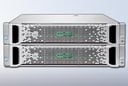
Hewlett Packard Enterprise later this month will release a new hyperconverged offering aimed at the midmarket and enterprises with remote offices.
The HC 380 is the latest offering in a growing hyperconverged infrastructure space that recently saw the entrance of Cisco Systems and a joint effort by Lenovo and Juniper Networks. It also adds to HPE’s portfolio that already includes hyperconverged solutions for Microsoft and VMware virtualization environments.
With the HC 380, HPE officials wanted to make managing the infrastructure as simple as possible and to base it on the vendor’s widely used ProLiant DL380, according to Paul Durzan, vice president of product management for converged data center infrastructure at HPE.
“We essentially decided to marry the two together,” Durzan told eWEEK. “We really wanted to focus on frictionless lifecycle management.”
HPE’s approach of using its own management software will bring greater simplicity, lower cost and faster response time, he said. It will take users only five clicks to deploy virtual machines (VMs) and 15 minutes to add capacity using templates for provisioning VMs. In addition, the software includes analytics capabilities and tools that will help companies reduce the over-provisioning of VMs by as much as 90 percent.
The HC 380 initially will support VMware virtualization technologies, with support for other hypervisors coming later, Durzan said.
In addition, firmware updates can be done in three clicks, Durzan said. With hyperconverged solutions from other vendors, firmware updates are done through separate management tools, increase the amount of time it takes and run the risk of having the updates conflict. HPE will offer pre-validated firmware updates that can be done through the same management software and eliminate conflicts, he said.
“The goal is to make it as simple as possible,” Durzan said.
The new system—which will be available March 31—also comes with a pay-as-you-grow capability and pre-configured hardware. In addition, using HPE’s StoreVirtual VSA technology, the HC 380 will reduce disaster recovery costs by 62 percent, according to the company.
The hyperconverged infrastructure market is expected to grow quickly over the next few years. According to numbers from Gartner, in 2014 the space was $371.5 million. That is expected to jump to almost $5 billion by 2019. Hyperconverged systems offer infrastructures with tightly integrated compute, networking, storage and virtualization technology.
More systems makers are looking to get into the market. Cisco earlier this month announced a hyperconverged infrastructure offering called HyperFlex, based on the vendor’s Unified Computing System (UCS) and Nexus networking switches, and developed in conjunction with startup SpringPath.
Lenovo and Juniper last week announced they were partnering to create hyperconverged, converged and hyperscale systems on the strength of Lenovo’s expertise in x86 servers and Juniper’s next-generation networking products.
For its part, HPE currently offers the HC 250 for VMware and HC 250 for Microsoft. Durzan said that hyperconverged systems grew from the desire to make virtualized environments—such as virtual desktop infrastructures—easier to run and manage. The HC 380 will be able to run multiple workloads, he said.