







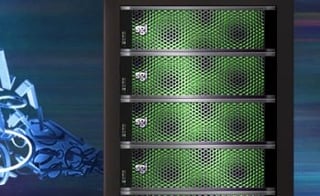
SGI, which has a longtime niche in the scientific and government IT sectors for its extreme-scale high-performance data center products, is moving into the new-gen storage world and literally scaling out its storage capabilities to larger markets.
Earlier this week the Fremont, Calif.-based company announced a strategic OEM agreement with software-defined storage provider Scality to provide a new, unified scale-out storage system. This is designed to provide both extreme scale and high performance, allowing customers to manage storage of massive stores of unstructured data.
The new package bundles SGI’s Modular InfiniteStorage platform with Scality’s new-generation RING Organic Storage software. The combination enables enterprises to take advantage of a converged multi-petabyte storage architecture that can scale to virtually an unlimited number of files in a single rack of arrays.
3 Petabytes of Capacity in a Single Rack
For example, a single 19-inch rack of 10 arrays can house nearly 3PB of scale-out storage with high-end data security and no single point of failure, SGI said.
SGI Modular InfiniteStorage platform is available in two base configurations: SGI Modular InfiniteStorage Server, which is available in single or dual motherboard configurations; or SGI Modular InfiniteStorage JBOD, a dense, lower-cost expansion configuration.
The SGI MIS storage server platform consists of two high-performance dual socket servers powered by Intel Xeon processors and up to 72 3.5-inch hard disk drives in a single 4U chassis. This can handle up to 280TB of storage, reserving two disks for system tasks, in one 4U chassis. Expanding the system is handled by simply adding more SGI MIS units; the Scality software automatically detects and load balances the storage across the entire infrastructure, SGI said.
Modular ‘Bricks’ Squeeze More HDDs Inside
SGI gets this extreme density using modular drive bricks, a patented drive packaging architecture that enables two 2.5-inch drives to be deployed within the same displacement of a single 3.5-inch slot. This design enables each of the bricks to be loaded with either nine 3.5-inch SAS or SATA drives, or 18 2.5-inch SAS or SSD drives.
SGI’s MIS supports Microsoft Windows and VMware, as well as multiple Linux distributions. The company said it has an initial deployment already under way at a large cloud-based solution provider. The SGI-Scality package is available now for early-access customers, SGI said.
SGI, an old-line IT company that along with Sun Microsystems was the leading enterprise-level workstation makers in the 1980s and 1990s, stumbled after the IT bubble burst in the early 2000s. It was forced to change its focus radically in recent years after its acquisition for about $42 million by Rackable in 2009. Rackable then retained the more well-known SGI name and branding after the deal.
San Francisco-based Scality’s object storage infrastructure for Petabyte scale cloud storage deployments is used by service providers to deploy storage-as-a-service offerings, email providers to store emails for millions of users and by Web services providers to manage billions of files.