







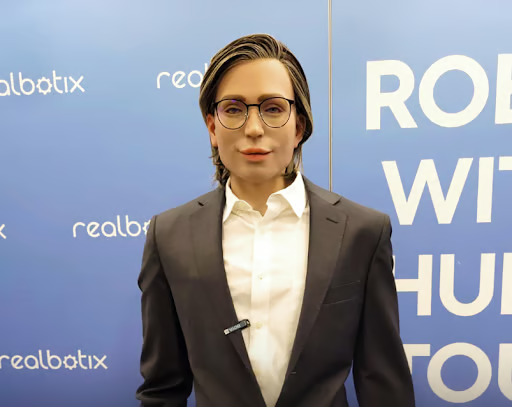
A classroom robot meant to inspire students has instead ignited a broader debate over AI in education.
A New York school district has paused plans to introduce a humanoid AI-powered robot into a high school classroom after criticism from educators, parents, community members, and state officials raised questions about privacy, student safety, and the growing role of artificial intelligence in schools.
Salamanca City Central School District announced on July 24 that its pilot project with Toronto-based Realbotix is on hold while it works on stronger student data privacy agreements with the New York State Education Department and continues discussions with the local community.
The decision came just hours after New York State Education Commissioner Betty Rosa sent a letter expressing concern about the proposal and stating that the department would monitor the project for potential legal, instructional, privacy, safety, and other issues.
The project centered on "Sally," a roughly $58,000 humanoid robot designed by Realbotix. According to the company, the silicone-skinned robot can engage in natural conversations, display facial expressions, and interact with students in real time to support classroom learning.
The district said the robot was intended to supplement teachers rather than replace them. Superintendent Mark Beehler previously told school board members, "This is not walking through the halls," while pushing back against fears about the project. He also said the system would not record conversations with students and would operate on a closed network rather than the open internet.
Still, critics questioned whether the technology belonged in classrooms at all.
The New York State United Teachers union strongly opposed the initiative. Union President Melinda Person said, "A robot built by a company associated with sex dolls has no business in our classrooms."
She added, "Our students don't need robots. They need real relationships with caring adults. Educators notice when students are struggling, celebrate when they succeed, and help them discover who they can become. No robot can do that, no matter how lifelike its skin or specific its regional accent."
Realbotix's corporate history intensified the controversy. In 2024, the company acquired Simulacra, the parent company behind RealDoll, although Realbotix has repeatedly said its education business is separate from any adult-products operations.
Realbotix defends the program
Realbotix CEO Andrew Kiguel backed the district's decision to pause the rollout.
"We fully respect any decision the school makes and encourage thorough due diligence by all parties involved," Kiguel told New York Focus. "We want the program to be demonstrably safe, fully district-approved, and strongly supported by teachers."
The company has also said Sally does not record audio or video, does not use facial recognition, and is not designed to replace educators. Meanwhile, the New York State Education Department said it is developing statewide guidance for schools on the responsible use of AI and other emerging technologies.
What this means for AI in classrooms
The Salamanca case highlights how schools may face growing resistance when introducing AI tools that closely resemble humans, even if the technology is designed to assist rather than replace teachers.
The episode shows that technical capabilities alone may not be enough to win public trust for technology companies. School districts will likely face greater pressure to demonstrate strong privacy protections, explain how student data is handled, and involve parents and educators before rolling out AI-powered systems.
The debate could also influence future state policies, with New York's teachers union now calling for enforceable statewide rules governing AI use in schools, particularly humanoid robots that interact directly with students.
While Salamanca's pilot project has been paused — not canceled — the outcome could shape how other school districts evaluate AI-powered classroom tools.
If New York ultimately adopts statewide guidance or new legislation, it may establish a framework that other states use when deciding how far AI, especially human-like robots, should be allowed to go inside classrooms.
Also read: Norway is restricting generative AI in schools, nearly banning it for pupils ages 6 to 13 while allowing older students limited, supervised use.