









Natural language processing (NLP) is a subfield of artificial intelligence (AI) that enables computers to interpret and understand human language. Using machine learning (ML) and AI, NLP tools analyze text or speech to identify context, meaning, and patterns, allowing computers to process language like humans do.
One key benefit of NLP is that it enables users to engage with computer systems through regular, conversational language, meaning no advanced computing or coding knowledge is needed. It’s the foundation of generative AI systems like ChatGPT, Google Gemini, and Claude, powering their ability to sift through vast amounts of data to extract valuable insights.
I evaluated six top-rated NLP software to see how they compared on features, pros and cons, and pricing.
- Grammarly: Best for AI-powered content creation
- IBM Watson: Best for comprehensive enterprise text analysis
- Google Cloud Natural Language API: Best for scalable text insights
- spaCy: Best for fast, production-ready text processing
- Hugging Face: Best for pre-trained models and customization
- Natural Language Toolkit: Best for educators and researchers
Top natural language processing tools comparison
NLP tools enable computers to understand and interpret human language. The table below compares the best NLP tools based on key criteria, including starting price and use case.
| Best for | Supported languages | Open source | License | Free plan | |
|---|---|---|---|---|---|
| Grammarly | Content creation | Multiple (JavaScript, Python, etc.) | No | Proprietary | Yes |
| IBM Watson | Comprehensive enterprise text analysis | Multiple (Python, JavaScript, C++, etc.) | No | Proprietary | Free for 30,000 NLU items per month |
| Google Cloud Natural Language API | Best for scalable text insights | Multiple (PHP, Node.js, Python, etc.) | No | Proprietary | $300 in free credits for new customers |
| spaCy | Fast, production-ready text processing | Python | Yes | MIT | Yes |
| Hugging Face Transformers | Pre-trained models and customizations | Python, JavaScript (via API) | Yes | Apache 2.0 | Yes |
| Natural Language Toolkit | Educators and researchers | Python | Yes | Apache 2.0 | Yes |
Overall, I picked Grammarly as the top NLP tool, ranking first for integrations and tying for cost.
Continue reading to learn more about each platform’s use case, pricing, and key features, or skip ahead to see my scoring logic.
Grammarly
Best for AI-powered content creation
Overall rating: 4.2/5
- Core features: 3.2/5
- Ease of use: 5/5
- Integrations: 5/5
- Cost: 4/5
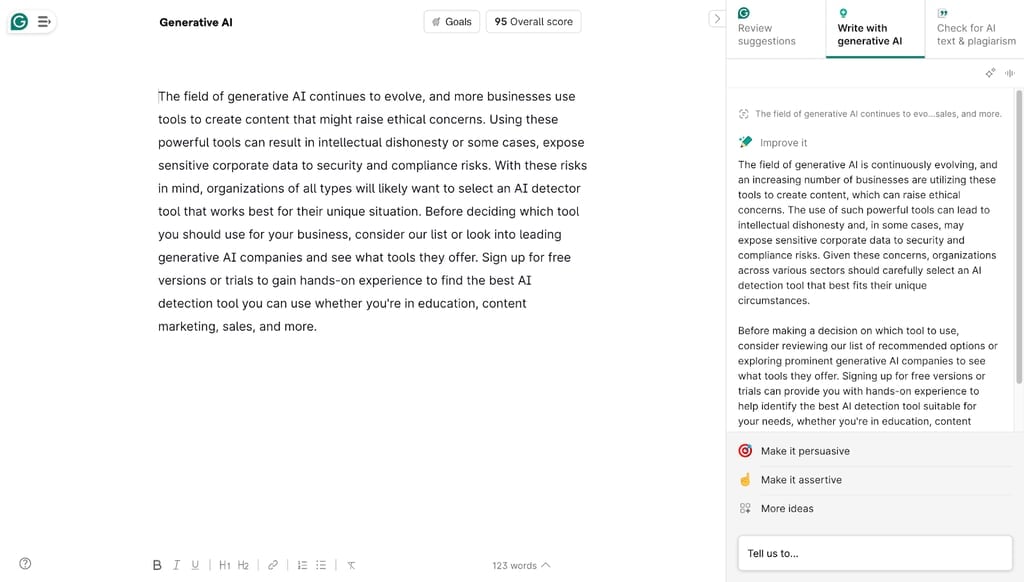
Grammarly is an AI-powered writing assistant that helps you improve your written communication across various platforms. It analyzes texts in real time and identifies potential issues in grammar, spelling, punctuation, and more. It also allows you to generate outlines, draft short stories, and enhance existing texts in various writing contexts.
Grammarly stands out for its intuitive interface and sophisticated writing and editing tool that evaluates overall document quality. You can customize style preferences and voice settings and receive tailored recommendations based on your goals. It also has a built-in plagiarism checker and AI detector, adding another layer of content verification all in one place.

Why I picked Grammarly
Grammarly’s features and accessibility are remarkable, catering to a wide range of users and supporting various use cases, from academic writing to professional communication. Its cross-platform functionality ensures writers receive instant feedback and recommendations.
Grammarly’s AI content creator also offers advanced generative AI capabilities, making it an ideal choice for producing high-quality text for blog posts, social media, documents, email campaigns, and more.
Pros and cons
| Pros | Cons |
|---|---|
| Real-time grammar and style checking | Limited free plan features |
| Seamless integration with various content platforms | Occasionally flags stylistic preferences as errors |
| Advanced insights into tone and readability | Limited offline functionality |
Pricing
- Free: One user
- Premium: $12 per user, per month, billed annually; $21 per user, billed monthly
- Enterprise: Contact sales for a quote
Key features
- Uses AI to create high-quality content
- Proofreads text, detecting issues in grammar, punctuation, and style
- Instantly identifies and adjusts your writing’s tone
- Checks for plagiarism and AI-generated content
IBM Watson
Best for comprehensive enterprise text analysis
Overall rating: 4/5
- Core features: 3.3/5
- Ease of use: 5/5
- Integrations: 3.3/5
- Cost: 5/5
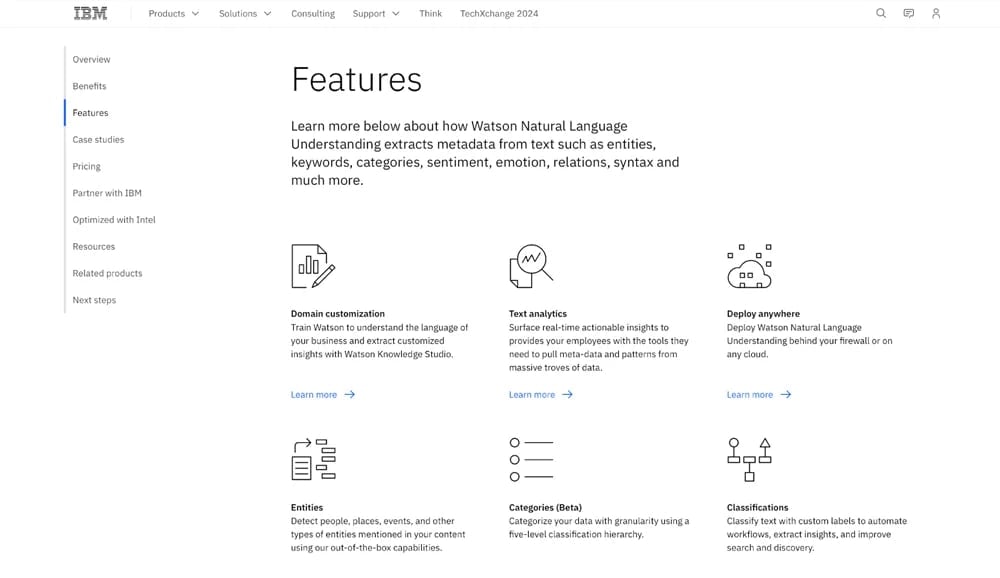
IBM Watson Natural Language Understanding (NLU) is a cloud-based platform that uses IBM’s proprietary artificial intelligence engine to analyze and interpret textual data. It can extract critical information from unstructured text, such as entities, keywords, sentiment, and categories, and identify relationships between concepts for deeper context.
IBM Watson NLU is popular with large enterprises and research institutions and can be used in various applications, from social media monitoring and customer feedback analysis to content categorization and market research. It’s well-suited for organizations that perform advanced text analyses to enhance decision-making and gain a deeper understanding of customer behavior, market trends, and other essential data insights. plagiarism checker and AI detector, adding another layer of content verification all in one place.

Why I picked IBM Watson NLU
IBM Watson NLU impresses with its advanced text analytics capabilities. Its numerous customization options and integration with IBM’s cloud services make it a powerful and robust solution for businesses in industries like customer service, healthcare, finance, and human resources.
Pros and Cons
| Pros | Cons |
|---|---|
| Simple and easy to use | Documentation could be better |
| Recognizes semantic roles | Sentiment analysis accuracy could be improved |
| Customizable models | High-volume use can be costly |
Pricing
- Lite: Free for 30,000 NLU items per month, along with one custom model
- Standard: $0.003 per 1–250,000 NLU items; $0.001 per 250,001–5,000,000 NLU items; $0.0002 per anything more than 5,000,000 NLU items
- Custom entities and relations model: $800 per custom model per month
- Custom classification model: $25 per custom classification model per month
NLU items are units of text up to 10,000 characters analyzed for a single feature; total cost depends on the number of text units and features analyzed.
Key features
- Extracts metadata from text, including language, concepts, and semantic roles
- Allows creation of custom models with domain-specific training for specialized industries like finance and healthcare
- Integrates with IBM’s cloud services for scalable, real-time text analysis
- Supports entity linking to Knowledge Graphs for more comprehensive data insights
Google Cloud Natural Language API
Best for scalable text insights
Overall rating: 3.8/5
- Core features: 3.1/5
- Ease of use: 4.6/5
- Integrations: 3.3/5
- Cost: 5/5
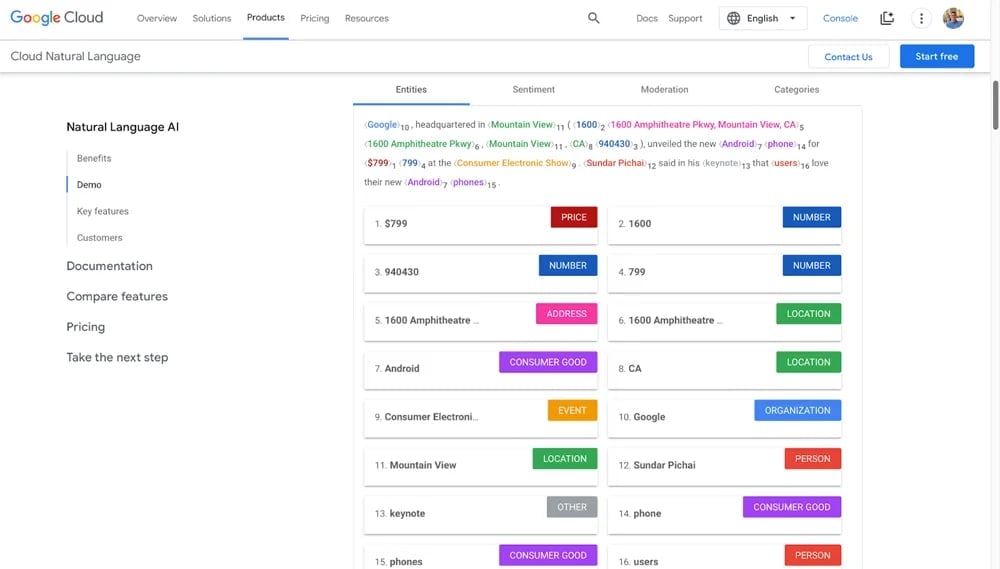
Google Cloud Natural Language API is a service provided by Google that helps developers generate insights from unstructured text using machine learning algorithms. The API can analyze text for sentiment, entities, and syntax and separate them into different categories. It also offers entity recognition, sentiment analysis, content classification, and syntax analysis tools.
Google Cloud Natural Language API is widely used by organizations leveraging Google’s cloud infrastructure for seamless integration with other Google services. It allows users to build custom ML models using AutoML Natural Language, a tool designed to create high-quality models without requiring extensive knowledge in machine learning, using Google’s NLP technology., and other essential data insights. plagiarism checker and AI detector, adding another layer of content verification all in one place.

Why I picked Google Cloud Natural Language API
I chose Google Cloud Natural Language API for its efficiency in extracting insights from large volumes of textual data. Its integration with Google Cloud services and support for custom machine learning models make it suitable for businesses performing complex, multilingual text analysis, although costs can add up quickly for high-volume tasks.
Pros and cons
| Pros | Cons |
|---|---|
| Multilingual support | Initial learning curve |
| Can classify documents in more than 700 predefined categories | Can be expensive for organizations with lots of data |
| Integrates with other Google Cloud services | Limited customization for specific domain requirements without using AutoML |
Pricing
- Up to $300 in free credits for new customers
- Monthly prices per 1,000-character unit vary by amount and feature
See Google Natural Cloud pricing chart for more information.
Key features
- Identifies entities and their sentiment within the text
- Allows custom text classification using AutoML for domain-specific needs
- Analyzes grammatical structure, extracting tokens, sentences, and syntax details
- Provides real-time insights from unstructured medical text through Healthcare Natural Language API
spaCy
Best for fast, production-ready text processing
Overall rating: 3.8/5
- Core features: 3.5/5
- Ease of use: 4.4/5
- Integrations: 2.8/5
- Cost: 5/5
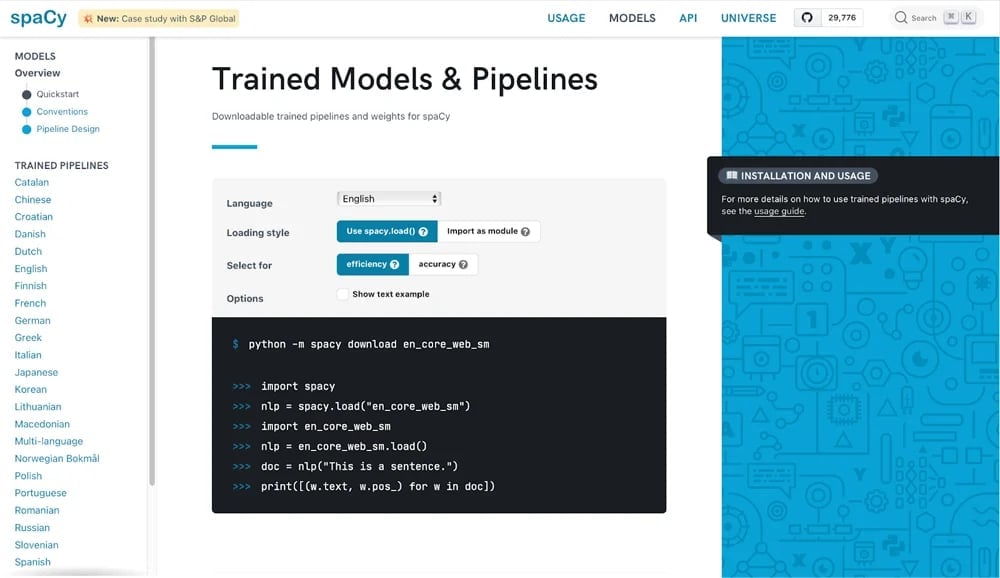
spaCy stands out for its speed and efficiency in text processing, making it an efficient tool for large-scale NLP tasks. Its pre-trained models can perform various NLP tasks out of the box, including tokenization, part-of-speech tagging, and dependency parsing. The ease of use it offers and streamlined API make it a popular choice among developers and researchers working on NLP projects.
spaCy supports more than 75 languages and has 84 trained pipelines for 25 of these languages. It also integrates with modern transformer models like BERT, adding more flexibility for advanced NLP applications.

Why I picked spaCy
I chose spaCy for its speed, efficiency, and comprehensive built-in tools. Its straightforward API, support for over 75 languages, and integration with modern transformer models make it ideal for research and software development projects. Its comprehensive support for transformer-based pipelines sets spaCy apart for fast, production-ready text processing, which facilitates smooth integration with models like BERT, GPT-2, and XLNet. Through this integration, users can achieve high accuracy in NLP tasks and also manage to train one model to do several related tasks simultaneously.
Pros and cons
| Pros | Cons |
|---|---|
| Straightforward and user-friendly API | Limited flexibility for customization and fine-tuning |
| Popular in the NLP community due to speed and efficiency | Requires some programming knowledge to customize models |
| Comprehensive built-in language tools | Limited support for deep language generation tasks |
Pricing
- Free, open-source library for personal and commercial use
Key features
- Offers fast and accurate dependency parsing optimized for production environments
- Provides pre-trained language models for 25 languages
- Uses word vectors to identify word relationships and similarities
- Integrates custom models using TensorFlow or PyTorch
Hugging Face Transformers
Best for pre-trained models and customizations
Overall rating: 3.8/5
- Core features: 4.3/5
- Ease of use: 3.9/5
- Integrations: 3.3/5
- Cost: 3.3/5
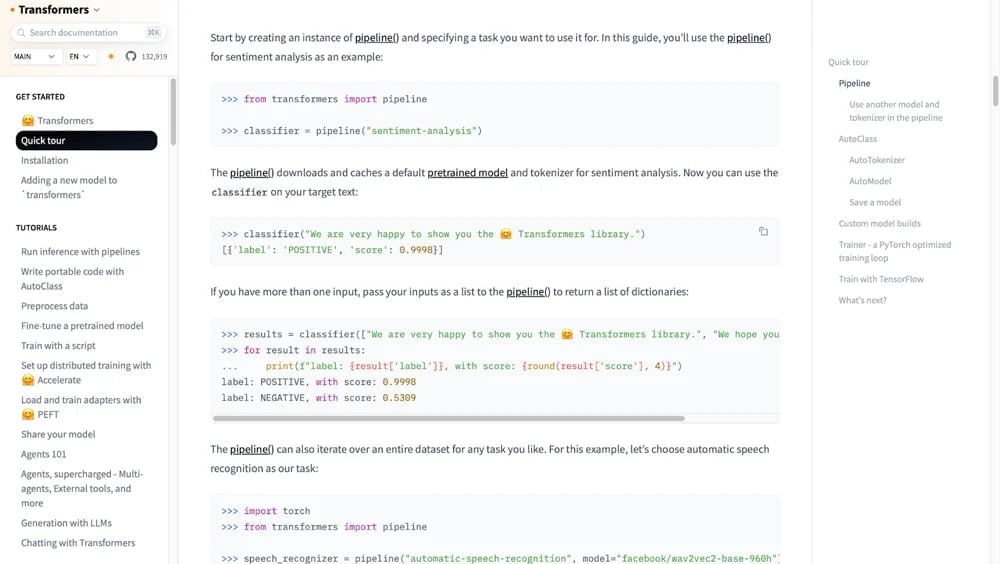
Hugging Face Transformers has established itself as a key player in the natural language processing field. It offers an extensive library of pre-trained models that cater to a range of tasks, from text generation to question answering.
Built primarily for Python, Hugging Face Transformers simplifies working with state-of-the-art models like BERT, GPT-2, RoBERTa, and T5. Developers can access these models through the Hugging Face API and integrate them into applications such as chatbots, translation services, virtual assistants, and voice recognition systems.
Hugging Face is known for its user-friendliness, allowing both beginners and advanced users to utilize powerful AI models without deep-diving into the weeds of machine learning. Its hub houses thousands of community-contributed models, including those fine-tuned for specific use cases like sentiment analysis and question answering.
Hugging Face also supports integration with the popular TensorFlow and PyTorch frameworks, bringing even more flexibility to building and deploying custom models.

Why I picked Hugging Face Transformers
I picked Hugging Face Transformers for its huge library of pre-trained models and its flexibility in customization. Its user-friendly interface and support for multiple deep learning frameworks make implementing robust NLP models quick and seamless.
Pros and Cons
| Pros | Cons |
|---|---|
| Extensive model library | High resource requirements for larger models |
| Cross-framework compatibility | Learning curve for customization |
| Active community and lots of documentation | Limited free API access |
Pricing
- Open-source and free to use under the Apache 2.0 license
- Inference endpoints (for deploying any ML model): Starts at $0.033 per hour
- Pro account: $9 per month
- Enterprise hub: $20 per user, per month
Key features
- Provides access to pre-trained models like GPT-2, BERT, and T5
- Supports custom model training and fine-tuning for specialized use cases
- Compatible with multiple deep learning frameworks (TensorFlow, PyTorch)
Natural Language Toolkit
Best for educators and researchers
Overall rating: 3.8/5
- Core features: 3.1/5
- Ease of use: 4.4/5
- Integrations: 3.3/5
- Cost: 5/5
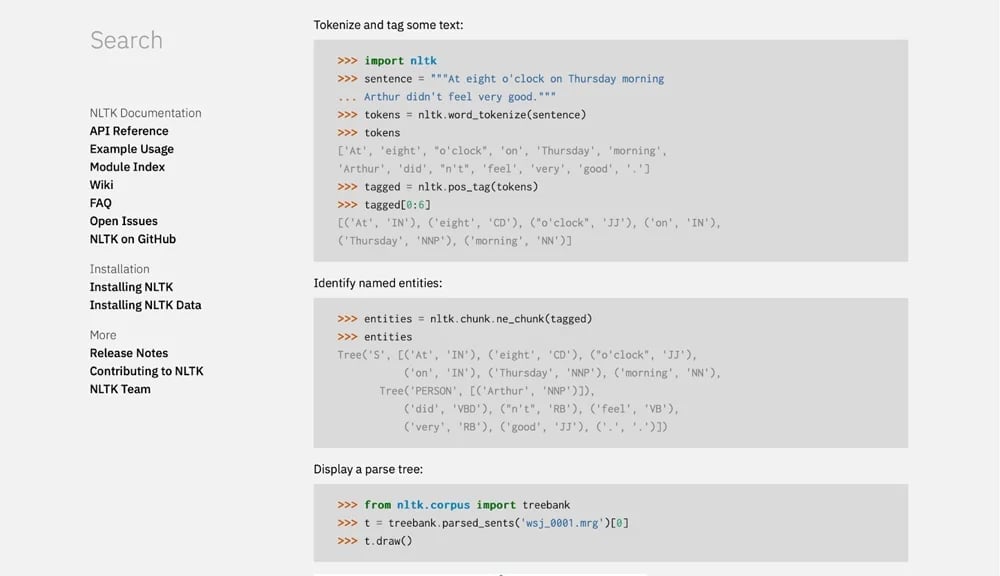
The Natural Language Toolkit (NLTK) is a Python library designed for various NLP tasks, including tokenization, part-of-speech tagging, parsing, and named entity recognition, providing a comprehensive toolkit for teaching, research, and building NLP applications. NLTK also provides access to more than 50 corpora (large collections of text) and lexicons for use in natural language processing projects.
NLTK is widely used in academia and research, garnering major community support. Its ability to process and analyze massive amounts of data is why it’s considered a valuable resource for those working on sentiment analysis, text classification, machine translation, and more.
Why I picked Natural Language Toolkit
I picked NLTK for its free and open-source format and wide range of functionality. It provides educators and researchers with a plethora of NLP tools and access to various text corpora, making academic and research-based NLP tasks easier and more manageable.
Pros and cons
| Pros | Cons |
|---|---|
| Excellent for academic research and NLP education | Not ideal for large-scale, production-level tasks |
| Rich community support and documentation | NLTK can be complex for beginners |
| Access to 50+ real-world text corpora and lexicons | Lacks modern deep learning tools |
Pricing
- Free, open-source, community-driven project
Key features
- Available for use on Windows, Mac OS X, and Linux
- Provides tokenization and part-of-speech tagging tools for text analysis
- Integrates with WordNet for lexical database access
- Includes modules for named entity recognition, facilitating the identification of entities in text
How I evaluated the best NLP Tools
I evaluated the top NLP tools based on key criteria, including core features, ease of use, integrations, and pricing. These software solutions were chosen for the benefits they offer, including better data analysis, enhanced customer service, and improved communication between humans and computers.
- Core features (35%): I considered the availability and depth of essential NLP capabilities, including text summarization, sentiment analysis, content generation, and multilingual support.
Criteria winner: Hugging Face
- Ease of use (30%): For this category, I evaluated the quality of the user interface (UI), user experience design (UX), and the comprehensiveness of documentation or knowledge base to ensure accessibility and usability.
Criteria winner: IBM Watson NLU
- Integrations (20%): I assessed each NLP tool based on its integration with popular apps like Google Suite and Microsoft 365, the availability of APIs or language integration capabilities, and compatibility with CMS and CRM platforms.
Criteria winner: Grammarly
- Price (20%): For this category, I scored the NLP tools based on the affordability of their subscription plans and the availability of free trials and free versions.
Criteria Winner: Multiple winners
FAQs
How do natural language processing tools work?
NLP tools use algorithms and linguistic rules to analyze and interpret human language. They extract meanings, sentiments, and patterns from text data, which can be used for language translation, chatbots, and text summarization tasks.
What are the applications of natural language processing tools?
NLP is a core feature in modern AI models. Applications include sentiment analysis, information retrieval, speech recognition, chatbots, machine translation, text classification, and text summarization.
What is the best NLP software?
There’s no single best NLP software solution, as the effectiveness of a tool can vary depending on the specific use case and requirements. Our review captured the best tools for different users and use cases.
Generally speaking, an enterprise business user will need a far more robust NLP solution than an academic researcher.
Is ChatGPT an example of an NLP tool?
Yes and no. ChatGPT is built on natural language processing techniques and uses deep learning to understand and generate human-like text. This allows it to engage in conversations and handle various language tasks. However, its primary purpose is content generation, rather than traditional NLP tasks like sentiment analysis or named entity recognition.
What are the benefits of natural language processing?
NLP makes it easier to automate repetitive tasks, like sorting customer support emails or analyzing feedback. It can quickly scan large amounts of text data to find key insights, helping companies understand customer sentiment or detect trends. NLP also powers virtual assistants like Siri and Alexa, allowing for more natural conversations between humans and computers.
Bottom line: Natural language processing software drives AI
In recent years, NLP has become a core part of modern AI, machine learning, and other business applications. Even existing legacy apps are integrating NLP capabilities into their workflows. Incorporating the best NLP software into your workflows will help you maximize several NLP capabilities, including automation, data extraction, and sentiment analysis.
Investing in the best NLP software can help your business streamline processes, gain insights from unstructured data, and improve customer experience. Take the time to research and evaluate different options to find the tool that best meets your organization’s needs. Ultimately, the success of your AI strategy will heavily depend on your NLP solution.
Read eWeek’s guide to the top AI companies for a detailed portrait of the AI vendors serving a wide array of business needs.