







- Dealing With the Half Life of Data Value
- Increasing Data Volume Requires Operational Efficiency
- Empowering Non-Engineers
- Reducing Time to Insight
- Building the Database for Today
- Using Commodity Hardware
- Creating Actionable Data
- Simplifying the Stack
- Adopting Durable IT to Last a Lifetime
- Maximizing Integration Out of the Box
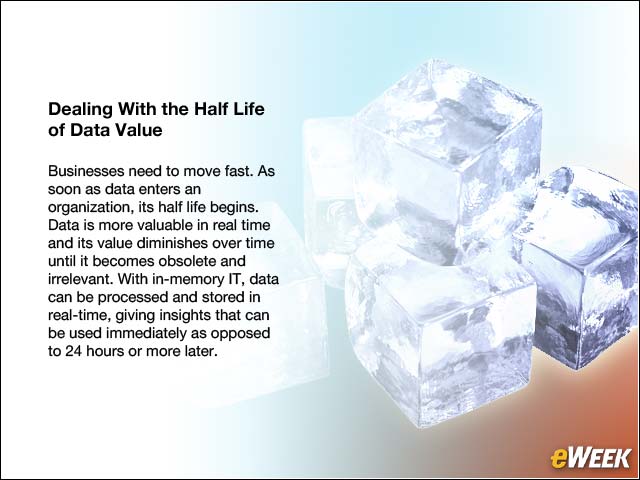
Dealing With the Half Life of Data Value
Businesses need to move fast. As soon as data enters an organization, its half life begins. Data is more valuable in real time and its value diminishes over time until it becomes obsolete and irrelevant. With in-memory IT, data can be processed and stored in real-time, giving insights that can be used immediately as opposed to 24 hours or more later.
Increasing Data Volume Requires Operational Efficiency
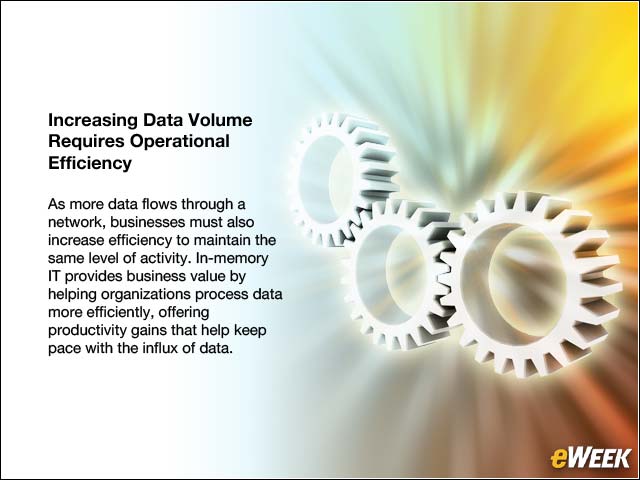
As more data flows through a network, businesses must also increase efficiency to maintain the same level of activity. In-memory IT provides business value by helping organizations process data more efficiently, offering productivity gains that help keep pace with the influx of data.
Empowering Non-Engineers
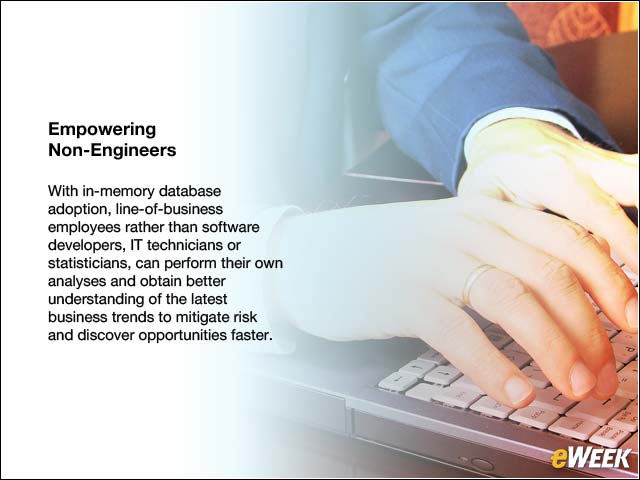
With in-memory database adoption, line-of-business employees rather than software developers, IT technicians or statisticians, can perform their own analyses and obtain better understanding of the latest business trends to mitigate risk and discover opportunities faster.
Reducing Time to Insight
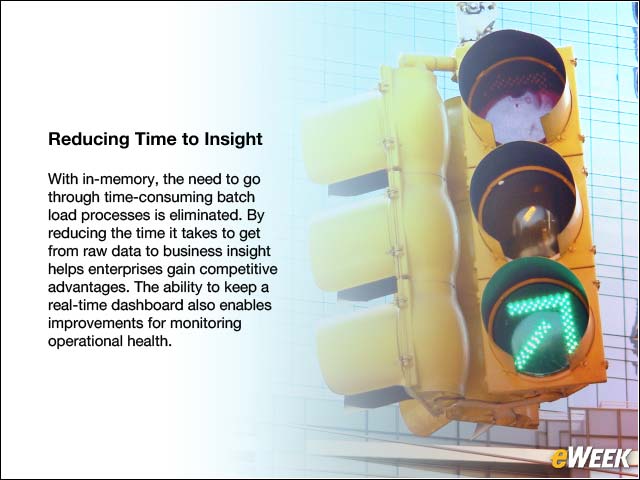
With in-memory, the need to go through time-consuming batch load processes is eliminated. By reducing the time it takes to get from raw data to business insight helps enterprises gain competitive advantages. The ability to keep a real-time dashboard also enables improvements for monitoring operational health.
Building the Database for Today
Too much time and energy is focused on vertical scalability. Databases now must be cloud-aware and horizontally scalable. By taking advantage of in-memory database technologies, employees can keep a pulse on company data, giving the CIO a better view of what’s happening in real time.
Using Commodity Hardware
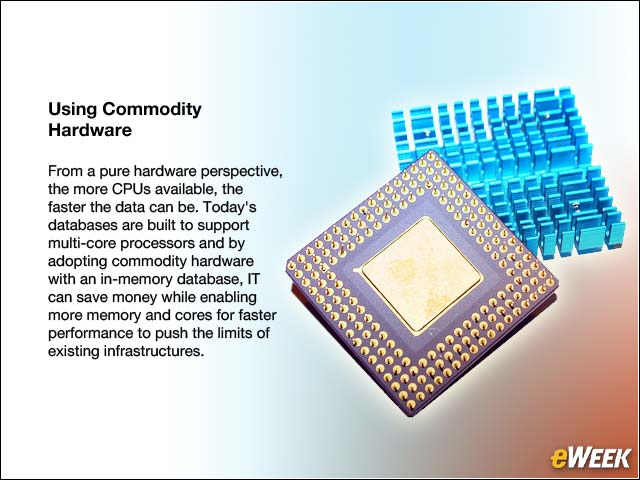
From a pure hardware perspective, the more CPUs available, the faster the data can be. Today’s databases are built to support multi-core processors and by adopting commodity hardware with an in-memory database, IT can save money while enabling more memory and cores for faster performance to push the limits of existing infrastructures.
Creating Actionable Data

Too many big data solutions and tools are too complex for today’s IT engineers to work with easily and require top-dollar data scientists, who are very much in demand worldwide. By adopting in-memory IT with a familiar SQL interface, engineers who don’t have a background in Hadoop or other specialty code bases—such as Pig or Hive—can be productive out of the gate. Managers don’t need to waste valuable engineering hours getting people up to speed, or alternatively, having to hire costly new talent. Additionally, engineers are empowered to focus time and energy on results instead of time-consuming data entry.
Simplifying the Stack
It is common for traditional databases to have too many caches and layers of infrastructure. With in-memory, engineers are able to simplify the stack as well as IT infrastructure and processes.
Adopting Durable IT to Last a Lifetime
Durable in-memory infrastructures can decrease the total cost of ownership over an entire IT lifecycle.
Maximizing Integration Out of the Box
In-memory IT can maximize existing IT investments with plug-and-play integration out of the box. This saves time and costly integration hours.