







It’s no secret that Microsoft harbors stratospheric ambitions for its artificial intelligence (AI) technologies, but the company’s latest project is literally taking AI to the skies.
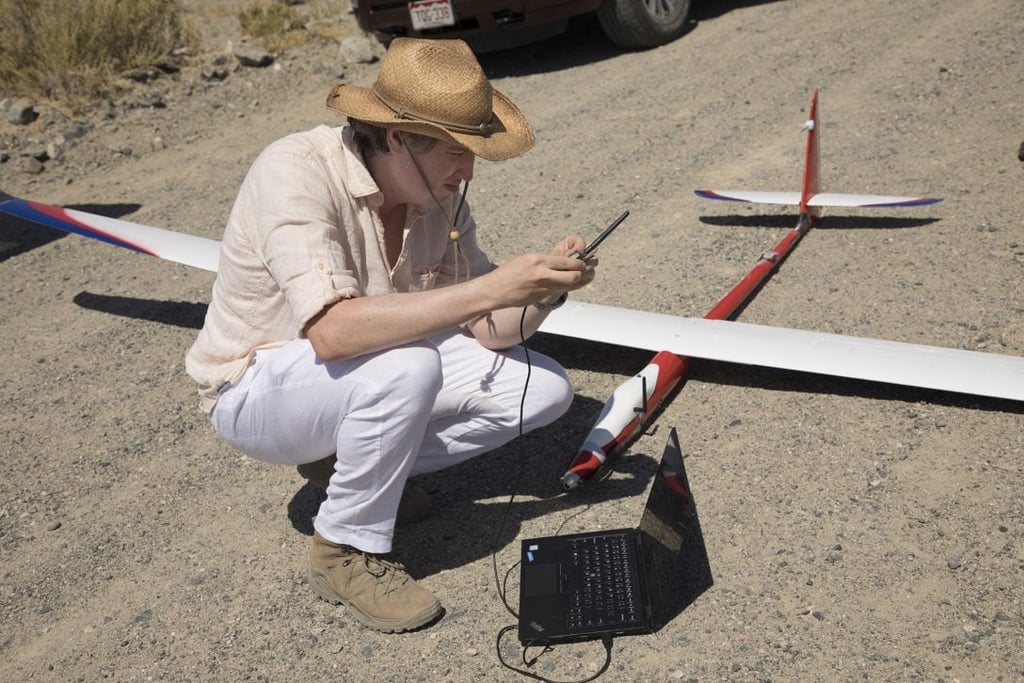
Microsoft today took the wraps off a new research and engineering project that may one day lead to autonomous sailplanes, a type of glider, that can fly indefinitely and give drones a run for their money. The sailplane uses AI to find thermals, naturally-occurring columns of rising warm air, to maneuver around area without a motor, an ability that comes naturally to many bird species.
While the “infinite soaring machine,” a device-laded glider that measures 16.5 feet and weighs 12.5 pounds, has a long way to go before it lives up to its name, Microsoft envisions some practical applications if it ever leaves the testing stage over the hot skies of Nevada. If the technology is perfected and paired with renewable energy systems that collect wind or solar energy, AI-enabled sailplanes can one day be used to map areas, monitor crops and even provide mobile phone service to remote locations.
The sailplane uses algorithms that analyze air temperature and wind direction and keep out of areas that are out of bounds. The AI system used to control the sailplane—it also features a remote-control system should the tests require human intervention to avert a mishap—uses two components, a high-level and a low-level planner, to improve its ability to find thermals over time, explained Microsoft representative Allison Linn.
“The high-level planner takes all the factors of the environment into account and tries to create a policy for where the sailplane should go to look for thermals. It gets better at making those predictions as time goes on, based on the information the sailplane collects each time it goes up in the air,” Lin wrote in an Aug. 16 announcement.
Meanwhile, the low-level planner exemplifies learning by doing, she added. “The low-level planner is the part that is using Bayesian reinforcement learning to detect and latch onto thermals in real time, based on data from the sailplane’s sensors.” Taken altogether, Microsoft’s AI enables the sailplane’s systems to make decisions on where to fly with little of any human input.
It’s not the first time Microsoft researchers have taken a stratified approach to piecing together working AI systems.
In June, the company announced that Maluuba, a recent acquisition, had built an AI that could beat Ms. Pac-Man, the notoriously challenging arcade game. The Hybrid Reward Architecture AI technology used by the system employed a top AI agent and lower-level agents to coordinate movements. In the future, Microsoft said the technology may be used in sales software that can predict the needs of customers.
Microsoft’s AI solutions will soon change how at least one retailer engages with its customers.
In the U.K., a major electronics chain called Dixons Carphone, is testing some Microsoft Cognitive Services offerings, including Language Understanding Intelligent Service (LUIS) Computer Vision API (application programming interface) in a bot that answers customer questions pertaining to stock availability and other product information.