






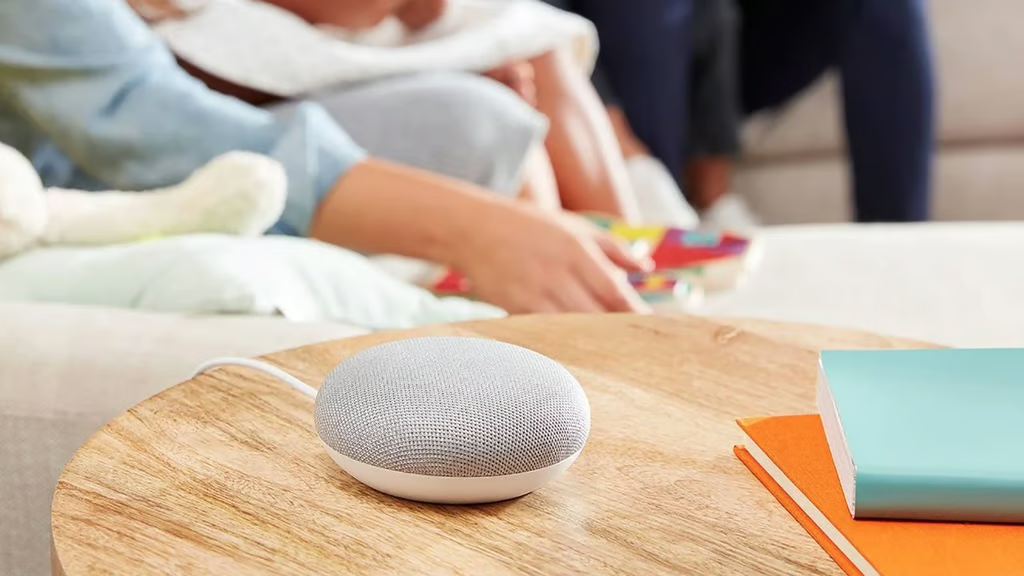


Google's Nest speakers are being quietly replaced.
In comments published on June 18, Google said it has ended production of the Nest Mini and Nest Audio, retiring two of its most familiar smart speakers as it prepares to launch a new Google Home Speaker built around Gemini. For current owners, the important answer is simple: your device should still work, and Google says support is not ending yet.
But the retirement is still a turning point. Google's smart home strategy is expanding beyond simple voice commands and toward AI-powered conversations, subscriptions, and devices designed around Gemini from the start.
According to a Google spokesperson cited by TechRadar, the company has "ended production" of both devices as it refines its Google Home and Nest portfolio.
What the retirement means for existing owners
Current owners do not need to replace their devices immediately.
Google told TechRadar that both speakers will continue receiving software updates, security patches, and customer support. The company also said the devices will remain compatible with Gemini for Home, Google's AI-powered smart home platform.
That distinction matters. Discontinued products often lose functionality over time, but Google appears to be taking a softer approach by maintaining support while transitioning users toward newer hardware. Owners can continue using their speakers for music playback, smart home controls, timers, reminders, and voice assistant functions.
The uncertainty is longer-term. Google has not announced an end-of-support date, leaving open the question of how long older hardware will receive new features compared with upcoming Gemini-native devices.
Why Google is moving beyond the Nest brand
The second-generation Nest Mini debuted in 2019 as the successor to the Google Home Mini, while Nest Audio arrived in 2020 as the successor to the original Google Home speaker.
Neither device has received a major hardware refresh since launch.
Their retirement coincides with the arrival of Google's first new smart speaker in roughly six years: the Google Home Speaker. The company appears to be reviving the "Home" branding while shifting its smart home experience away from Google Assistant and toward Gemini.
According to The Verge, the new device is the first speaker built specifically for Gemini for Home and includes local AI processing improvements, Matter support, and Thread connectivity.
In other words, Google is no longer treating smart speakers as simple voice-command hubs. It wants them to function as AI interfaces for the connected home.
How Gemini is reshaping Google's smart home strategy
The retirement of Nest Mini and Nest Audio reflects a broader shift happening across Google's ecosystem.
Google has been replacing or augmenting traditional Google Assistant experiences with Gemini across phones, productivity tools, and connected devices. Smart speakers are now following the same path.
As Android Central reported, the new Google Home Speaker is designed to support more natural conversations, follow-up questions, and complex smart home requests than earlier Assistant-powered devices. The goal is to make smart home interactions feel less like issuing commands and more like speaking naturally.
Whether consumers actually want that experience remains an open question.
For years, smart speakers have struggled to become more than convenient household accessories. Gemini gives Google an opportunity to make them more useful by turning them into AI assistants that can understand context, manage routines, and handle more sophisticated requests.
The challenge is proving that these new capabilities solve real problems rather than simply adding another layer of AI to everyday tasks.
The growing role of subscriptions in the smart home
Google's AI ambitions may also introduce a new challenge: subscriptions.
Some advanced Gemini features on the new Google Home Speaker are expected to require Google Home Premium, though eligible early buyers may receive six months included. According to TechRadar's launch coverage, features such as Gemini Live and more advanced home intelligence may sit behind a recurring fee.
That could create a growing gap between older Nest devices and Google's latest hardware.
Even if Nest Mini and Nest Audio remain supported, future AI features may be optimized for newer devices and premium services.
For Google, that is an opportunity to monetize the smart home beyond hardware sales. For consumers, it is another example of AI becoming increasingly tied to subscription ecosystems.
What Nest owners should watch next
For now, Nest Mini and Nest Audio owners can continue using their devices without disruption.
Google has not announced an end-of-support date, and the company says both products will remain part of its supported smart home ecosystem.
Still, the devices' retirement serves as a reminder that Google's smart home priorities are changing. The company's next-generation products are being built around Gemini, and future innovations are likely to arrive first on hardware specifically designed for AI-powered experiences.
The Nest era helped make voice assistants mainstream. The question now is whether Gemini can convince users that smart speakers deserve a second act.
For existing owners, the answer is reassuring: support continues. For Google, however, the retirement of Nest Mini and Nest Audio signals something larger. The company is betting that the future of the smart home will be defined less by voice commands and more by AI conversations.
Also read: The shift also comes as Google expands Gemini across its product lineup, including a recent global rollout of AI-powered Gmail summaries that bring the assistant deeper into everyday workflows.