






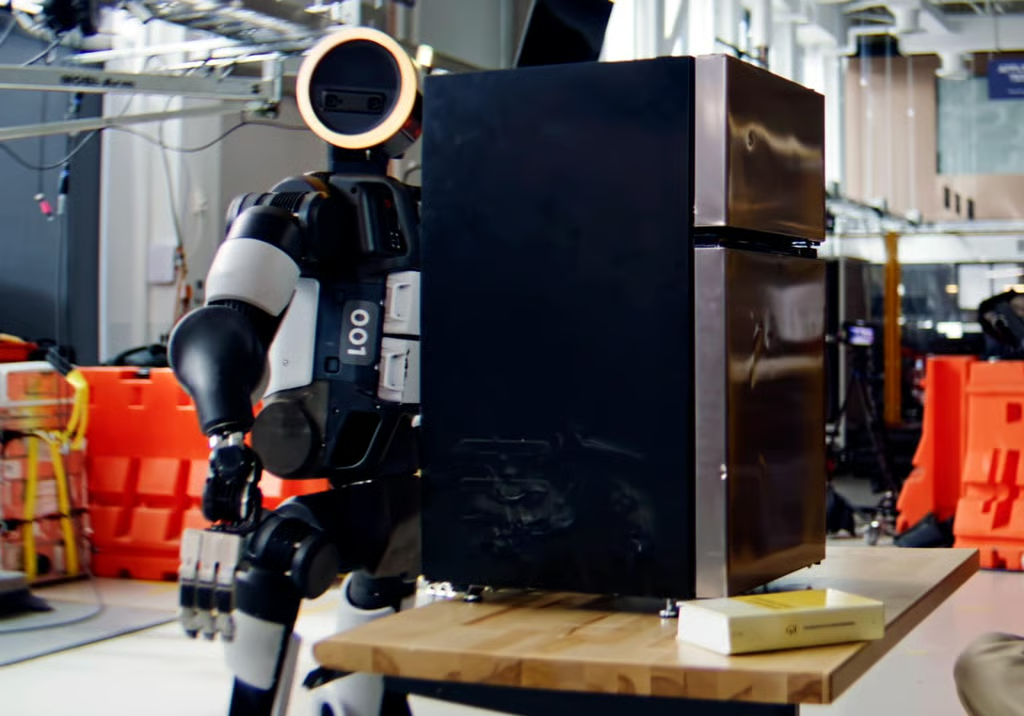


Boston Dynamics’ Atlas robot can now pick up and carry a mini-fridge. The more interesting part is how it learned to do it.
In a recent blog post detailing the experiment, Boston Dynamics revealed that Atlas practiced the task for millions of hours in parallel simulations running on GPUs before researchers transferred the learned behavior to the physical robot. The resulting system allowed Atlas to squat, lift the mini-fridge, maintain its balance, and adapt to variations in the task.
Moving a mini-fridge may not sound revolutionary. But for humanoid robots, reliably handling an awkward, heavy object is the kind of deceptively difficult task that separates an impressive demonstration from a machine that could eventually perform useful work.
Atlas learned the job before touching the fridge
Teaching a physical robot through trial and error can be slow, expensive, and occasionally destructive. Boston Dynamics is increasingly shifting much of that learning into simulation instead.
For Atlas, researchers created virtual environments where the robot could practice the task repeatedly at enormous scale. According to Boston Dynamics’ explanation of the training process, Atlas accumulated millions of hours of simulated practice in parallel on GPUs.
Researchers varied factors including the fridge’s location and mass, how Atlas gripped it, floor friction, and even the strength of the robot’s motors. The goal was to prevent Atlas from learning one perfect sequence that only worked under one set of conditions.
In the physical demonstration, Atlas squats, grasps the mini-fridge, stands back up, and carries it while maintaining its balance. Boston Dynamics says the training policy was designed around loads of 50 to 70 pounds, while Atlas successfully moved a loaded fridge weighing more than 100 pounds.
That sequence requires more than raw lifting power.
Atlas has to coordinate its legs, torso, arms, and hands while continuously accounting for the object and its effect on the robot’s movement. When conditions vary, the system needs to adapt rather than simply replay a predetermined motion.
That ability becomes important if humanoid robots are going to move beyond controlled demonstrations and into real workplaces.
Why a mini-fridge is harder than it looks
Industrial robots have moved heavy objects for decades, but many operate in highly structured environments.
A traditional robotic arm might repeat the same movement thousands of times while standing in one place. The object arrives at a predictable position. The machine knows where it needs to go next. People can also be separated from its workspace.
Humanoid robots are being developed around a different proposition: operating in environments already designed for people. That can mean navigating human-scale spaces, reaching objects at different heights, carrying loads while moving, and adapting when physical conditions differ from what the robot encountered during training.
Boston Dynamics has increasingly emphasized industrial applications for the production version of Atlas, including material-handling tasks in manufacturing environments. The mini-fridge provides a simple way to see that challenge in action.
Almost anyone understands what it takes to squat down, grab something large and awkward, stand without losing balance, and carry it somewhere else. That familiarity makes the technical progress unusually easy to grasp.
Millions of virtual hours, one physical robot
The larger story may be happening before Atlas ever touches a physical object.
Simulation allows robotics researchers to generate enormous amounts of training experience without requiring physical robots to perform every attempt in the real world. In simulation, a robot can fail repeatedly without damaging expensive hardware. Researchers can also change object weights, positions, friction, motor strength, and other variables to expose the system to a much wider range of conditions.
Boston Dynamics says its researchers used massive parallel simulation to give Atlas millions of hours of practice before transferring the resulting control policy to the physical robot. That transition matters because simulated success does not guarantee real-world success.
Small differences in surfaces, friction, sensors, hardware, and other physical conditions can cause a behavior that works virtually to perform differently on an actual machine. Boston Dynamics describes this challenge as the “sim-to-real gap.”
The mini-fridge experiment demonstrates that an increasingly complex whole-body behavior can make that jump from simulation to a physical Atlas robot.
Why this matters
The mini-fridge is not really the story. The training method is.
If humanoid robots require engineers to manually program every movement needed for every new workplace task, deploying them across factories, warehouses, and other environments becomes considerably harder to scale.
Simulation offers another path. Researchers can give robots enormous amounts of virtual practice, introduce variations that would be difficult or time-consuming to reproduce physically, and then test whether the resulting behavior transfers successfully to real hardware. That could accelerate how quickly humanoid robots acquire new physical capabilities.
Instead of engineering every movement individually, developers could increasingly train robots toward desired outcomes and expose them to huge numbers of simulated attempts before putting the resulting behaviors to work in the physical world.
There is still an enormous difference between a successful demonstration and a robot performing the same task safely and reliably thousands of times inside an unpredictable workplace.
Reliability, speed, cost, and failure rates will ultimately matter far more than whether Atlas can carry a mini-fridge once for a camera. But that is exactly why the demonstration is worth watching.
The impressive part is no longer simply that a humanoid robot can pick something up. It is that Atlas learned this physical task using quantities of practice that would be impractical to reproduce with a single physical robot.
Also read: For another glimpse at how researchers are accelerating humanoid robot training, see how Georgia Tech’s “Learn to Teach” AI helped a robot master sand, gravel, slopes, and slippery surfaces.