







Passwords, a mainstay of IT security for decades, are unquestionably on the way out when it comes to device or account security. It’s simply too easy for a motivated hacker with the right tools to discover one or more of a typical user’s passwords and do serious damage to bank and credit accounts.
There are a number of alternative security schemes available to organizations and individuals, including two-factor authentication, encryption and secure virtual private networks. However, it is very clear that new biometrics IT and devices have become the hottest security area of interest at the CES 2015 in Las Vegas.
Biometrics certainly isn’t new, but like all IT, it has continued to evolve over the years and now apparently has arrived as a feature that ostensibly will be included on most connected devices we’ll be owning in the future. Most laptop and smartphone owners already are familiar with fingerprint sensors that allow only one user; however, the biometric software and devices being shown at CES go way beyond that simple use case.
Biometrics Being Deployed in Imaginative Ways
Most biometrics are being developed for security purposes, but other entrepreneurs are using their imaginations to find other new and interesting ways to measure bodily attributes — including skin temperature and voice and facial recognition.
Some of the new biometric devices — many of which involve children — being demonstrated at CES include:
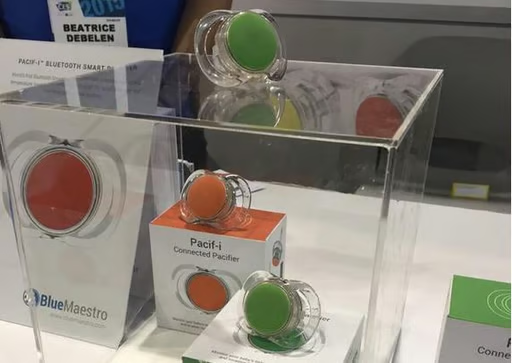
—a connected pacifier (pictured) that monitors temperature and location of the baby and notifies a parent via smartphone when there’s an important change;
—a smart baby bottle that keeps track of how fast and how much a baby is drinking and sends the results to a smartphone;
—a device that measures car-interior temperature and oxygen levels and notifies parents that they have left a child or children alone (this happens more often than one might think);
—bras, socks and headbands that analyze brain waves, heart rates and sweat levels to help detect early signs of disease or determine a wearer’s level of concentration;
—cars that only will start only upon recognition of the owner’s voice; and
—ear buds that enable tracking of a listener’s music choices.
The raft of new biometric tools has been aided by three key factors: a new abundance of less-expensive sensors — most of which are made in the Far East; continual advances in software that connects them with cloud services; and a growing IT investment economy.
CES 2015: Why Biometric IT Is Finally Moving Into Prime Time
Biometrics Reaches Tipping Point into Mainstream
Shawn DuBravac, Chief Economist of the Consumer Electronics Association, the Arlington, Va.-based industry group that organizes the CES, believes biometrics has finally reached a tipping point in that it is now airtight and ready for mainstream use cases.
“This is an inflection point that I call the sensorization of consumer tech,” DuBravac said. “This allows the digitization of everyday objects. Anything that we want to digitize we now can, and health and fitness is just one component. This is where things get into ‘Minority Report’ territory, because we can embed sensors into so many aspects of our lives.”
So how will different types of wearable biometric devices improve individual identification?
“Wearable biometric devices (such as Google Glass, smart watches and wristbands) connected with smartphones or computers using wireless Bluetooth, Wi-Fi, or NFC (near field communications) offer a convenient way to identify individuals in different industries,” said Arifin Hussain of M2SYS Technology, which develops biometric identity management IT.
“Health care, banking/financial services, and the Internet of things are examples of settings that stand to see huge benefits in different identification scenarios, such as patient identification, mobile payments, banking transactions, employee identification, digital authentication, and more.”
Standards Closer Than You Might Think
Surprisingly, IT industry biometric standards aren’t far away from being ready for prime time. Fast Identity Online (FIDO), a industry alliance that includes Microsoft, Amazon, Google, Lenovo, Acer and BlackBerry, will reveal new technological standards for biometrics in security at the CES this week.
For example, one of the new standards will enable multiple family members who shared a laptop or tablet PCto use fingerprint biometrics to log on and off their Facebook accounts without having to manually input passwords.
However, there are so many different types of devices and applications, that finalizing enough standards still will take years to complete.
Nonetheless, biometrics — which has been knocking on the door of mainstream IT for years — appears finally to have walked through that door and into general acceptance.