







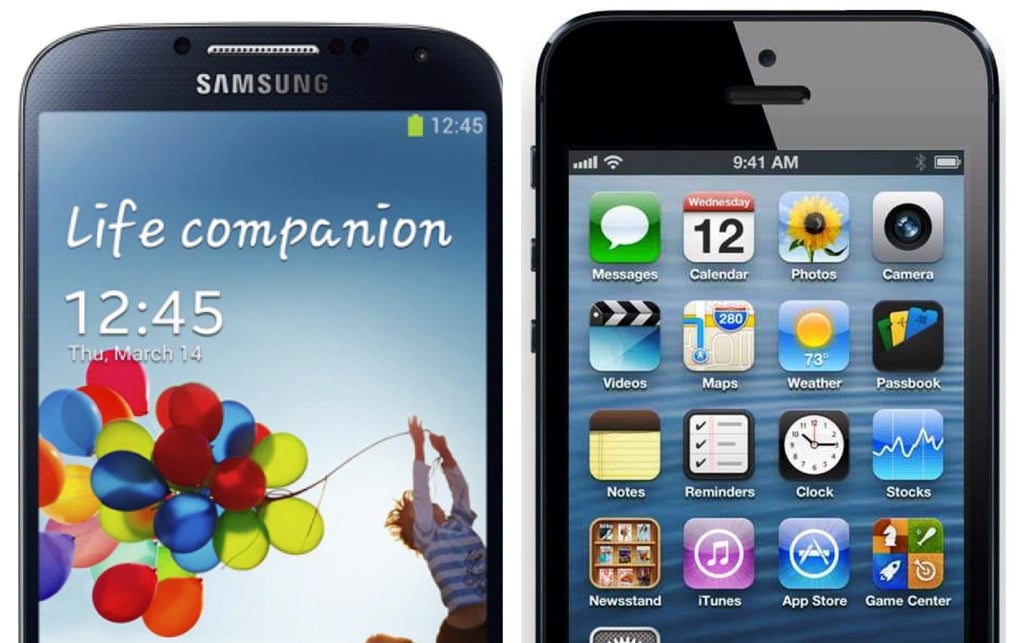
It was a telling moment over the weekend when Apple found itself in a highly unfamiliar position—on the defensive. This is a rare occurrence, indeed, and it takes a mighty circumstance to make Apple do anything it doesn’t plan to do.
Two days after Samsung introduced its snazzy new Galaxy S 4 smartphone at an awkwardly-executed launch event at Radio City Music Hall in New York City, Apple immediately saw the need to say, “Hello, don’t forget about us!” and was compelled to publish a Web page that explains in a nice way why the iPhone 5 is still the better device. Nothing wrong with this. It’s simply unusual to see Apple respond to a market pressure like that.
Apple Marketer Gets in Some Digs
Apple marketing guru Phil Schiller also made sure he got some digs in at Samsung the day before the launch in The Wall Street Journal.
Schiller has got to be worried, even though the iPhone 5 has sold more than 50 million units and is averaging 3.5 million sales per week. Let’s look at a few numbers. Research firm ComScore reports that Android-powered smartphones own 53.4 percent of the U.S. market. Apple is in second at 36.3 percent, up 2 percentage points from the third quarter to the fourth quarter of last year, thanks mostly to the iPhone 5. BlackBerry and Windows Phone are third and fourth, and both are slowly losing market share.
Samsung itself is in second place at 21 percent in U.S. sales, up 2.3 percent quarter-to-quarter. Next up are HTC at 10.2 percent, Motorola at 9.1 percent and LG at 7.1 percent.
In global market share, the numbers are radically different. Android phones control about 69 percent, while Apple is at about 19 percent. Naturally, pricing plays hugely into all of this; Android phones are generally 20 to 30 percent less in cost than iPhones.
Distinguishing Factors
It may be too early to be sure, but Apple’s attitude could well be a sign that the tide is beginning to turn in the smartphone wars here in the United States. Samsung’s latest device has more than just incremental improvements going for it.
The S 4 has several key hardware features that outflank the iPhone 5: a larger 5-inch display; an eight-core processor; and a 13-megapixel back camera are the big ones. Its screen resolution of 1920 by 1080—providing 441 pixels per inch—is about as high definition as can be defined. Oh, yes, it’s also thinner, a feature everyone likes. So it packs more power into a stylishly thinner body.
It has a two-way camera function, in which the front and rear cameras—in literally eight different scenarios—can be used at the same time. This opens new videoconferencing possibilities that haven’t been available previously. The S4’s Dual Video Call function enables users to make a video call while showing the person on the end of the call what the user sees. Nokia offered this eight years ago, so it’s not innovative, but Apple’s phones still don’t do this.
Impressive Capabilities
However, it’s in the operating system capabilities and applications that Galaxy S 4 really shines. Samsung apparently has gesture control down; one doesn’t have to touch the device to make it do something. Just a wave of a finger right above the screen commands the native email function and others. Users will probably need some practice before being able to put this “hover” feature to regular use. This part is innovative and likely disruptive.
Samsung is looking to build on the momentum it generated with the Galaxy S III in May 2012, and off the top it looks like success is inevitable. Research firm Strategy Analytics, in a blog post following the launch, said that Samsung has clearly “worked hard on its software, and the results are impressive.”
Strategy Analytics, which tested the smartphone ahead of its debut, expects Samsung to ship tens of millions of them worldwide this year. “Provided there aren’t major ‘hidden’ bugs that become apparent after launch, the S 4 will be another blockbuster product for Samsung,” the consultants wrote.
Samsung Has Moved the Performance Standard Up
In summary, Samsung has moved the bar up substantially in the smartphone market. There’s a lot of innovation packed inside the device; arguably more so than the iPhone 5 brought to the table.
All of this has to concern Apple, which needs to identify its next big innovation and introduce it. The company has, all by itself, set extremely high industry and consumer standards under the guidance of Steve Jobs, who passed away in 2011. In 1998, it was the iMac. In 2001, it was the iPod. In 2007 came the iPhone. In 2010, it was the iPad. All have been huge successes.
Sorry, the iPad Mini (October 2012) doesn’t count as a big innovation. It’s incremental to the full-size iPad.
The stakes are enormous for CEO Tim Cook and Apple’s product development team as they develop their next one. Apple has more loyal fans than anybody, but they’re accustomed to high performance and won’t hang around for long if they’re not dazzled.
What’s next? Google now has the advantage in wearable computing, automated cars and cloud business tools. Samsung and Google are rejiggering the smartphone and tablet markets.
Buyers are awaiting more from Apple, and soon.
eWEEK staff editors Michelle Maisto and Jeff Burt contributed to this article.