






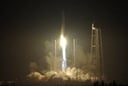


WALLOPS ISLAND, Va.—In a spectacular night launch visible to millions along the east coast from New York to the Carolinas, Orbital ATK and NASA delivered a flawless launch of more than 5,100 pounds of cargo to the International Space Station.
An upgraded version of Orbital’s Antares launch vehicle left its pad at 7:45 p.m., EDT on Oct.17. The launch was delayed several days due to Hurricane Matthew and then Hurricane Nicole, while managers waited for optimal conditions.
Those conditions finally arrived over the weekend and the launch went forward after the spacecraft passed all of its pre-flight checks. A previous attempt in October 2014 ended with the explosion of the Antares booster, resulting in a total loss of the payload and significant damage to the launch pad at the Mid-Atlantic Regional Spaceport.
The improved version of the launch vehicle, now an Antares 230, includes new engines with improved reliability and upgraded performance that allows higher payload capacity than earlier versions of the vehicle. The launch vehicle now uses a pair of Energomash RD-181 liquid-fueled engines. The second stage of the launch vehicle is now a solid-fueled Orbital ATK Castor 30XL rocket motor.
The increased performance of both stages enabled the payload to reach a higher orbit than originally planned in about 10 minutes from launch. The payload for this launch was a Cygnus spacecraft that includes a pressurized cabin and the ability to deploy satellites from an external rack.
The Cygnus spacecraft carried supplies ranging from food and repair parts for the Space Station to clothing and personal items for the astronauts assigned to the Space Station. The scientific payload includes materials and equipment for 250 new and existing investigations to be carried out by Expeditions 49 and 50 station crews.
Despite having reached orbit in 10 minutes, the Cygnus spacecraft will have to hang out near the Space Station while the Expedition 49 crew arrives on a Soyuz spacecraft and transfers to the Space Station. Then, returning crew members will board the Soyuz spacecraft for a return to Earth.
Once the Soyuz departs, Cygnus will approach and astronauts on the Space Station will use the station’s arm to grasp the spacecraft and attach it to the Unity module on the station for access.
Two of the scientific experiments being delivered on board Cygnus are critical to future exploration plans because they are intended to examine the nature of fire in a weightless environment. These experiments will remain on Cygnus and be conducted after the spacecraft leaves the Space Station.