








- BYOD Brings Greater Productivity—as Well as Security Issues
- It’s All About the Employees
- BYOD Adoption Among Businesses Varies
- No Surprise: Security Is the Top Barrier
- There Are Plenty of Security Concerns
- Protection Is What’s Needed in Mobile Security
- Security Threats Are Increasing, but Not Most Security Budgets
- Beware the Malware
- Applications and BYOD
- Apple, Android the Top Platforms Supported on BYOD
- There’s No Standard for Support of Mobile Devices
- Protecting the Mobile Device
- Protecting the Data Downloaded Onto the Mobile Device
- A Lot of Things Are Needed in Mobile Application Management
- Wiping the Mobile Device Is Important, but Not Often Done
BYOD Brings Greater Productivity—as Well as Security Issues
While employees are helping to drive the adoption of BYOD, companies have different policies about who participates, the platforms available and more.
It’s All About the Employees
According to the survey, it is employee-related concerns driving the adoption of BYOD. Improved employee mobility came in first at 61 percent, followed by greater employee satisfaction (56 percent) and increased employee productivity (55 percent). Coming in fourth, at 47 percent, was reduced costs.
BYOD Adoption Among Businesses Varies

Forty percent of survey respondents say BYOD is open to all employees, while 32 percent say it’s available to select employees. However, 13 percent have no plans for BYOD adoption, and 9 percent don’t currently support it, though they plan to in the next 12 months. Three percent tried it, but abandoned it.
No Surprise: Security Is the Top Barrier
Thirty-nine percent say the top hurdle to BYOD adoption is security, while 15 percent say there is no resistance. For another 12 percent, the challenge is employee privacy concerns.
There Are Plenty of Security Concerns
Chief among them, at 72 percent, is data leakage and loss. Crunched together after that are unauthorized access to company data and systems (56 percent), users downloading unsafe apps or content (54 percent) and malware (52 percent).
Protection Is What’s Needed in Mobile Security

Forty-two percent say they need technology that detects and remediates threats based on corporate policy. Thirty-three percent say they want a solution that integrates with their existing networks, and 15 percent want something that sees all affected devices and threats.
Security Threats Are Increasing, but Not Most Security Budgets

Thirty-seven percent of respondents say their budgets are staying flat, while 30 percent say theirs will increase. Seven percent will see their budgets decline.
Beware the Malware
When asked if any of their company’s corporate-owned or BYO devices has downloaded malware in the past, 39 percent said yes, another 26 percent said no and 35 percent were unsure. However, while 21 percent said that mobile devices had been involved in security breaches at the companies, 42 percent said they hadn’t. Thirty-seven percent were unsure.
Applications and BYOD
Email, calendar and contacts management, at 84 percent, are the most popular applications on BYOD mobile devices. Document accessing and editing, access to SharePoint and the intranet, and video conferencing follow far behind.
Apple, Android the Top Platforms Supported on BYOD
Seventy-seven percent of respondents said their BYOD policies support Apple’s iOS operating system, while 75 percent said they support Google’s Android. Microsoft Windows, at 60 percent, and Mac OS X, at 32 percent, come in next.
There’s No Standard for Support of Mobile Devices
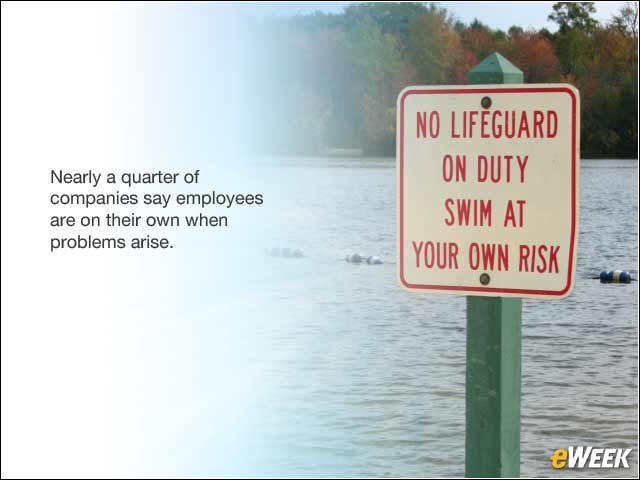
For 32 percent of respondents, there’s no formal process. Instead, there’s ad hoc support from the desk. For another 27 percent, support from the help desk is limited to designated models. Twenty-three percent of companies said their employees are on their own when problems arise with their BYO devices, while 15 percent offer full support.
Protecting the Mobile Device
The most popular way to protect mobile devices—at 63 percent—is through passwords. That’s followed by remote wipe (49 percent), device encryption (43 percent), and data removal when an employee leaves or device disposal (38 percent).
Protecting the Data Downloaded Onto the Mobile Device
Forty-three percent of respondents said their companies use mobile device management (MDM) tools, while 28 percent use endpoint security tools—such as malware protection—and 27 percent use network access control (NAC).
A Lot of Things Are Needed in Mobile Application Management
The needs include logging, monitoring and reporting (according to 80 percent of respondents), malware protection (79 percent) and vulnerability exploit defense (71 percent). Easy deployment, network and WiFi attack defense and cross-platform support also are important.
Wiping the Mobile Device Is Important, but Not Often Done
When an employee leaves the company, only 34 percent of respondents said their companies wipe the device 100 percent of the time. Fourteen percent said their companies never do it, while 29 percent said they do it sometimes.