







Adobe put AI at the center of its creative future at Adobe MAX 2025, debuting the Express AI Assistant for conversational design and Firefly Foundry, a platform for building custom generative models. The pair marks a new chapter in Adobe’s bid to merge creativity with intelligence.
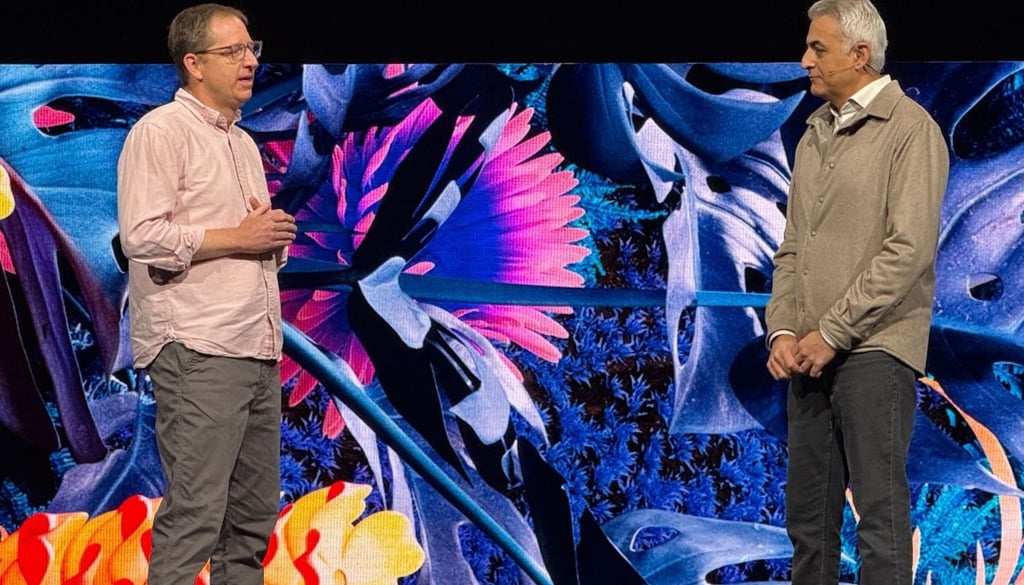
Unveiled in Los Angeles, the announcements came as David Wadhwani, Adobe’s Digital Media President, said the creative industry is undergoing “an incredibly important transformation — driven by two massive trends: generative AI models and conversational AI agents.”
Turning design into dialogue with the new AI Assistant
Adobe’s new AI Assistant in Adobe Express turns creation into conversation. The beta feature lets users describe what they want, and watch Express bring it to life in seconds.
Govind Balakrishnan, senior vice president and general manager of Adobe Express, said the tool “transforms how you create” by removing friction and helping people “create beyond-the-template content that represents their unique brand or vision.”
That vision comes to life through a set of features designed to make creation effortless:
- Create by conversation: The assistant blends conversational creation and editing with contextual understanding of design elements. Users can change fonts, backgrounds, or colors simply by asking, no need to hunt for tools or layers.
- Understands what you mean: It can interpret open-ended prompts like “make this more tropical” and automatically refresh visuals with lush foliage and vibrant tones, then follow up with contextual nudges such as, “Would you like to change the font to match your new theme?”
- Edit without starting over: The AI Assistant lets users tweak specific elements, such as images, fonts, or layers, while preserving the rest of the design. It also works across chatbot platforms, so creators can design directly through conversation wherever they are
Under the hood, the system pulls from Adobe Firefly and third-party models to “choose the best AI for the job.” Adobe says it’s been trained on creative best practices, from color harmonization to layout, bringing professional-grade design intuition to non-designers.
Enterprise features are coming next, including locked templates, batch content creation, and approval workflows, giving teams a conversational path to on-brand production.
Firefly Foundry gives brands their own forge for generative AI
Firefly Foundry brings Adobe’s generative AI to the enterprise, giving companies a way to build private, brand-specific models trained on their own creative assets. These models can generate images, videos, audio, vector art, and 3D, kept consistent with the brand’s visual identity and tone.
In a keynote attended by Corey Noles of The Neuron (one of eWeek’s sister sites), Balakrishnan said that “keeping up with new model releases and juggling multiple accounts is expensive, tiresome, and tedious. It distracts from what truly matters — your creative flow.” He added, “To simplify this, Adobe is making three commitments: deliver our own Firefly models, integrate the best models from across the industry, and empower you to create your own.”
Firefly Foundry was built around four key capabilities:
- Trains on your IP: Uses a company’s own creative libraries to fine-tune models that mirror its visual language and values.
- Works across every format: Generates image, video, audio, vector, and 3D outputs so teams can scale content consistently across channels.
- Lives inside Adobe tools: Integrates directly with Creative Cloud, GenStudio, Firefly, and Express, putting on-brand intelligence where creators already work.
- Builds in enterprise control: Grounded in Adobe’s responsible AI framework, each model is secure, transparent, and managed through a unified dashboard.
It’s the company’s bid to make AI not just smart, but distinctly on-brand.
Adobe’s unified AI direction
Adobe is stitching its tools together so creation feels seamless, whether it starts with a prompt in Express or a brand model built in Firefly Foundry.
Wadhwani said Adobe’s goal is to “bring these technologies to you while keeping you at the center of the creative process.” He added, “Generative AI is evolving fast — and that’s good news for every creator.”
It’s a roadmap that transforms AI from a feature into a creative collaborator, one that moves with, not ahead of, the people who use it.
Some in finance are sounding alarms over AI’s market momentum, with one analyst warning that today’s boom could dwarf even the dot-com bubble in scale.