





Lawyers can now turn recurring legal tasks into applications their colleagues can use inside Claude.
Anthropic introduced six ready-made legal Artifacts on Oct. 28, giving law firms and corporate legal departments customizable tools for reviewing contracts, checking citations, tracking matters, and monitoring regulations. Teams can adapt the applications to their procedures and reuse them for future assignments.
Legal software providers are also bringing their services into Claude. But sharing these applications across a firm introduces another consideration: whether colleagues can access the underlying documents and connected systems without exposing information they should not see.
New tools handle contracts and other legal assignments
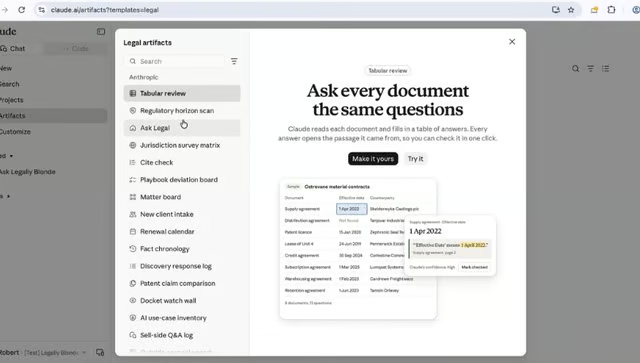
Users can open one of the interactive Artifacts in Anthropic's new legal gallery, then customize it with their own documents and instructions. Six applications cover different assignments.
- Cite check examines legal documents for inaccurate quotations, incorrect page references, and claims unsupported by their cited sources.
- Jurisdiction survey matrix compares legal requirements across states or countries, identifying differences in applicable laws.
- Matter board tracks active legal matters, assigned lawyers, upcoming deadlines, and next steps.
- Playbook deviation board flags contract clauses that differ from a company's approved terms.
- Regulatory horizon scan monitors upcoming regulations and assesses their potential impact on an organization.
- Tabular review extracts requested information from multiple contracts into a table, with links to the original clauses.
Customized versions can be reused for subsequent assignments. Source-linked results also allow legal professionals to examine the underlying material before relying on an application's findings.
Legal software providers bring their services into Claude
Anthropic's May introduction of Claude for Legal came with practice-area plugins and connections to external software. Its catalog now has more than 60 legal integrations, including Bloomberg Law, Filevine, Ivo, Legora, and Patlytics.
One example is Harvey Intake, which lets employees submit questions to their company's legal department through Claude. Routine requests can receive answers drawn from approved guidance stored in Harvey. More complicated cases are assigned to lawyers in the specialist platform, with their responses delivered back through the assistant.
Law firm Goodwin contributed an AI Governance Benchmark for assessing corporate AI policies. Foley & Lardner developed an agreement obligations checker, and PwC created a tool for preparing initial responses to subpoenas using existing legal templates.
The AI company is also supporting legal aid organizations with nine access-to-justice Artifacts, such as tools for immigration paperwork and criminal-record clearance eligibility. Participating public-interest groups can receive Claude credits and a new Legal Ambassadors Program for professionals building applications.
What eWeek found: Claude's legal sharing tools have access limits
An eWeek review of Anthropic's Artifact sharing documentation and enterprise administration guide identified restrictions absent from the announcement.
Applications using Claude or connected software cannot be distributed through unrestricted public links. External email invitations also have limitations, with outside recipients unable to use features dependent on Claude or connected applications.
Consider a law firm creating a contract-review Artifact linked to its private document management system. Colleagues could open the application, but employees without permission to retrieve the underlying contracts might encounter errors. Inviting an external client would not automatically grant access to the source files or enable connected features.
Case notes entered into a shared matter tracker could be visible to colleagues who cannot access the original client files. Anthropic's guidance distinguishes personal storage from shared storage, where information added by one user can be viewed by others using the same application.
Legal and IT teams should test new Artifacts using accounts with different document permissions before distributing them. Administrators should also review external invitation settings and shared storage configurations to determine who can retrieve source material and view saved information.
An Artifact that opens successfully for everyone may still be unable to retrieve the documents it needs. Conversely, shared application data could become visible to more users than intended if access controls are not configured carefully.
For legal teams handling confidential client information, the key question is not simply whether an AI application can be shared, but whether its data and permissions remain appropriately restricted after sharing.
More AI news: Claude also helped one pharmaceutical research team reduce manufacturing document review time by 89%, demonstrating a measurable benefit outside laboratory experiments.