







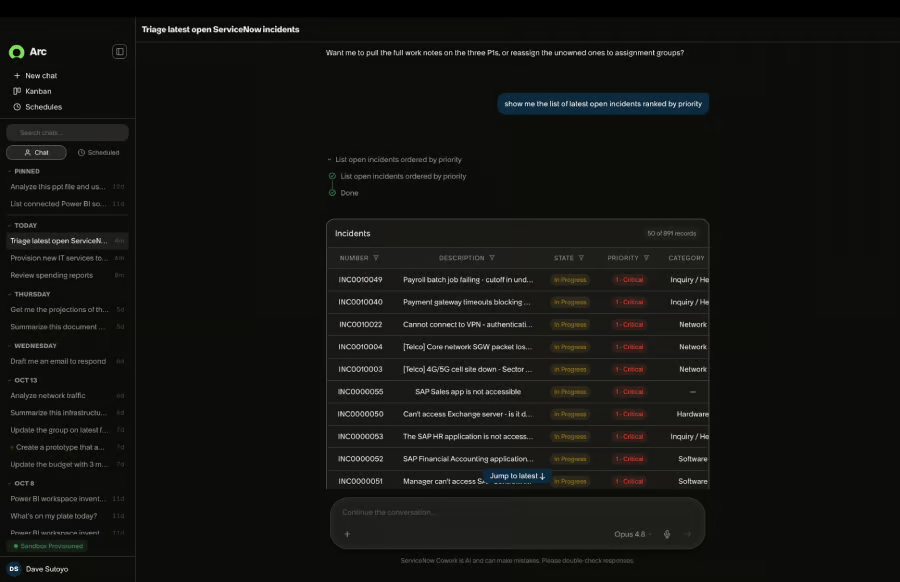
An employee can finish the workday without finishing the assignment. ServiceNow wants its new AI agent to take it from there.
ServiceNow announced Arc’s general availability on Oct. 21 as part of its expanded partnership with Nvidia. The company says the personal enterprise AI agent can handle extended assignments across workplace applications under IT-defined access policies.
For employers, the challenge is whether an agent can complete work accurately across changing systems while staying within its permissions. Errors could leave approvals unfinished or business records incorrectly updated, even when the agent has permission to access them.
From inbox follow-ups to custom integrations
ServiceNow says employees can give Arc a goal instead of prescribing every step. The agent develops a plan, performs actions across business systems, checks its progress, and adjusts when necessary. Assignments can continue for minutes or days without someone supervising each step.
It also identifies unfinished work from an employee's inbox, task backlog, and meeting conversations, including pending approvals and follow-ups. Connections to ServiceNow workflows, email, Microsoft Teams, and other productivity tools allow it to coordinate automated workflows. Memory and skills developed over time are intended to improve how the assistant handles recurring assignments.
When an existing connector cannot support a task, the software can write a new integration to communicate with another application. For everyday workloads, it can use smaller local models on Nvidia RTX Spark hardware, turning to frontier models for more demanding requests.
The AI tool can operate on an employee's desktop or a separate computer inside a secure environment. ServiceNow includes it with EmployeeWorks Foundation, Advanced, and Prime subscriptions at no additional cost.
Mac support is available now, with Windows support expected within weeks.
IT policies govern Arc's actions across systems
Administrators define AI agent permissions through ServiceNow's Super Intelligence Control Tower, specifying which applications and data the agent can access. Nvidia OpenShell provides a sandboxed environment that enforces those restrictions during execution. Integrations created by the assistant must operate within the same boundaries.
The chipmaker’s OpenShell Reference Architecture also includes Sentry software, designed to run on BlueField-4 data processing units. Nvidia says Sentry will monitor agents independently of their host software and enforce security policies at the hardware level. Its availability is planned for early 2027.
ServiceNow also plans to extend its controls through AI Passport, an authorization record specifying what each agent is permitted to do. Future integration would allow the software and hardware enforcement layers to recognize revoked permissions and stop unauthorized activity. Passport enforcement across these layers is expected in a later release and is not part of Arc's current availability.
What eWeek found: Supplied plans helped a smaller model outperform a larger one
ServiceNow Research's March EnterpriseOps-Gym study examined how AI models performed across 1,150 simulated workplace tasks.
When the company and Nvidia introduced Project Arc in May, they also discussed their work on enterprise agent benchmarking. One experiment revealed a surprising finding about the relationship between model size and planning quality.
Researchers supplied smaller AI models with expert-written plans for completing workplace assignments. With those instructions, the four-billion-parameter Qwen3-4B model outperformed the larger Qwen3-30B model across all three tested work areas.
Work area | Qwen3-4B | Qwen3-30B |
| Customer service | 37.2% | 33.9% |
| IT service management | 23.3% | 20.9% |
| Human resources | 36.4% | 33.2% |
Task completion rates with human-written plans, based on Table 3 of the EnterpriseOps-Gym study.
Across the three models and three work areas in this experiment, human-written plans improved task completion by approximately 14 to 35 percentage points compared with models working without supplied plans.
The experiment does not establish Arc’s accuracy or cost savings. Human-written reference plans gave the tested models instructions that an autonomous agent would need to generate or obtain itself. The researchers also found that model-generated plans delivered smaller improvements than human-written plans.
For enterprise buyers, the distinction matters: running a smaller model locally may reduce inference costs, but a workflow that needs frequent correction can still consume staff time. Evaluations should measure whether assignments are completed correctly within policy, including any manual work needed to repair mistakes.
IT leaders evaluating that potential should begin with familiar multistep assignments and compare the agent's planned actions with established employee procedures. Tests should also include situations where workplace records change during execution, followed by checks that the correct updates were made in the business systems.
Tracking staff intervention, rework, and cost per successfully completed assignment would help determine whether Arc's approach delivers those efficiencies under actual workplace conditions.
Want to learn more AI tips, tricks, and prompting techniques? eWeek readers get free 7-day access to The Neuron Academy, our practical learning platform designed to help professionals use AI more confidently at work. Browse all lessons →
AI agents like Arc may handle the planning, but people still need to communicate what they want accomplished. Our free six-minute How to Talk to AI course teaches simple ways to write clearer prompts, with seven days of free access to other AI courses. Check out all the lessons here →