






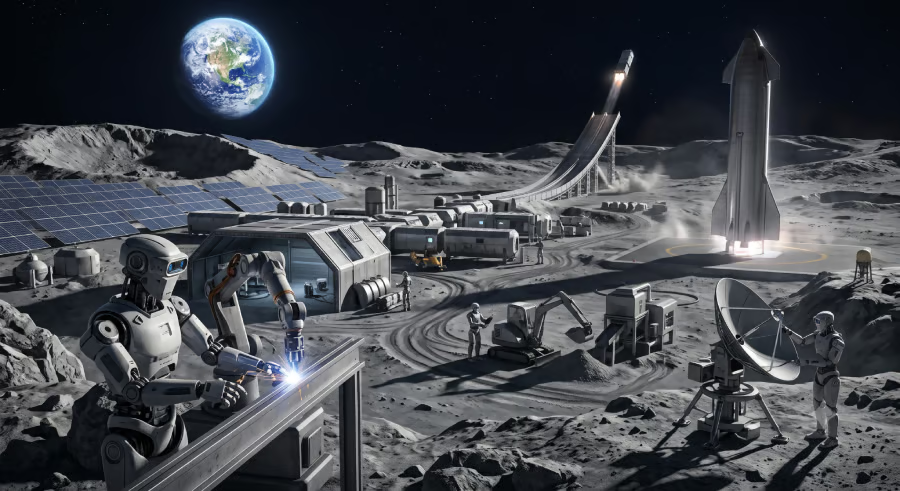


Elon Musk says the moon could become SpaceX’s next factory floor.
During SpaceX’s first earnings call as a public company, Musk outlined a plan to ship large amounts of equipment to the lunar surface and build automated factories using robots.
“I know this sounds totally nuts,” Musk told investors, according to Fortune.
The idea goes beyond simply establishing a lunar base. SpaceX’s investor materials describe lunar factories that could produce AI compute satellites. Fortune reported that the company could extract materials such as aluminum, titanium, and silicon from lunar soil while shipping chips and other components from Earth.
A lunar “mass driver” would then use electromagnetic force to launch satellites and other payloads from the Moon without conventional rockets, Fortune reported.
Musk has also linked the lunar strategy to a much larger expansion of the space economy. WION reported that he believes lunar manufacturing could support economic activity equivalent to 1,000 times Earth’s economy, measured by what he called “intelligence launched to space.”
Robots instead of workers
Humanoid robots would be critical because sending people to perform routine construction and maintenance would be expensive and dangerous.
“Anyone who is thinking about doing industrial processes on the moon, they aren’t imagining a workforce of humans wrenching on things there,” Jaret Matthews, CEO of Astrolab and a former SpaceX employee, told Fortune.
Jim Cantrell, a former SpaceX executive, suggested Tesla’s Optimus robots could eventually provide the workforce, although Musk referred only to “robots” during the earnings call. SpaceX, however, has not said that Optimus will be used, and it has disclosed no specific robot deployment plan, investment figure or timeline, according to WION.
The environment itself presents a formidable engineering challenge. Lunar dust can damage equipment, temperatures can rise above boiling in sunlight, while permanently shadowed areas can fall below minus 300 degrees Fahrenheit, and the Moon experiences roughly two weeks of sunlight followed by two weeks of darkness.
“Everything is trying to kill you on the moon,” Matthews said.
The business case
The Moon has one major logistical advantage over Mars: proximity. A trip to the Moon takes days, while reaching Mars can take many months, making lunar operations a potentially useful testing ground for technologies SpaceX could eventually deploy farther away.
Mars launch windows occur roughly every 26 months, and the trip can take six months or longer. Spacecraft can reach the Moon in several days.
SpaceX is also pursuing orbital AI infrastructure, giving lunar manufacturing a potential internal use case for the satellites it hopes to build.
But the financial payoff remains distant. SpaceX reported $7.8 billion in second-quarter revenue, while its space segment posted an adjusted EBITDA loss of $205 million amid higher research-and-development spending, including accelerated investment in Starship, Fortune reported.
The hard part is making it work
The biggest question is not whether lunar resources exist, but whether SpaceX can build a reliable industrial system capable of extracting them, powering robots and manufacturing complex hardware far from Earth.
“He’s usually off by a few years and a little on the optimistic side,” Ryan Westerdahl, a former SpaceX engineer, told Fortune.
That may be the central gamble for investors: SpaceX is betting that the infrastructure it builds for the Moon can eventually support a much larger space economy, but the technology, economics and timetable remain highly speculative.
For now, Musk is asking investors to believe that the same approach that helped SpaceX industrialize rocket launches can eventually work 238,900 miles away — with robots doing the building.
Read more: SpaceX’s lunar ambitions are closely tied to its broader AI infrastructure strategy. Learn why Musk says the company will use Nvidia exclusively for AI compute.