







An AI processor can have plenty of computing power and still spend time waiting for data. Google's latest hardware tackles that bottleneck alongside another enterprise concern: protecting sensitive information while AI models process it.
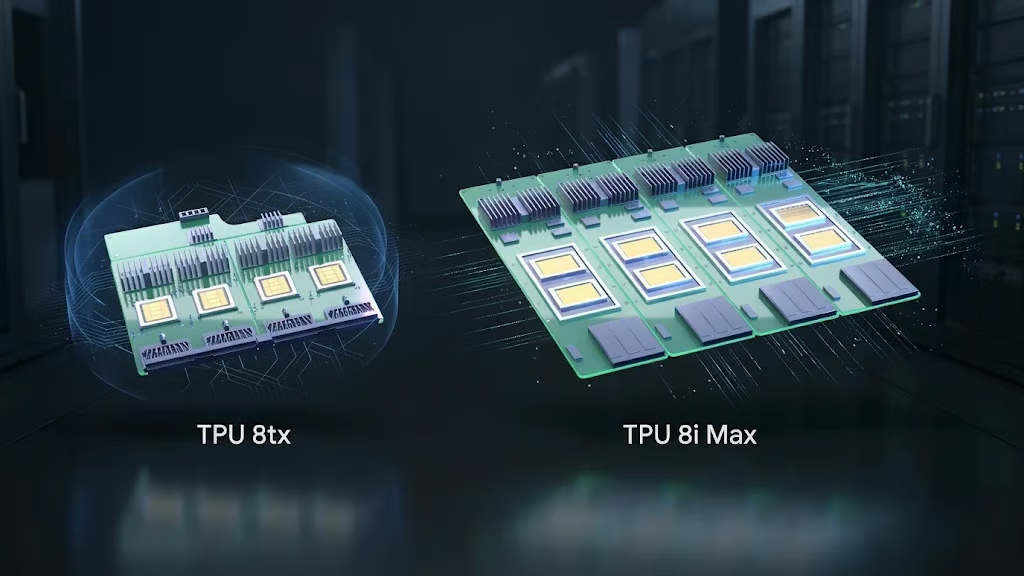
Google announced two new tensor processing unit (TPU) systems on November 9: TPU 8i Max, designed for memory-intensive AI workloads, and TPU 8tx, built for confidential computing. Both expand Google's eighth-generation TPU portfolio as businesses move increasingly complex AI agents into production.
The systems use existing TPU silicon rather than entirely new chip architectures. Google's hardware announcement addresses two constraints facing enterprises expanding AI deployments and engineering support: memory bandwidth and protection of proprietary data during processing.
A 2024 study on the AI memory wall found that peak server computing power grew roughly threefold every two years, compared with 1.6-fold growth in DRAM bandwidth. The gap helps explain why faster processors alone may not improve AI inference.
TPU 8i Max doubles memory bandwidth
TPU 8i Max combines two TPU 8i chips into one package. Google says it doubles computing capacity, on-chip static random-access memory (SRAM) and high-bandwidth memory (HBM) bandwidth compared with TPU 8i. It also fits twice the silicon into the same rack footprint.
The system targets workloads requiring extensive context, including AI agents analyzing large software repositories or hours of video. Greater memory bandwidth can reduce processing delays, although doubling hardware resources does not guarantee twice the application throughput.
Google also introduced TPU Sync, a model-state management layer that transfers cached AI context between accelerator memory, host memory and storage. Internal tests showed reductions exceeding 90% in certain cache-transfer operations. However, those results came from Google's earlier Ironwood architecture, not TPU 8i Max.
Actual performance will depend on each workload's memory demands, networking and utilization. Enterprises must measure those factors alongside the costs of operating AI agents before assessing the return on additional accelerator capacity.
TPU 8tx adds confidential computing
TPU 8tx addresses data protection during AI processing. Confidential computing uses hardware-backed isolation to protect information in use, complementing encryption at rest and in transit.
The system combines TPU 8t silicon with fifth-generation AMD EPYC processors. In its November 9 announcement, AMD described how its Secure Encrypted Virtualization technology helps extend confidential-computing protections from the host CPU to connected accelerators.
Google says TPU 8tx supports private model fine-tuning, distillation and reinforcement learning without moving sensitive data between separate clusters. Its Boardfly network reportedly delivers up to twice as low latency as TPU 8t, with what the company describes as minimal overhead from confidential-computing protections.
The system could appeal to financial institutions, healthcare providers and other organizations processing confidential information. An October 2026 Cloudflare AI data leak exposed cached information from earlier requests in responses delivered to other customers. The failure illustrates the importance of memory isolation, although there is no evidence TPU 8tx would have prevented it.
What eWeek Found: More hardware capacity doesn't guarantee better enterprise AI performance
Google's specifications reveal two approaches to enterprise AI infrastructure, but neither establishes how much businesses will gain in production.
| TPU 8i Max | TPU 8tx | |
|---|---|---|
| Primary purpose | Memory-intensive AI workloads | Confidential AI processing |
| Hardware design | Two TPU 8i chips in one package | TPU 8t silicon with AMD EPYC hosts |
| Key improvement | 2× compute, SRAM and HBM bandwidth vs. TPU 8i | Hardware-backed protection for data in use |
| Enterprise application | Large-context inference and AI agents | Private model customization and sensitive workloads |
| What remains unproven | Production performance gains and cost benefits | Independent security validation and compliance suitability |
Source: Google Cloud and AMD, November 9, 2026. Performance specifications are manufacturer-reported.
TPU 8i Max doubles compute capacity and memory bandwidth, yet workloads constrained by networking, storage or software may see smaller performance gains. TPU 8tx adds hardware-backed confidential computing without eliminating application-level vulnerabilities or establishing regulatory compliance.
Enterprise buyers still need workload-specific benchmarks and pricing to assess TPU 8i Max's economics. For TPU 8tx, AMD describes hardware verification of accelerator identity and security configuration, but customers must evaluate attestation evidence and independent security testing.
Until pricing, availability and production performance are established, the systems' enterprise benefits remain unproven beyond their architectural specifications.
Want to learn more AI tips, tricks, and prompting techniques? Let us teach you How to Talk to AI for free! Try our six-minute course at The Neuron Academy, our practical learning platform designed to help professionals use AI more confidently at work.
Learn a few simple ways to write better prompts and get more useful results from AI, or browse our other AI course for free for seven days. eWeek readers get free 7-day access. Check out all the lessons here →