







Alibaba wants people to ask Qwen for help without reaching for their phones.
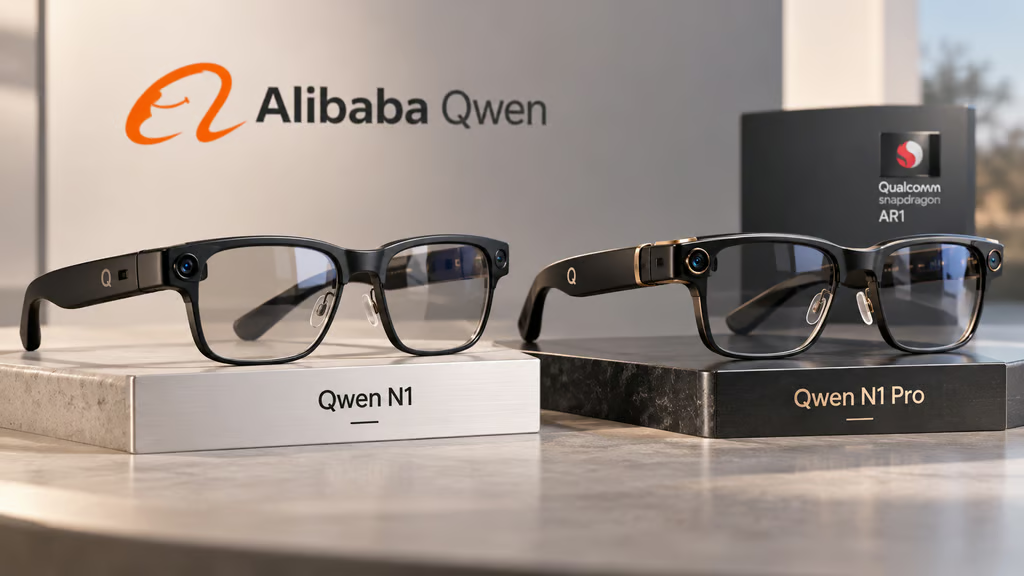
The company introduced its Qwen N1 and N1 Pro AI glasses in China on October 13. Both models combine cameras and voice assistance in a screenless design, while the higher-end N1 Pro adds health monitoring and biometric features.
The glasses are designed to respond to what wearers see and hear, but Alibaba's broader Qwen glasses terms also raise questions about automatic photography and recording. As AI assistants become more aware of their surroundings, the challenge is determining how much they should be allowed to capture without repeated instructions from users.
N1 Pro adds sensors to shared hardware
Both models use Qualcomm's Snapdragon AR1 platform and a 50-megapixel camera capable of recording 4K video. Wearers can also replace the 272mAh battery without shutting down the glasses, while an optional MiniBag provides another 700mAh of charge.
Qualcomm China's launch details identify the main differences between the two models.
Feature | Qwen N1 | Qwen N1 Pro |
|---|---|---|
| Health monitoring | Not offered | Heart rate, blood oxygen, skin temperature, heart-rate variability and stress |
| Eye tracking | No | Yes |
| Iris payment verification | No | Supported Alipay transactions |
| Launch price | 2,999 yuan | 3,499 yuan |
| Discounted starting price | 2,218 yuan | 2,600 yuan |
Both models are on sale in China, with lower introductory prices reflecting local subsidies and limited-time discounts. Qualcomm also details image stabilization and software intended to improve low-light footage.
N1 Pro's health readings lack published clinical validation, so buyers should not assume medical-grade accuracy. Its iris verification also works through supported Alipay services.
Alibaba has not established clinical-grade accuracy for the N1 Pro's health readings, so the features should not be treated as substitutes for medical devices.
Qwen brings visual recognition and voice assistance into daily tasks
Spoken requests let wearers use Qwen without reaching for their phones. Its features include the following.
- Visual recognition and translation. Qwen can identify objects in view and translate conversations. Users can also customize the assistant's wake phrase and voice.
- Meeting assistance and reminders. Wearers can get meeting transcripts, summaries and reminders based on their surroundings.
- AI Inspiration Album. Captured moments can be organized into a personal album.
Song Gang, vice president of Alibaba's Qwen division, told Yicai that the company wants the AI tool to understand situations and offer assistance without waiting for every instruction.
Alibaba also offers ways to extend the glasses' capabilities through its Qwen hardware platform. The portal lists N1 and N1 Pro and provides tools for developers to create voice-activated Skills, connect existing software through APIs or MCP tools, and test their work on compatible glasses. Developers can publish Skills for public, private, or enterprise use.
What eWEEK found: Alibaba's recording terms raise privacy questions
Recognizing a meeting room can start a recording the wearer has authorized in advance. An eWeek examination of Alibaba's environmental visual-perception agreement found that ongoing recordings and similar activities do not stop automatically. Wearers must give an explicit command to end them.
Once users enable optional environmental sensing, the glasses continuously process grayscale camera images locally to recognize scenes. Activating the service also turns on AI Inspiration Album by default, allowing the camera to capture color photographs automatically when it identifies moments worth recording.
The company says those photos go to cloud AI for analysis only after the wearer uploads them manually.
Alibaba's agreement also addresses visible recording indicators and consent from people nearby. Similar issues involving wearable cameras capturing surrounding activity and recording-indicator safeguards have emerged elsewhere in the AI glasses market.
The company’s agreement applies to Qwen glasses generally, without identifying N1 or N1 Pro individually, so the exact implementation on either new model remains unverified.
Companies considering these glasses for meetings or field work should check several controls before approving employee use.
- Test recording controls. Verify how automatically triggered recordings begin, how employees stop them, and whether recording indicators remain visible.
- Review automatic photography. Check whether AI Inspiration Album can be disabled before employees enter areas containing confidential information.
- Check consent and data handling. Establish recording policies, identify what information reaches cloud services, and confirm employees understand the restrictions.
For organizations considering Qwen glasses for meetings or field work, the immediate priority is understanding how recording and photography features are activated, what information is stored or uploaded, and whether employees can reliably disable those functions in sensitive environments.
Alibaba's launch reflects a broader push to make AI assistance available throughout everyday life rather than through a phone screen. Whether that approach gains acceptance may depend as much on transparent recording controls and privacy safeguards as on the capabilities of the glasses themselves.
More AI news: Anthropic’s research raises a new IoT security concern as small AI models become capable enough to run on inexpensive consumer hardware.