






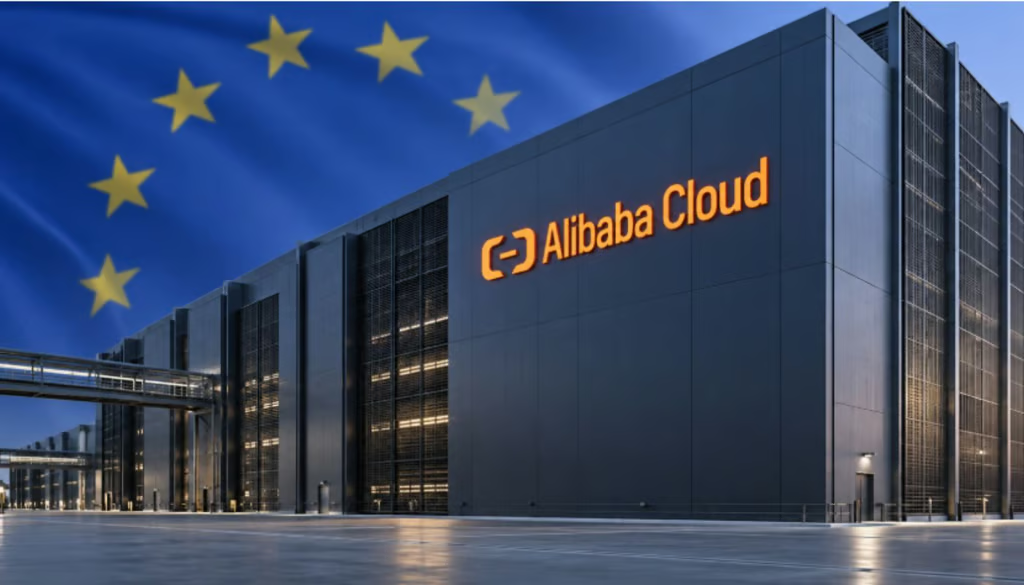


Alibaba Cloud is extending its AI infrastructure deeper into Europe, with Finland, the Netherlands, and Turkey next on its cloud map.
The Chinese cloud provider plans to establish its first cloud regions in all three markets over the next 12 months while adding capacity in Germany and France. The Netherlands will come online first, with an October launch planned.
The expansion gives Alibaba a larger physical footprint as European demand for AI compute grows. But important details remain unanswered, including how much capacity the new regions will provide and which AI hardware and services will be available when they open.
Alibaba Cloud adds three new European regions
Alibaba Cloud CTO and international business president Li Feifei announced the expansion at the company's Apsara Conference in Hangzhou. The Netherlands region is scheduled to come online first in October, with Finland and Turkey following within the next year.
Alibaba will also expand its existing footprint in Germany, France, the United Arab Emirates, Malaysia, and Hong Kong.
“We are expanding our global cloud footprint to bring computing resources closer to customers and partners,” Li said, according to SCMP. Li highlighted that businesses were moving AI from experiments into real-world deployment.
Alibaba Cloud currently operates 107 availability zones across 31 regions. SCMP noted that Gartner ranked the company fourth globally by infrastructure-as-a-service revenue in 2025, behind Amazon, Microsoft, and Google. Alibaba remained the largest provider in Asia-Pacific with a 22.5% market share.
The expansion gives Alibaba more physical reach in Europe, but it enters those markets while the three US hyperscalers continue to hold the leading positions globally.
Europe becomes part of Alibaba's larger AI buildout
The new regions are one piece of a much larger infrastructure plan.
Euronews said that Alibaba has set a target of operating more than 20 GW of global data center capacity by 2032 as demand for AI computing grows.
The company is also building more of the AI stack itself. Alibaba discussed future Qwen models scaling to between 5 trillion and 10 trillion parameters at Apsara and unveiled its Zhenwu V900 AI processor, which is expected to become commercially available in the first quarter of 2027.
Those plans illustrate the scale of compute Alibaba expects future AI systems to require. AI Weekly also reported that the 20 GW target sits within Alibaba's previously announced $53 billion, three-year AI and cloud investment plan.
Citigroup estimated that reaching that capacity could translate to more than $160 billion in external cloud revenue by fiscal 2033, although that remains a long-term analyst projection rather than company guidance.
What eWeek found: Alibaba has revealed where, but not how much
Alibaba's European expansion includes three newly announced cloud regions in Finland, the Netherlands, and Turkey, plus additional capacity in Germany and France, where the company already operates infrastructure.
European market | Alibaba Cloud status | What was newly announced | What remains unclear |
| Netherlands | Newly announced cloud region | Alibaba's first region in the country, scheduled to open in October 2026 | Site capacity, capex, accelerator mix, and AI services available at launch |
| Finland | Newly announced cloud region | Alibaba's first region in the country, planned within the next 12 months | Opening date, capacity, hardware, investment, and service availability |
| Turkey | Newly announced cloud region | Alibaba's first region in the country, planned within the next 12 months | Opening date, capacity, hardware, investment, and service availability |
| Germany | Existing footprint expansion | Additional data center capacity | Scale, timing, and hardware behind the expansion |
| France | Existing footprint expansion | Additional data center capacity | Scale, timing, and hardware behind the expansion |
The Netherlands is the only newly announced European region with a firm launch window, with service expected to begin in October. Alibaba has not disclosed site-level capacity, regional capital spending, accelerator configurations, or which AI services will be available at launch.
What Alibaba has not said yet is how much AI compute each region will actually offer. Capacity, accelerator availability, AI services, and pricing will determine how useful the new regions are for demanding enterprise workloads and how directly they can compete with infrastructure from larger cloud providers.
Alibaba's 20 GW global target demonstrates the scale of its infrastructure ambitions but says little about Europe's eventual share. The Netherlands launch should provide the first clearer indication of how Alibaba's global AI buildout translates into actual compute capacity for EMEA customers.
As AI infrastructure expands across Europe, demand is also growing for the specialized workers who build and operate it. Read how AI data centers are fueling demand for jobs paying $100,000 or more.