







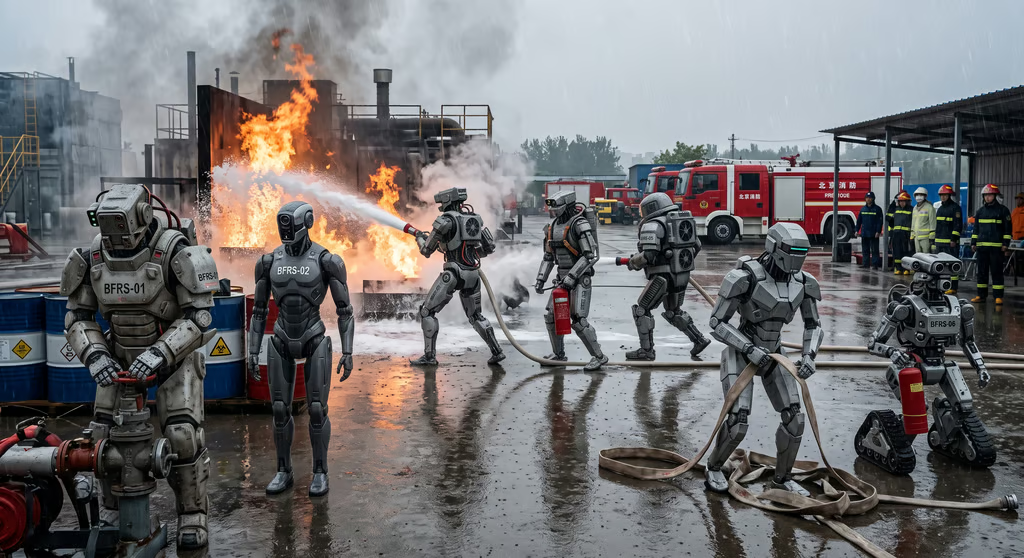
Nine of 12 humanoid robot teams failed to complete a simulated firefighting mission in Beijing on Sunday.
Twenty-three teams entered the emergency-management event, part of the second World Humanoid Robot Games. Among the robots competing, only three made it through the full assignment within 30 minutes at a real fire brigade.
Firefighting forced several robotic abilities to survive the same assignment. Most runs broke down somewhere along the way.
Hazards and valves came before the fire
Competitors first had to identify two randomly placed mock hazardous substances and send images of them to judges, according to Global Times. Three open valves came next, with robots required to find and close each one.
Fire suppression finished the mission. Robots had to locate an extinguisher and use equipment designed for people, adding a demanding manipulation task for human-like robot hands.
Unlike many athletic contests at the World Humanoid Robot Games, success depended on carrying one physical task into another without losing track of the environment or the next action.
Changing conditions exposed technical weak spots
Rain and shifting light complicated object recognition during the runs. Physical control created another obstacle once robots reached the correct equipment.
UniX AI was one of the three finishers, but its robot needed a second attempt to align correctly during the extinguisher operation. Engineers had already given the system up to three tries, allowing it to respond when an attempt did not work.
Failed runs also gave teams material to study. Tiangong representative Jin Chenran, whose robot completed one of the three stages, told Global Times that recognition and motion-planning errors could be used to improve algorithms and AI models.
Developers are increasingly relying on real-world humanoid training to uncover problems that controlled environments may miss.
Firefighting puts recovery ahead of spectacle
Fire departments and industrial safety teams considering humanoids should ask vendors what happens when something goes wrong. Perfect first attempts are unlikely in hazardous environments, so a system's ability to recognize a failed action and try again may be as important as getting it right once.
Reliable recovery also changes how speed should be judged. A humanoid may still earn a role if it works more slowly than a firefighter but completes the task consistently while keeping people away from jobs considered too dangerous for humans
Human assistance deserves a closer look as well. Some teams used VR equipment to adjust robots shortly before their runs. Remote operation can still make sense in dangerous locations, but buyers and emergency agencies need to know when a robot can act independently and when a person remains part of the control loop.
Beijing's firefighting event showed why recovery may become one of the more revealing measures of humanoid progress. Real emergencies will not guarantee perfect lighting, familiar object placement, or a successful first attempt.
More news: Atlas’ under-three-minute battery swap is a small operational feature with big implications for continuous industrial use.