







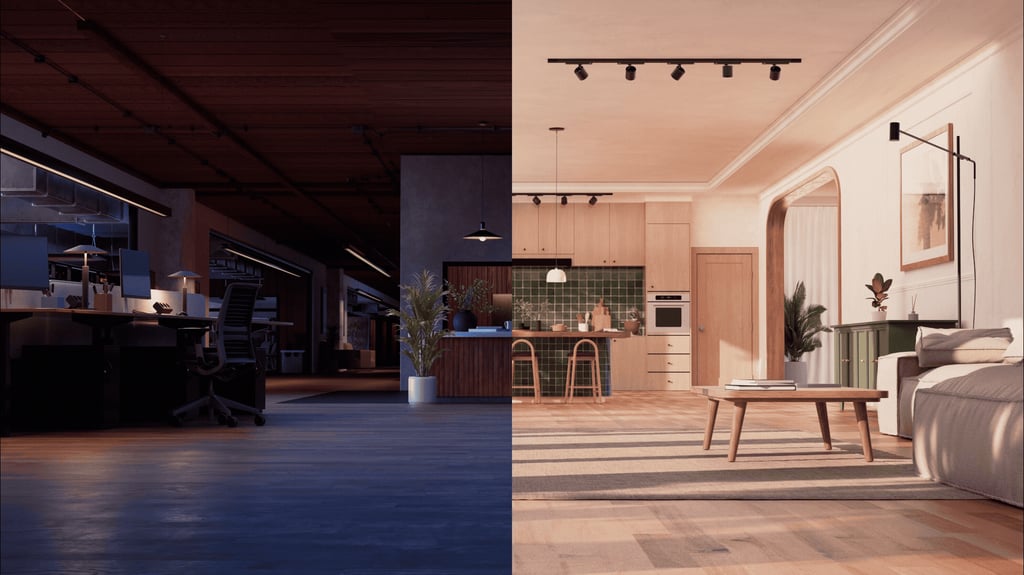
Your next Ring camera could leave its charging dock and fly down the hallway to check an alarm.
Amazon’s security brand announced Ring Robotics on Nov. 10, introducing a flying camera for homes and a wheeled patrol robot for businesses. The Ring Drone Cam costs $249.99, with US shipping planned for Jan. 27, 2027. The $999.99 Ring Rover Cam is available for preorder and is scheduled to start shipping in the US on Dec. 16, 2026.
| Product | Intended use | US price | Planned shipping |
| Ring Drone Cam | Indoor home security | $249.99 | Jan. 27, 2027 |
| Ring Rover Cam | Indoor business patrols | $999.99 | Dec. 16, 2026 |
The drone’s date comes with a regulatory asterisk: it still needs Federal Communications Commission authorization. Ring is taking notification signups, and the company notes that it can’t legally sell or lease the drone until the FCC gives the green light.
Just yesterday, Amazon’s renewed effort to build a home robot highlighted the company's ambitions to create something useful enough to earn a place in the house. Ring’s announcement gives that broader robotics story a more specific assignment: mobile security. Unlike the aimlessly wandering Astro, Ring’s new devices arrive with a clearly defined purpose: keeping an eye on homes and businesses.
That brings us back to what useful work justifies owning a robot: These cameras have a defined task, but Ring’s announcement does not identify either as the still-undisclosed consumer robot associated with Amazon’s Fauna Robotics acquisition. Amazon has not revealed that device’s design, capabilities, price, or release date.
However, Ring still needs to demonstrate how reliably its own machines do the job.
The flying camera has a short shift
The Drone Cam captures 2K video with a 148-degree field of view and can rotate to inspect a room. Two LED spotlights illuminate dark spaces; it does not use infrared night vision. There is no microphone, speaker, or two-way talk, meaning you can’t yell at intruders from the sky.
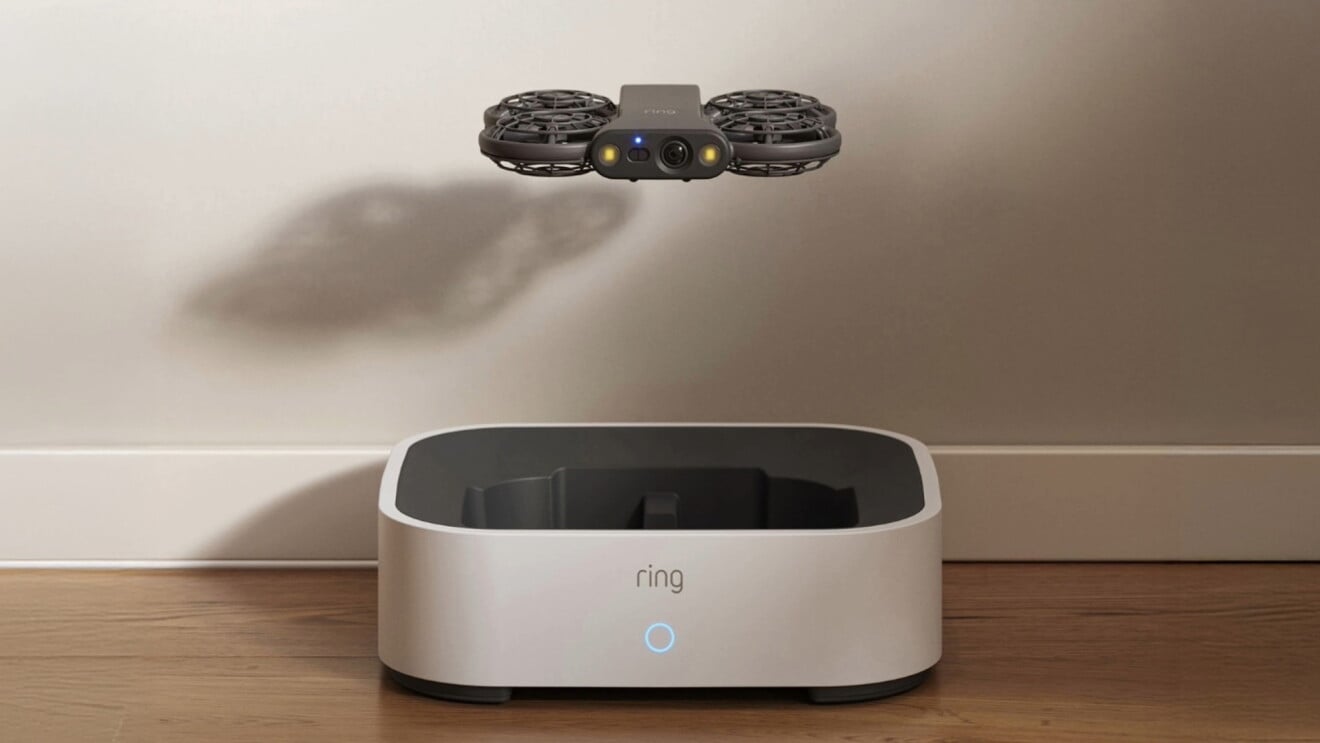
Owners can save viewpoints, start flights on demand, schedule patrols with a compatible subscription, or link the drone to alerts from Ring cameras, sensors, and alarms. A triggered sensor can send it to a previously configured patrol point. It records while flying, then returns to a dock where its camera is off.
You choose the destination or patrol route; AI Pilot handles the flying. That distinction matters, because sending it to check a window is different from steering a camera drone with a joystick or giving it permission to decide where to snoop. Ring also says the camera can be controlled through its new Alexa Home Map interface.
Ring advertises up to eight minutes of flight, tested with a new, fully charged battery under controlled conditions. Your real-world mileage will inevitably vary depending on how much your drone has to maneuver, the temperature, and how degraded the battery gets over time.
Because a full recharge takes about an hour, every minute in the air requires roughly eight minutes on the charging pad. This is a camera for brief checks with substantial breaks between them. The airborne night shift is decidedly part-time. If a thief breaks in during the second hour of a recharge cycle, they’ll just have to wait patiently for the drone to wake up.
Rover gives businesses a moving viewpoint
The Rover Cam targets shops, offices, and storage areas where an owner might want an after-hours look at the register, receiving door, or back room.
For $1,000, you essentially get a mall cop that never takes a lunch break. A scheduled sweep could provide additional views between fixed cameras, while linked Ring alerts can dispatch it to programmed patrol points.
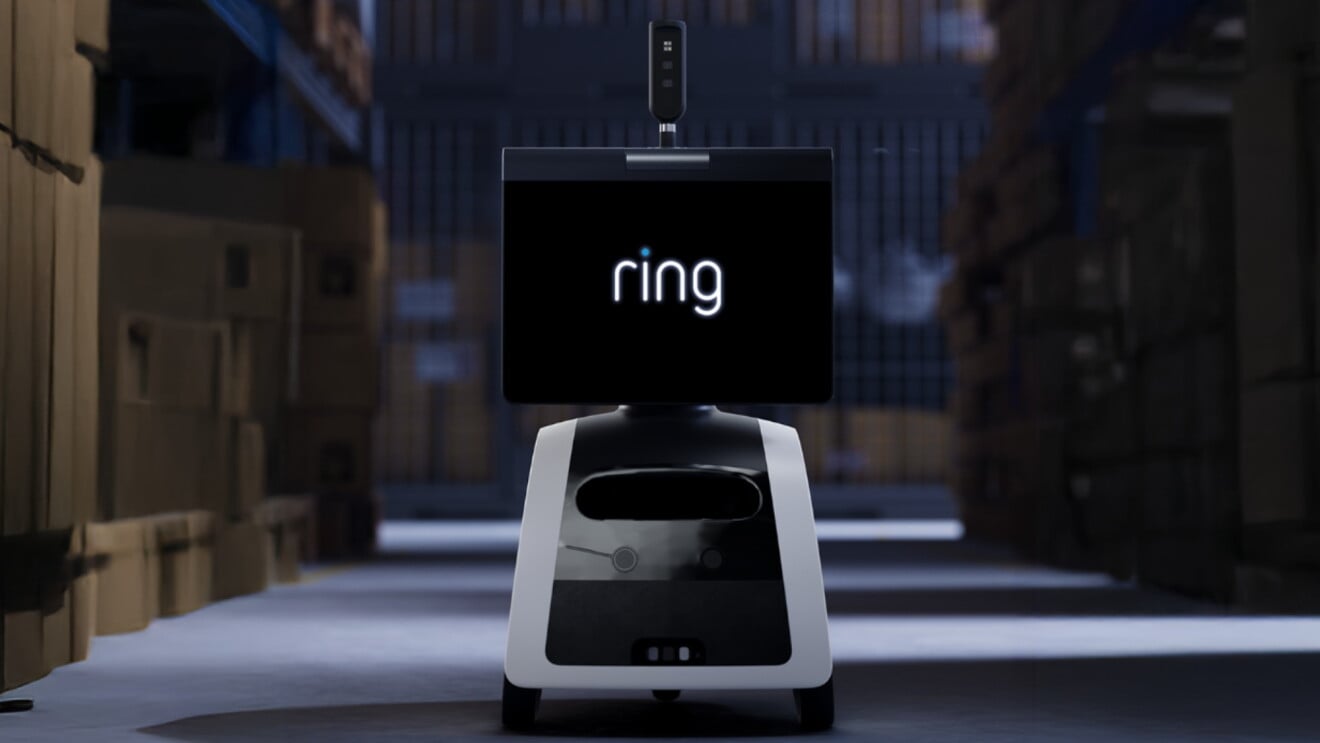
Its adjustable periscope raises the camera to look over counters or shelving, with heights saved for individual stops. Ring says Rover streams and records in up to 4K while moving, then performs a 360-degree scan at its destination. Resolution can vary with bandwidth, device temperature, and lighting.
Two-way audio lets an owner speak through the robot. A remotely activated siren and red lights serve as deterrents, while a projected ceiling light helps people locate it behind furniture or shelving. Person detection can trigger recording even while it is docked. However, that does not amount to nonstop 24/7 recording.
Ring markets coverage of up to 5,000 square feet. Bloomberg reports a claimed patrol runtime of up to 30 minutes; Ring’s product specifications list approximately 45 minutes to recharge. Its mobile security approach draws directly on Astro, whose customers identified roving security as a favorite feature, according to Ring.
The practical opportunity is to supplement fixed cameras with another angle when something needs checking. One moving camera cannot watch every room simultaneously, and charging creates further gaps. Ring has not established staffing reductions, lower total costs, or equivalent protection to a human guard. Someone still needs to assess the footage and decide how to respond.
AI Pilot still needs an internet connection
Setup begins with a tour: carry the drone through the home or let Rover explore the business.
Ring says AI Pilot builds a floor plan, identifies rooms, and suggests patrol points such as doors, registers, and corridors. Users can edit or add points. The system combines cameras, onboard sensors, vision models, and cloud processing to plan routes and navigate around obstacles.
Both support 2.4 GHz and 5 GHz Wi-Fi, so coverage needs to extend along their routes. Ring recommends at least 15 Mbps upload for Rover’s optimal performance. For the drone, Ring recommends a 5 Mbps upload speed, but given the heavy reliance on cloud processing for AI Pilot, a spotty internet connection will turn your futuristic security guard into a very expensive paperweight.
The cloud connection also affects movement. WIRED reports that the drone retains enough onboard capability to land if internet access fails, while cloud AI directs its normal navigation.
That is an emergency fallback, not continued patrol service.
Your internet provider has effectively joined the security team. Rover’s product FAQ says Wi-Fi is required to map and get around, but it does not specify how the device recovers during an outage. Buyers need that explained before treating it as dependable after-hours coverage.
Your floor plan and subscription get a vote
Ring says the drone can navigate multiple floors and even fly up stairs — though it conveniently skipped demoing that party trick at its launch event. The manufacturer admits that transparent glass, completely blank walls, and super-shiny floors could easily confuse the drone’s navigation. A beautifully minimalist home may prove less cooperative than the brochure suggests.
Rover is restricted to dry indoor spaces on one floor and cannot climb or descend stairs. So if the burglars head upstairs, the robot is out of luck. Its listing excludes curved edges, sunken areas, black glossy floors, and floor transitions above 1.375 inches. Ring says it is unsuitable around children under 3 or small pets. Closed doors also block access for either product, so the human still gets door duty. The drone’s noise makes pet reactions another practical concern.
The hardware price is only part of ownership. Both product listings require a compatible Ring subscription for scheduled patrols and saving or reviewing recorded video, with cloud event history of up to 180 days. The patrol schedule comes with a billing schedule. Launching a check and watching it live should not be confused with having a recording available afterward.
Ring’s published US plans start with Solo at $4.99 a month or $49.99 a year for one device. Multi costs $9.99 a month or $99.99 a year for devices at one location; Pro is $19.99 a month or $199.99 a year and adds intelligent features and professional monitoring, subject to eligibility.
However, the robot listings do not identify the minimum qualifying tier for scheduled patrols. Confirm that before pricing a deployment, any existing cameras or monitoring needs are included.
Privacy requires more than a recording light
Both devices have LED recording indicators, and Rover also displays recording status on its screen.
Thankfully, the drone’s camera is off while docked, shielded by the dock itself. Rover can still detect people and record while docked, unless privacy controls disable it; its Sleep Mode retracts the periscope and switches off the microphone. The drone’s rotors emit a loud, high-pitched whine that ensures it will never sneak up on anyone, but sounding like a hive of angry bees doesn’t exactly make it unobtrusive.
Ring confirms both products will protect video using Throw Away the Key encryption, or TAKE. As TechRepublic recently covered, Ring’s new TAKE encryption deletes video keys without giving up AI features, temporarily holding copies of rotating encryption keys in a secure cloud enclave, where Ring can access them for enabled intelligent features before deleting its copies. TAKE therefore permits temporary cloud access to the keys.
That differs from optional end-to-end encryption, which restricts video access to enrolled mobile devices and disables features including Shared Users and cloud-based Smart Alerts. Ring’s general guidance says most cameras support it, but the launch materials reviewed do not explicitly establish these robots’ eligibility or explain how it would interact with AI Pilot. TAKE is confirmed; full end-to-end encryption for either robot should not be assumed.
For a business, setup should also include informing employees and visitors where the camera is directed and when audio may be active, limiting account access to those who need it, and choosing an appropriate retention period. Up to 180 days is the maximum available, not a reason to keep every workplace recording that long. A recording indicator cannot make those decisions for management.
Ring has a launch history to overcome
Ring first announced the Always Home Cam in 2020, but that flying camera never reached general sale.
Ring founder Jamie Siminoff told reporters that redesigns faced escalating demands for sensors, computing, battery, and weight before Ring moved more processing to the cloud. Amazon also introduced Astro for Business in November 2023 and discontinued it in July 2024. That cancellation concerned the business version; Amazon says it continues supporting consumer Astro owners — for now, anyway.
Early demonstrations establish less than a home or workplace trial. The Verge observed a roughly one-minute flight around a simple living room layout, including takeoffs and landings, but did not see unexpected obstacles or stair navigation tested. Ring’s broader navigation and endurance claims still need independent testing in spaces that have not been arranged for a launch event.
Repairability deserves the same scrutiny. The drone has a built-in battery, while repair options and replacement-battery arrangements for either robot are not detailed in the launch materials. Ring told WIRED that owners should stop flying a damaged drone and contact support. In other words, there are zero details on actual repairability. If your cat swats it out of the air, you might just be out $250.
Ring’s drone support page guarantees software security updates until at least four years after its last sale as a new unit on Ring’s websites. That is a specific update commitment, not a guarantee that every cloud service or repair option will last the same length of time.
Buyers still need demonstrated navigation reliability, useful coverage between charges, accurate alerts, predictable outage recovery, and clear long-term support. Ring has given its robots a concrete assignment. Now it needs to show they can keep the job after the furniture moves and the demonstration ends. And, hopefully, before the dog eats the drone.
Amazon's robotics ambitions extend beyond security cameras, with its acquisition of Fauna Robotics and its 3.5-foot humanoid Sprout offering another glimpse into the company's plans for home robots.