







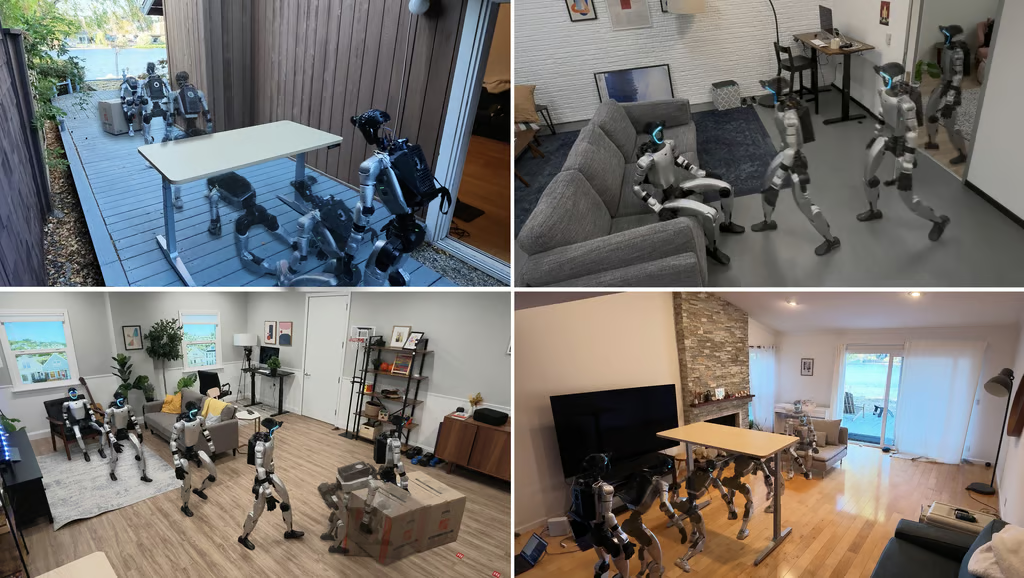
A Mac mini riding on a humanoid robot’s back is helping Apple test whether skills learned in simulation can survive an unfamiliar room.
Apple researchers have introduced HALO, an autonomous control system designed to help humanoid robots understand instructions, navigate unfamiliar environments and perform physical tasks without relying on pre-mapped spaces. The team detailed the technology in Perceptive Humanoid Motion from Simulation, a research preprint posted on arXiv on Nov. 4.
The researchers tested HALO on Unitree Robotics' G1 humanoid robot, which achieved a reported average single-task success rate of 91% across 360 trials in six real-world environments. Unlike robots that depend on preprogrammed movements or detailed environmental maps, HALO uses visual information and learned motion patterns to respond to changing surroundings. Demonstrations show the robot pushing boxes, following people, sitting on chairs and maneuvering through narrow openings.
The results offer a look at Apple’s robotics research within the broader push into physical AI, although the company has not announced a commercial humanoid robot.
A Mac mini powers the robot's intelligence
HALO uses a three-layer architecture to coordinate decision-making and physical movement. The first layer interprets natural-language instructions and breaks them into smaller tasks. It runs Qwen3.6-35B-A3B locally on a Mac mini M4 Pro with 64GB of unified memory.
The second layer uses a Qwen3.5-2B vision-language encoder and a diffusion transformer to generate whole-body movement plans covering approximately five seconds. It updates those plans roughly three times per second.
A third layer runs on the G1's Nvidia Jetson Orin NX processor, tracking movements and issuing joint-level commands 50 times per second. The robot also carries an OAK-1W camera mounted on its head. The Mac mini and Jetson communicate over onboard gigabit Ethernet. HALO’s default configuration runs without internet access, although optional cloud-model orchestration requires connectivity.
Simulation helps HALO learn before entering real homes
Rather than collecting thousands of hours of human-operated robot demonstrations, Apple's researchers generated approximately 300 hours of training data across 1,000 procedurally created simulated homes.
The process took about 48 hours using 250 Nvidia H100 GPUs. The motion generator was trained using 64 B200 GPUs, while the motion tracker used four H100 GPUs. The approach allows researchers to create diverse training environments without physically constructing or scanning each location.
However, performance becomes less consistent when HALO must combine several actions. Individual-task testing averaged 91% success across 360 trials in six real-world environments. A separate evaluation of three composite task sequences averaged 70%, based on 10 trials per sequence in one environment. A sequence involving crouching, walking toward a box and pushing it succeeded only 50% of the time.
The gap between individual skills and autonomy
The research also exposes several obstacles Apple must overcome before this technology can support more demanding applications.
The researchers found that HALO still needs humans to define new tasks through written instructions and designed movement sequences. Its reliance on visual perception also makes it difficult to handle objects that become obscured or move outside the camera's view.
Other limitations include a narrow connection between movement planning and execution, as well as a relatively basic task-orchestration system. The team identified tactile sensing and more advanced AI agents as potential improvements. These shortcomings matter because robots operating in homes, warehouses and factories must handle unexpected situations rather than simply repeat familiar movements.
What eWeek found: Training diversity matters, but autonomy remains limited
One of the most interesting findings in Apple’s paper is how much the diversity of simulated environments affects robot performance.
In a simulation experiment involving HALO’s sitting task, reducing its training environments from 1,000 to 100 lowered success from 84% to 81% and reducing them to 10 brought success down to 64%, while training in just one environment resulted in 43%.
This suggests that exposing robots to different environmental conditions could be more valuable than simply increasing the number of demonstrations involving similar surroundings.
The finding has implications for companies developing physical AI systems for enterprise environments. A warehouse robot, for example, must contend with different layouts, obstacles and object positions. A system trained primarily around predictable conditions could struggle when deployed at another facility.
Apple's approach also demonstrates that meaningful robot intelligence does not necessarily require a data-center computer physically connected to every machine. HALO performs its higher-level reasoning on a Mac mini while leaving time-sensitive movement control to the robot's onboard processor.
However, its 70% composite-task success rate shows that reliable individual movements do not automatically translate into dependable autonomy. That distinction will matter to businesses considering humanoid robots for tasks where mistakes could damage equipment, interrupt operations or create safety risks.
For businesses evaluating humanoid robots, the next demonstration should answer three practical questions:
- Does performance transfer? Ask for testing across unfamiliar layouts, lighting conditions, and object positions.
- Can the robot complete the workflow? Evaluate entire task sequences, including recovery after a missed step.
- What resources does deployment require? Separate the computing needed to train the system from the hardware and connectivity needed to operate it.
For now, HALO offers a research direction rather than a purchasing case. Businesses still need evidence that a robot can complete their workflows consistently under the conditions it will encounter.
Read more: HALO’s onboard computing highlights the appeal of running AI locally. Explore how Apple’s Mac Studio targets larger local AI workloads.