







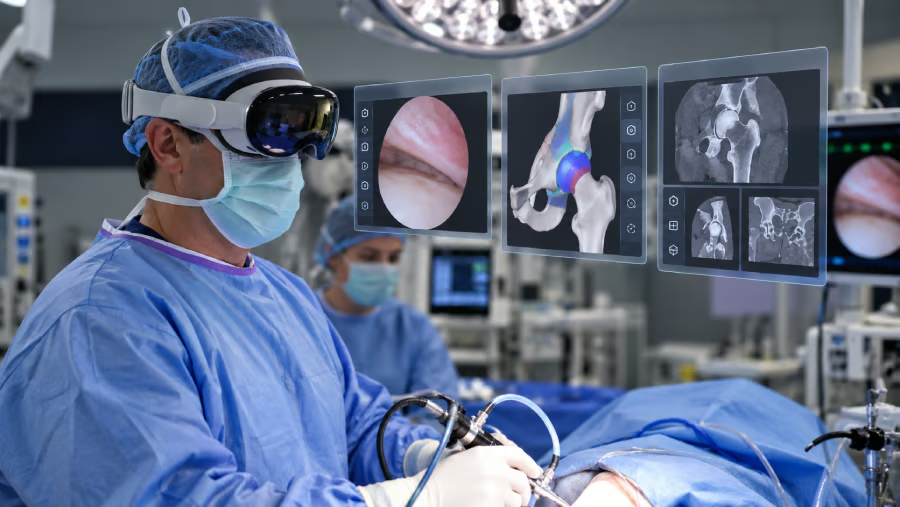
Apple Vision Pro made its way into a Duke Health operating room, where a surgeon used it to keep imaging and planning tools directly in view during a hip arthroscopy.
Stryker’s SportSuite Vision app gave orthopedic surgeon Chad Mather III access to arthroscopic video, CT imaging, and surgical planning tools while he could still see the patient and operating room. Stryker received FDA De Novo authorization for the software on July 17 and says SportSuite Vision is the first app authorized for intraoperative use with Apple Vision Pro.
The headset did not perform the procedure or replace the surgical systems already in use. SportSuite Vision instead changed where the surgeon could see and arrange information from those systems.
Surgical data moves into the surgeon’s field of view
Arthroscopic procedures can require surgeons to reference several displays positioned around an operating room. Stryker designed SportSuite Vision to bring multiple sources of information into Apple Vision Pro and let surgeons position them within their visual space.
The app uses video see-through technology so surgeons can keep seeing the operating room while accessing the arthroscope feed, HipCheck, HipMap, and CT scans. Stryker says surgeons can also adjust the placement and orientation of those virtual displays without being limited by fixed monitors, room dimensions, equipment, or other physical constraints.
“Using spatial computing enabled me to customize the placement of key clinical information to fit my workflow and access it within the sterile field. He added that the setup created a more comfortable and streamlined operating room while keeping needed information in view,” Mather said, according to Engadget.
FDA authorization puts the app into clinical use
9to5Mac noted that the Duke procedure marked the first completed surgery using SportSuite Vision. Its July 17 FDA De Novo authorization also made it the first application Stryker says is authorized for intraoperative use with Vision Pro.
Vision Pro itself is not entirely new to surgery. AppleInsider pointed to previous uses of the headset in healthcare, including hundreds of cataract procedures, as well as surgeon feedback citing improvements in ergonomics and workload.
The Duke case is different because SportSuite Vision was built specifically to bring multiple surgical information sources together inside the surgeon’s field of view.
Vision Pro is finding other roles in healthcare
Healthcare organizations are also experimenting with Vision Pro outside the operating room.
Pfizer worked with Groove Jones on an immersive mixed-reality oncology experience for patients, healthcare providers, and internal stakeholders. The experience uses Vision Pro to place users inside a virtual laboratory, where they can interact with scientific content and explore how antibody-drug conjugates work.
Pfizer’s project is not an intraoperative application, but it shows another way healthcare companies are testing spatial computing as an interface for complex medical information.
What eWeek found
In healthcare, Vision Pro may be most useful as a new way to access and interact with medical information rather than as a replacement for existing tools.
SportSuite Vision brings existing imaging and planning tools into a surgeon-controlled visual workspace. Pfizer’s experience takes a different approach, using spatial computing to make medical concepts interactive and easier to explore.
The Duke procedure carries more weight for clinical adoption because SportSuite Vision has FDA authorization for intraoperative use. Still, the available sources do not show that the headset improves patient outcomes, reduces procedure times, or lowers operating costs.
The clearest benefit demonstrated so far is workflow. Instead of asking surgeons to arrange themselves around several physical displays, SportSuite Vision lets them bring multiple data sources into their own field of view.
Apple’s health ambitions go beyond Vision Pro. See how it’s competing with Samsung to turn glucose data into AI-powered health advice.