







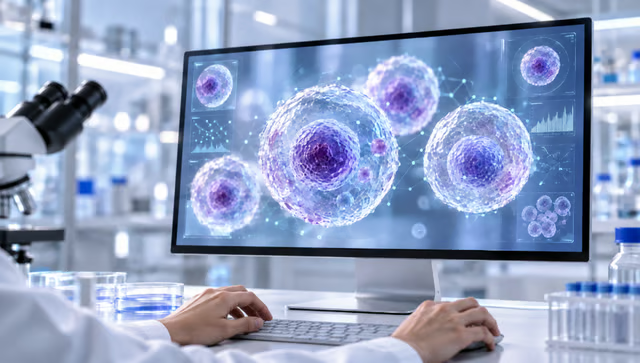
Biohub science head Alex Rives says existing datasets cover hundreds of millions of cells, while accurate AI “virtual cells” may require data from billions and eventually trillions. Google and Meta are joining a $1.8 billion effort to bridge that gap.
On Oct. 7, Biohub, the nonprofit founded by Mark Zuckerberg and Priscilla Chan, announced new government and technology partners expanding its Virtual Biology Initiative. The plan is to create standardized biological datasets for AI models that could predict how cells respond to drugs or changes in their environment. Scientists could eventually test ideas digitally before spending time and money in the laboratory, but the announcement does not present a completed universal virtual-cell model.
The $1.8 billion behind Biohub’s virtual cell project
Reuters reported that the initiative mixes new investment with research resources funded previously. Google DeepMind, Meta, and Isomorphic Labs are investing $300 million collectively, not $300 million each.
Contributor | Commitment | Role |
| Biohub | $500 million pledged in April | $400 million for measurement technologies; $100 million for external research |
| Google DeepMind, Meta, Isomorphic Labs | $300 million combined | Private investment |
| US Department of Energy | More than $500 million over five years | Measurement, modeling and computing |
| National Institutes of Health | Resources from over $500 million in earlier funding | Existing datasets and repositories |
The NIH contribution is not newly pledged cash. DOE spending also spans five years, making the $1.8 billion figure a combination of funding and existing assets.
Building virtual cells starts with real biological data
A virtual cell would use measurements from real experiments to predict how a cell responds to an intervention. The Verge noted that Biohub hopes this will let scientists investigate biological questions digitally and select promising experiments to run in the lab.
Measuring living cells at scale
Researchers will collect data using spatial transcriptomics, which maps molecular activity inside tissue, and screens that measure cellular responses. Interesting Engineering described additional tools, including cryo-electron tomography and microscopy systems intended to image millions or billions of cells.
The Department of Energy will contribute national-laboratory capabilities such as exascale computing and imaging equipment. NVIDIA is providing accelerated computing and technical support. Biohub plans shared standards so labs can combine their measurements into usable training datasets.
Training AI to predict cell behavior
Collecting more data is only part of the challenge. Researchers must also check whether models correctly predict cellular responses in experiments they were not trained on.
Axios highlighted a further uncertainty: nobody yet knows whether whole-cell models will improve predictably as biological datasets grow, as some other AI models have. It cited aging, regeneration and Alzheimer's disease as longer-term questions predictive cells might help investigate. Much of the missing training data must first be generated through physical experiments.
What eWeek found: Accuracy is the test that matters
The $1.8 billion headline combines new commitments with existing scientific resources, rather than representing entirely new cash. For biotech companies and research teams, the milestone to watch is whether these models can predict cellular responses in experiments they were not trained on. Commercial partners’ early data access could give them a research head start, but access alone does not establish predictive accuracy. Until laboratory tests validate those predictions, faster drug development remains a goal rather than a demonstrated benefit.
The datasets will eventually become public, but commercial partners will get early access. Axios reported that companies funding the research will have one year of exclusive access to the data they help generate.
Biohub also said that the arrangement encourages private investment while keeping the research available to the scientific community in the long term. Reuters noted that government-funded work will not face the same restriction.
Biohub expects its first dataset in about a year
Rives told Reuters that he expects a first dataset in about a year and accurate predictive models within five years. Those are research expectations rather than guaranteed delivery dates. Researchers will need to test whether models trained on the data accurately predict cellular responses in new experiments.
The early results should give scientists a better idea of whether the approach can work at a larger scale. Laboratory experiments will still be necessary to verify the models' predictions, but reliable results could eventually help researchers identify promising treatments and investigate diseases more efficiently.
Read more: While virtual cells remain a research goal, Oracle’s Clinical AI Agent is expanding into medical coding and chart review, showing how AI is being applied to healthcare workflows.