







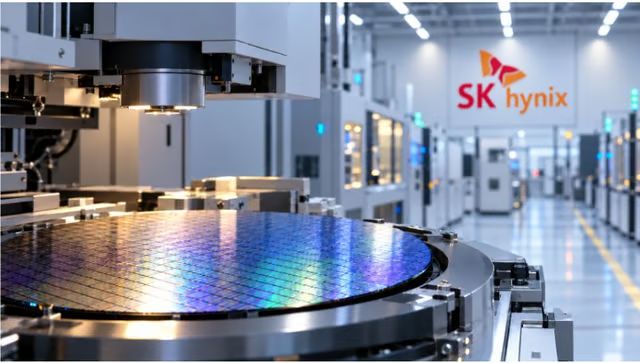
SK Hynix’s proposed US NAND factory could hinge on equipment approvals for its Chinese operations. Reuters reported that its Solidigm unit is linking the project to Washington’s approval of additional American chipmaking tools for Dalian, China.
The request puts Solidigm in the middle of US export controls. The Bureau of Industry and Security (BIS) has said it intends to approve licenses supporting existing operations at affected Chinese fabs, but not capacity expansion or technology upgrades. Reuters reported that more Dalian output could help fund the proposed US factory, while SK Hynix denied that it is seeking a capacity expansion.
For APAC businesses, the outcome matters because Dalian produces NAND for data-center SSDs, while any new US capacity would take years to come online.
Solidigm seeks more equipment for Dalian before a US buildout
Reuters reported that Solidigm had applied for export licenses to install additional tools in Dalian’s Mod B, where part of the production space remains unequipped after a memory-market downturn.
One source said higher Chinese production could help fund the proposed US NAND plant and provide supply before American production starts.
SK Hynix denied that the request was meant to expand capacity at Mod B and said equipment installation was being carried out under US authorization. Solidigm declined to comment, and the Commerce Department did not respond to Reuters.
US export rules make the Dalian request the key hurdle
Washington restricts chipmaking equipment exports to China to limit advanced semiconductor development. In 2025, the Bureau of Industry and Security said it intended to license shipments needed to keep existing Chinese factories running, but not equipment for capacity expansion or technology upgrades.
According to Reuters, Dalian received a quantity-limited license for 2026. A source said approval for additional US equipment and technology in 2027 had not yet been issued.
The key issue is whether Washington views the requested tools as supporting existing operations or expanding production capacity. The available statements do not establish how US officials will classify the request.
What eWeek found: Financing options do not resolve the licensing question
Under the proposal described by Reuters, higher production in China could help pay for a future NAND factory in the US. Washington would still have to approve the requested equipment, while Solidigm would still need to commit to the American project.
In an Oct. 1 statement, SK Hynix said Solidigm’s financing arrangements remained undecided and discussed internal and external capital. Those choices would be evaluated alongside the company’s broader investment priorities, which include other chip investments.
The statement addresses Solidigm’s broader capital needs, rather than financing arrangements for this particular US factory. It therefore does not establish whether another funding source could replace the role Reuters’ sources attributed to higher Dalian production.
Financing and export authorization also remain separate decisions. Access to capital would not itself authorize equipment shipments to China, while equipment approval would not establish a final US factory commitment or production schedule.
Project | What is known | What is still unclear |
| Dalian Mod B | Solidigm requested approval for additional chipmaking equipment. SK Hynix said the request is not intended to expand capacity. | US approval for the additional equipment and its potential effect on output. |
| US NAND factory | Reuters’ sources said approval for additional equipment in Dalian could affect Solidigm’s decision to build the US factory. | Solidigm’s final commitment, factory location, financing, and production timeline. |
| Solidigm funding | SK Hynix said internal and external financing remain under consideration. | Whether the broader financing options would support the proposed US factory, and what role Dalian production could play. |
Why a US factory would not immediately ease SSD supply
TrendForce described strong data-center SSD demand and slow growth in production capacity. It also noted that new factories take time to ramp up, without assessing Dalian specifically.
For APAC companies planning AI chip deployments, server upgrades, or cloud storage expansion, a US factory announcement would not immediately mean more drives are available. Buyers still need to confirm:
- Availability: How much enterprise SSD capacity can suppliers commit to?
- Delivery: Which shipment dates are firm, and which depend on future production?
- Pricing: How long are current quotes valid?
The reports do not show that existing orders have been disrupted or that the talks will lower prices. What happens next depends on whether Washington approves more equipment for Dalian and whether Solidigm moves ahead with the US factory.
The broader issue is how export controls shape investment across an interconnected chip supply chain. For enterprise storage buyers, the milestones to watch are equipment approvals, a firm factory commitment, and a credible production schedule.
Also read: SK Hynix isn’t the only chipmaker reshaping its manufacturing footprint. Vietnam’s $101 billion electronics boom is fueling its push into AI, chips, and robotics as Asian markets compete for semiconductor investment.