







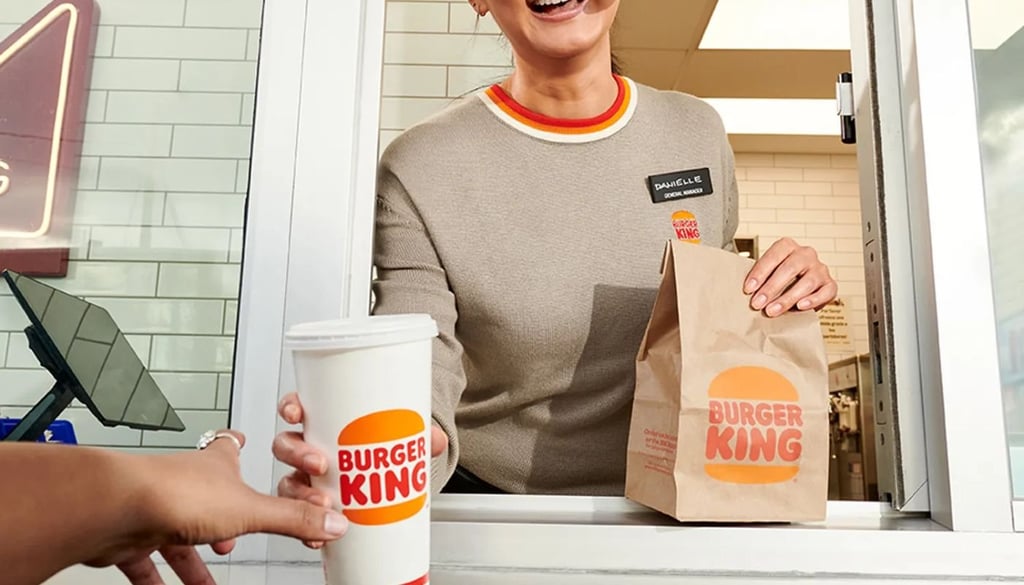
Burger King has quietly slipped artificial intelligence into its headsets along with the lunch rush.
The fast-food chain is experimenting with a new generation of AI tools inside its restaurants that will act as a sort of digital coworker for employees. The company has begun testing AI-powered headsets for its workers, which can offer coaching, monitor restaurant operations, and even track staff politeness during customer interactions.
The pilot program, now running in about 500 US restaurants, pivots on an AI assistant called “Patty.”
A new AI coworker in the kitchen
Patty functions as a real-time digital assistant, designed to streamline daily restaurant operations. During a typical shift, workers can ask the AI how to prepare menu items, get reminders about equipment cleaning procedures, or check ingredient requirements.
For example:
- If a drink machine starts running low on Sprite, Patty can alert a manager, allowing staff to address the issue quickly.
- If a customer reports a dirty restroom through a QR code feedback system, the AI can immediately send a notification.
- If an ingredient runs out, managers can instruct Patty to automatically pull items from digital menus, ensuring consistency across ordering platforms to prevent orders that kitchens can’t fulfill.
According to company executives, the assistant integrates data from kitchen equipment, inventory systems, drive-thru interactions, and cloud-based point-of-sale software, enabling restaurants to respond quickly to operational issues.
Essentially, Patty works to ease operations and improve customer satisfaction. After all, reducing operational chaos is a common challenge in fast-food environments where high turnover and fast-paced service meet.
Burger King says Patty is part of a broader platform called BK Assistant, which it plans to roll out to all U.S. locations by the end of 2026.
Measuring and managing hospitality friendliness
While Patty sounds like a great addition to food service on paper, one feature has caused controversy: Patty’s ability to evaluate customer interactions.
The AI solution has been trained to recognize keywords and phrases associated with friendly hospitality, such as “welcome,” “please,” and “thank you.” Managers can then review aggregated insights showing how often staff use such language during customer interactions, as well as summaries of overall service trends at a location.
Burger King insists the feature is intended for coaching, not surveillance. The company maintains that the system isn’t designed to grade individual employees or enforce rigid scripts, but rather to give managers broader insights into how teams interact with guests.
Executives say hospitality remains “fundamentally human,” arguing the tool allows employees to maintain focus on guests rather than operational management.
Still, the idea of AI listening in on workplace conversations has triggered strong reactions online. Some observers see it as a natural evolution of customer-service monitoring, noting that call centers and drive-thru conversations have long been recorded for training purposes.
Meanwhile, others worry that having AI analyze workplace conversations crosses a line, raising questions about whether speech-recognition systems can fairly interpret tone, context, and regional speech differences, longstanding challenges for AI audio analysis tools.
The fast-food AI race
Burger King isn’t the only restaurant incorporating AI into their operations. The company’s experiment exemplifies a wider transformation underway across the fast-food restaurant industry, where major chains are investing in automation tools to improve efficiency, reduce costs, and standardize customer experiences.
Yum Brands, the parent company of KFC, Taco Bell, and Pizza Hut, announced a partnership with Nvidia to develop AI-powered restaurant technologies just last year. McDonald’s has also continued pursuing new AI initiatives after ending an earlier automated drive-thru partnership with IBM in 2024 and shifting toward new AI initiatives developed with Google.
Whereas some workplace automation efforts have felt like replacing real workers, Burger King’s headset strategy positions its AI as an operational assistant embedded alongside employees rather than as a fully autonomous system.
Still, executives have acknowledged that fully AI-operated drive-thrus remain a “risky bet.” Company leaders have indicated they remain cautious about fully automated AI-driven drive-thrus, as many customers remain uncomfortable interacting directly with machines. Trust in AI is growing, but over half of Americans (57%) rate the societal risks of AI as high, compared with 25% who rate the benefits of AI as high, according to the Pew Research Center.
Current drive-thru AI tests remain limited to fewer than 100 locations.
What comes next for AI-managed workplaces
The new initiative is more than just a growing trend in fast food, as AI systems in service-industry areas have increasingly been acting as digital supervisors, coaches, and workflow managers. AI is increasingly moving beyond customer-facing chatbots to employee workflows, acting as a real-time trainer, operations manager, and performance coach all in one.
Burger King says the technology is meant to support staff by providing real-time guidance and operational insights, allowing employees to stay focused on guests rather than troubleshooting equipment or inventory issues.
On the other hand, the monitoring features have already sparked criticism online, with some describing the technology as intrusive and questioning whether AI systems can accurately judge tone or friendliness, concerns highlighted in early reactions reported by the BBC.
For now, Burger King is framing the technology as a way to strengthen human hospitality, not replace it. Whether workers embrace an invisible AI teammate listening in on every order may determine how quickly similar systems spread across restaurants, retail stores, and other frontline workplaces.
For a taste of how powerful and speedy next-gen AI tools are shaping both creative and operational workflows, check out Google’s freshly launched Nano Banana 2 image model.