







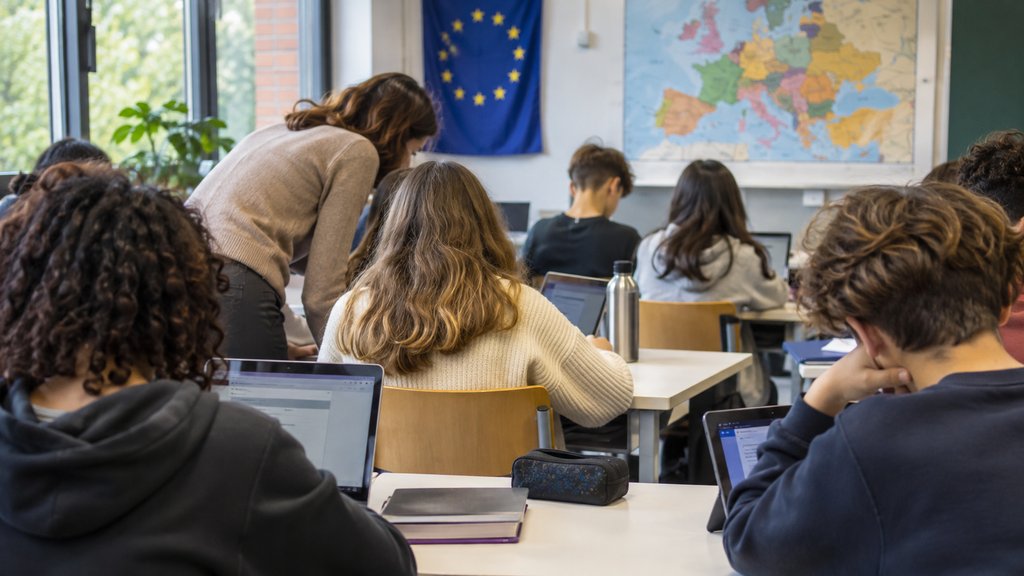
Students across Europe are using AI for homework faster than schools are teaching them how to use it. New research cited by OpenAI found that 79% of surveyed teenagers had used AI for assignments, but just 47% said someone had shown them how.
The findings appear in OpenAI's Nov. 10 report on responsible AI in education across Europe, the Middle East, and Africa (EMEA). The company argues that providing AI tools isn't enough: schools also need teacher training, clear rules, and ways to measure whether the technology improves learning.
OpenAI is working with education systems in Estonia, Slovakia, Greece, and Italy. Its report describes early progress but acknowledges that classroom adoption and reported time savings don't establish better educational outcomes.
OpenAI research finds students lack guidance on AI use
The OpenAI education report draws on ThinkYoung research covering 5,000 secondary students ages 13–19 across 10 European countries. The broader ThinkYoung study includes 600 teachers and research across 12 EMEA countries.
The findings suggest schools are struggling to keep guidance aligned with students' existing AI use.
Teachers face a related challenge. The OECD's Education Policy Outlook 2024 found that governments generally placed less emphasis on AI-supported professional development for teachers than on AI applications for students.
That imbalance appears in the education technology market, too. Fewer than 5% of Europe's 200 most-promising EdTech startups in 2024 focused on teacher support, according to HolonIQ data cited by the OECD.
OpenAI's report describes several approaches countries are taking:
- Estonia: Its AI Leap initiative combines ChatGPT access with teacher training, professional learning communities, and subject-specific resources.
- Greece: A May 2026 framework establishes requirements for teacher oversight, data protection, assessments, and AI coordinators in participating secondary schools.
- Slovakia: Education officials are working with universities and technical partners to develop teacher competencies and integrate AI into professional standards.
- Italy: OpenAI identifies education partnerships focused on AI literacy and local implementation, although the report provides less detail about measurable outcomes.
These efforts reflect a broader push to equip teachers with practical AI skills. OpenAI previously introduced ChatGPT for Teachers, while Anthropic launched its own AI assistant for educators through an international training partnership.
The initiatives differ in scope, but all recognize that access to AI software must be accompanied by training.
What eWeek found: AI adoption is ahead of evidence on learning outcomes
OpenAI's report provides specific examples of adoption, but the evidence for improved learning remains limited.
In Estonia, 794 of 828 teachers responding to a survey reported using AI professionally. Separately, 723 teachers estimated average time savings of 1.8 hours per week.
Those figures describe reported usage and efficiency, not independently demonstrated improvements in student achievement.
OpenAI also cites a Stanford review that found only 20 high-quality causal studies among more than 800 papers on AI in K-12 education available in its repository as of October 2025.
For schools considering AI deployments, several priorities emerge:
- Train teachers before expanding access. Cover verification, privacy, AI limitations, and appropriate classroom use.
- Define acceptable student use. Explain when AI assistance is permitted and when independent work is required.
- Protect teacher oversight. Keep educators responsible for instructional and assessment decisions.
- Measure learning outcomes. Evaluate comprehension, independent reasoning, and retention rather than relying on adoption statistics.
Privacy also requires attention. Microsoft's recent agreement on school data demonstrates how education providers are beginning to address AI training, student information, and institutional safeguards through contractual protections.
OpenAI recommends that governments fund ongoing professional development and commission independent research capable of identifying both successful and unsuccessful approaches.
The company's findings support a defined guidance gap among surveyed students, but they don't establish how effective individual national programs will be.
For education leaders, the next test is whether teacher preparation and clear classroom policies translate into better learning, rather than simply more AI usage.
Want to learn more AI tips, tricks, and prompting techniques? eWeek readers get free 7-day access to The Neuron Academy, our practical learning platform designed to help professionals use AI more confidently at work. Browse all lessons →
Let us teach you How to Talk to AI for free! Try our six-minute course at The Neuron Academy and learn a few simple ways to write better prompts and get more useful results from AI, or browse our other AI course for free for seven days. Check out all the lessons here →