







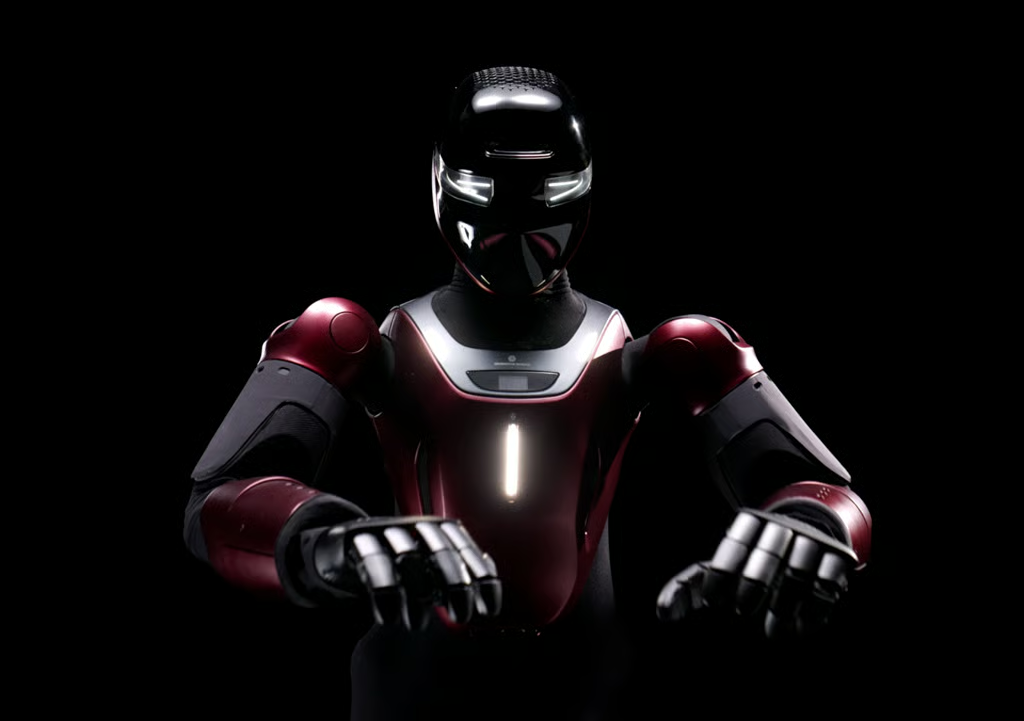
Italian robotics startup Generative Bionics has introduced Gene.01, a humanoid robot platform that combines full-body tactile sensing with what the company calls physics-native AI, aiming to make robots safer and easier to deploy alongside human workers in industrial settings.
The company said it built the platform in six months and is positioning it as a customizable foundation for industrial robots rather than a one-size-fits-all humanoid.
Gene.01 will make its US debut at AMD Advancing AI 2026 after first being revealed in Italy.
"Unlike other one-size fits all humanoids, Gene.01 is a scalable platform, customized at the edge of AI, design and end-effector level to maximize each customer's needs," said Daniele Pucci, CEO of Generative Bionics. "It is also the first expression of our belief that Physical AI must be human-aware, physics-native and industrial from day one."
Smart skin goes beyond cameras
Gene.01's standout feature is its distributed smart skin, which can detect touch, proximity, force, and temperature across its body. Generative Bionics said those sensors allow the robot to recognize nearby people before and during physical contact, improving safety when humans and robots share the same workspace.
The force-sensing system also lets workers teach tasks by physically guiding the robot while demonstrating how much force to apply. That could help with jobs such as gripping or handling objects, where camera-based learning alone often struggles to understand the physical forces involved.
The robot runs on the company's proprietary physics-native AI, which jointly optimizes the robot's mechanics, sensing, hardware, and motion instead of treating them as separate systems. Generative Bionics said the approach builds on research published in Nature Machine Intelligence describing a human-aware embodied intelligence framework developed through the ergoCub project.
Built as an open platform
Generative Bionics is also releasing Gene.01's digital twin as open source through software ecosystems already used by robotics developers, including PyPI, conda-forge, and the official ROS build farm.
The company said developers can install the robot model directly into existing robotics, AI, and simulation environments, allowing them to test applications before physical hardware is deployed.
Rather than selling a single humanoid design, Generative Bionics plans to customize Gene.01 by adapting its AI, external design, and end effectors such as hands and feet for different industries, including manufacturing, logistics, healthcare, inspection, and public safety.
Its first industrial deployment is being developed with Italian shipbuilder Fincantieri, where the platform is being adapted into a welding robot for shipyard operations.
Tactile data's uncharted horizon
While full-body tactile sensing solves fundamental safety and force-demonstration problems, it introduces an implicit friction point: data management. Processing continuous, multi-point tactile data across an entire robot body creates significant bandwidth and onboard computational demands compared to processing standard camera feeds.
Additionally, soft, sensorized external skins deployed in harsh, real-world industrial environments such as shipyards filled with flying welding sparks, heavy metal debris, and extreme temperatures face severe wear-and-tear risks. Maintaining sensor calibration over thousands of operational hours will remain a crucial test for the platform as it scales from trial runs to full factory deployment.
Check out our guide to the top factory humanoid robots, which compares Tesla Optimus, Figure AI, Apptronik Apollo, and other systems moving toward industrial work.