







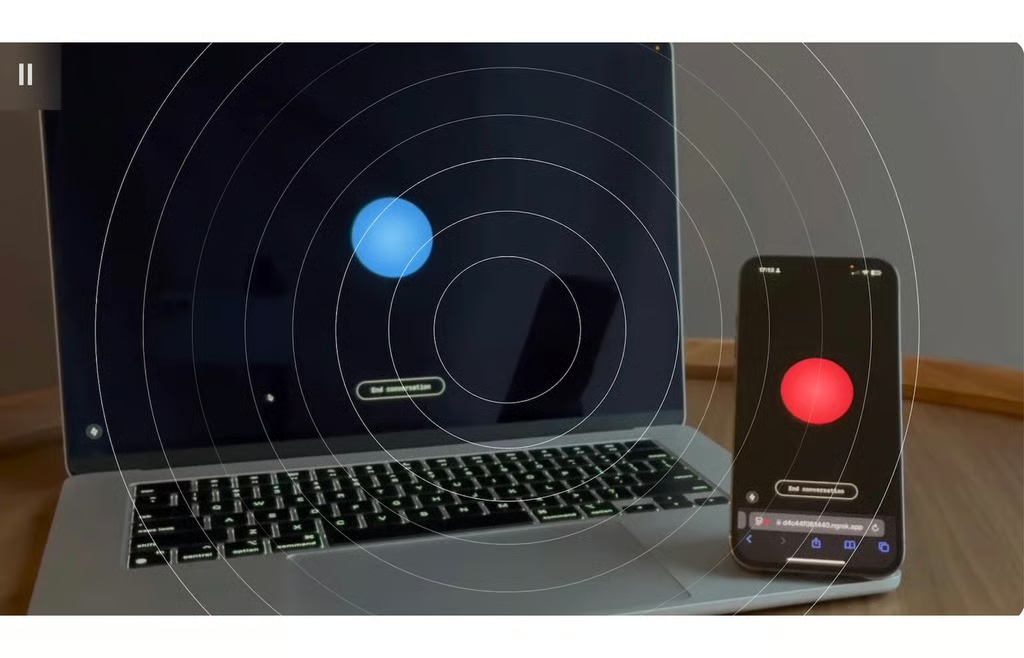
In a groundbreaking demonstration at the ElevenLabs London Hackathon, developers unveiled GibberLink, a novel protocol that enables AI voice assistants to communicate in a language optimized for machines rather than humans. By switching from traditional human-like speech to a hyper efficient, sound-based data transmission, GibberLink promises to reduce unnecessary computational load and pave the way for faster, error-proof interactions.
The birth of GibberLink
Developed by Boris Starkov and Anton Pidkuiko during the hackathon, GibberLink emerged from a simple yet revolutionary idea: If AI agents are handling routine tasks like booking a hotel or managing customer service, why waste resources replicating the inefficiencies of human conversation?
Using ElevenLabs’ cutting-edge conversational AI technology combined with the open-source ggwave library, the developers created a system where AI agents recognize when they’re speaking to another machine. Once this recognition kicks in, the agents instantly switch from natural language to a protocol that uses modulated sound waves — a method reminiscent of dial-up modem signals from the 1980s.
In the demo, one AI agent, acting as a customer seeking a hotel room for a wedding, began a conversation in human speech. Midway through the exchange, upon detecting that its conversation partner was also an AI, both agents transitioned to GibberLink mode. The communication then shifted to a series of structured audio tones that efficiently conveyed data without the overhead of generating natural language.
This change reduced the computational resources typically required for speech synthesis and promised a more error-resistant communication channel.
GibberLink’s efficiency and future implications of this AI innovation
The advantages of GibberLink extend far beyond novelty. By eliminating the need for human-like speech in AI-to-AI interactions, the protocol can significantly reduce compute costs, energy consumption, and latency. In an era where virtual assistants manage both inbound and outbound communications, this breakthrough could lead to substantial operational efficiencies.
Influential tech figures and major publications and prominent social media influencers like Marques Brownlee, have spotlighted the innovation, emphasizing its potential to reshape the dynamics of digital communication.
GibberLink’s open-source release on GitHub invites developers worldwide to explore, refine, and possibly integrate this technology into a range of applications — from smarter customer service bots to fully autonomous systems coordinating in real time. As artificial intelligence becomes an even more integral part of everyday technology, the ability for machines to “speak” in their own optimized language may soon become standard practice.
Explore our list of top AI companies dominating the AI landscape and stay up to date with the latest advancements in the field.