






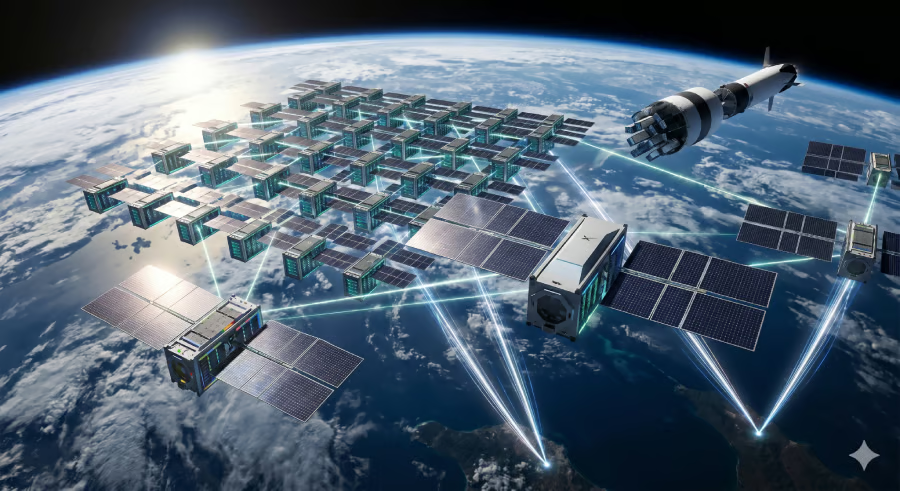


AI’s data center boom may be running out of room on Earth: Google is reportedly exploring a partnership with SpaceX to launch orbital data centers, as part of its ambitious moonshot Project Suncatcher.
The search giant revealed its moonshot late last year, which would involve solar-powered satellites packed tightly together and communicating via optical links. Data would be beamed down from these satellites to the ground, potentially at a much lower cost due to the availability of free solar energy.
Google said it planned to have a first prototype ready by next year to test how the technology would perform in low orbit. It has partnered with Planet Labs to build the satellites, and now appears to be tapping SpaceX to launch the payload, according to Bloomberg.
A new business segment of SpaceX: data centers
While SpaceX is a rival in the AI space, following the incorporation of xAI into the company in February, it is also the dominant launch provider for any serious orbital infrastructure project. It has also not been shy about working with rivals, recently inking an agreement with Anthropic to use its data centers.
The launch of orbital data centers was also one of the key points SpaceX CEO Elon Musk made when merging the two companies. In his assessment, SpaceX could launch these data centers at a much lower cost than competitors and reap the rewards of cheaper compute power. It could also sell data center capacity to others, similar to the service it provides with Starlink, but on an enterprise scale.
This could further elevate SpaceX’s valuation, which is reportedly expected to be set at $1.75 trillion at the time of IPO. It was last valued at $1.25 trillion at the time of the xAI merger.
Since November 2025, when Project Suncatcher was first announced, the hype surrounding AI has intensified, with recent model launches by Anthropic, OpenAI, and Meta all receiving praise for their sophistication. That, in turn, has led to more price speculation across the entire data center stack, making the value of off-world compute more appealing than it was even a few months ago.
Still, launching data centers into space is costly. In its original analysis, Google said it could see launch prices drop to $200 per kilogram by the mid-2030s, through advances in rocket reliability and reusability. And that is just getting them into space. Once there, keeping them online, avoiding radiation spikes, and repairing them could all add to maintenance costs.
Off-world, or off-land?
Google, SpaceX, and others are working through some of these kinks, and the first prototypes should provide a lot of data on the challenges ahead.
In the meantime, others are looking to the sea as another potential solution for data centers, as it removes land and cooling costs while potentially tapping another renewable energy source: wind. Offshore wind developer Aikido Technologies and Shanghai HiCloud Technology, backed by the Chinese government, are both working on prototypes.
The push toward off-world compute also comes as SpaceX deepens its footprint in the AI economy through deals closer to Earth, including its reported partnership talks with Cursor maker Anysphere.