






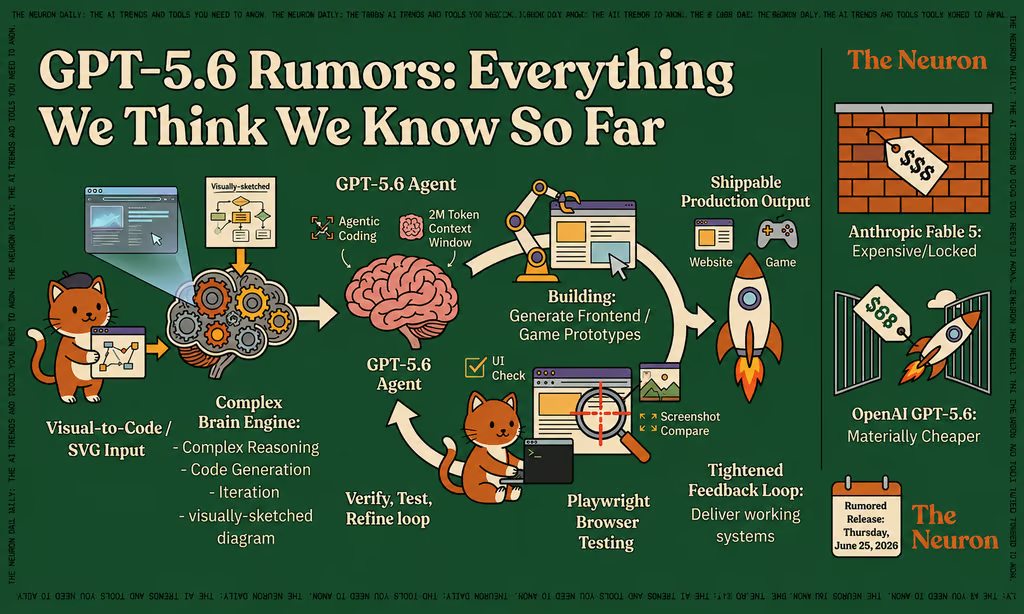


The next OpenAI model has not launched yet. But if the current GPT-5.6 rumors are even directionally right, the story is not simply “ChatGPT gets smarter.” We have had enough of that headline to power a small midwestern county.
The real story shaping up is arguably more important: OpenAI may be preparing a model tuned for the work people are actually trying to hand off now: coding agents, visual-to-code replication, frontend generation, game prototypes, long-context execution, and tool-driven verification.
As of Monday, June 22, 2026, OpenAI’s own docs still list GPT-5.5 as the latest flagship model, with GPT-5.5 positioned for “complex reasoning and coding,” a 1 million context window, Dec. 1, 2025, knowledge cutoff, and pricing of $5 per million input tokens and $30 per million output tokens. OpenAI’s pricing page also lists GPT-5.5 Pro, but no GPT-5.6 yet.
So, the rumor stack is unusually specific. That usually means we're either a) close to release, or b) that people don't know what the hell they're talking about. I'm leaning toward a, but some of these may well be more related to b.
The chatter points to a likely Thursday, June 25, 2026, release for GPT-5.6 and GPT-5.6 Pro, roughly 5x cheaper than Anthropic’s Fable 5, with up to a 2 million-token context window, stronger reasoning allocation, better agentic coding, better image-to-web replication, stronger SVG generation, improved frontend output, more stable game generation, and Playwright-style browser testing integrated more directly into ChatGPT.
That is a very particular wishlist. It is less “make the model know everything” and more “make the model ship things.”
The timing matters because OpenAI is no longer competing only on benchmark leaderboard theatrics. Anthropic’s Fable 5 has become the model people invoke when discussing high-end agentic capabilities and safety anxieties. Of course, that also comes with a giant caveat that it's entirely unavailable.
Meanwhile, China’s Z.ai just put pressure on the entire category with GLM-5.2, a model drawing attention for its open availability, strong coding capabilities, and a 1M-token context window. GLM-5.2’s 1 million context has framed itself as a serious challenger to closed U.S. frontier labs.
If GPT-5.6 really comes with 2M context, the headline will write itself. Twice the window, fewer dropped threads, more whole-codebase and whole-company-memory use cases. But context size by itself is a trap. A huge context window is only useful if the model can retrieve, prioritize, and act without getting lost in its own attic. Most haven't proven they can do that reliably yet.
That is why the agentic coding rumor is more interesting than the context rumor. GPT-5.5 works very well for code generation, particularly inside Codex. If GPT-5.6 improves long-horizon coding, tool selection, browser control, and self-checking, the win we hope for is fewer “almost done” outputs.
Anyone who has used coding agents knows the pain: the model can make a decent first pass, then wander during verification, miss a broken layout, fail to run the exact test that matters, or confidently hand you a frontend with one button floating in the emotional distance. This has gotten markedly better in recent models from both OpenAI and Anthropic.
The rumored Playwright integration is the quiet killer feature here. If ChatGPT can generate a UI, open it, inspect it, test flows, compare screenshots, and patch problems in a loop, then frontend generation becomes actual production assistance.
The visual rumors point in the same direction. Better vision and concept replication from images means “turn this screenshot into a working website” gets less goofy and meh. Stronger SVG generation means sharper diagrams, icons, product graphics, and 3D-ish interface assets without immediately punting to an image model. Better game generation with fewer visual glitches means agents are learning not just to write code, but to maintain coherent states across visual systems.
That is a bigger product shift than it sounds. The frontier is moving from language performance to environment performance. Can the model understand the task, operate the tools, review the result, identify what is wrong, and fix it? That is where builders and operators start caring less about raw IQ metaphors and more about whether the thing can finish Tuesday’s work.
There are reasons to stay skeptical. The rumored December 2025 knowledge cutoff is not a clear upgrade over GPT-5.5, because OpenAI’s official model page already lists GPT-5.5 with a Dec. 1, 2025, cutoff while GPT-5.4 sits at Aug. 31, 2025.
The rumored “reasoning juice” increase also needs to be translated. Bigger inference-time reasoning budgets can improve performance on hard tasks, but users usually experience this as a trade-off among quality, latency, and cost. More thinking is great until your agent spends $9 contemplating a dropdown.
The pricing rumor is the one that could change buyer behavior fastest. If GPT-5.6 is materially cheaper than Fable 5 while competitive on coding and design-to-code workflows, OpenAI would not need to win every benchmark. It would only need to be the model teams can afford to run all day.
That is the underappreciated part of the AI market right now: capability is only half the story. The model that wins inside companies is often the one that is good enough, cheap enough, integrated enough, and auditable enough. OpenAI has ChatGPT, Codex, the API, file tools, web tools, computer use, and a growing ecosystem around skills and agents.
As we've argued before in this guide, the real leverage comes when models stop being one-off chat partners and become reusable work systems.
That is why GPT-5.6, if these rumors hold, may be all about OpenAI tightening the loop between model, tools, browser, code, and visual feedback.
The best version of GPT-5.6 would answer a lot better. It would build, inspect, revise, and hand back something closer to done.
The worst version would be a larger context window with nicer vibes and the same ye olde “trust me bro” final answer.
Thursday, June 25, is the rumored date. Until OpenAI posts the actual release notes, treat every spec as provisional. But the direction of travel is clear: the frontier model fight is becoming a workflow fight. Not who can talk the smartest. Who can do the work, check the work, and make it cheap enough to repeat?
And yes, if the rumors are right, this week may indeed be very cool.
Editor’s note: This article originally appeared on our sister publication, The Neuron.