






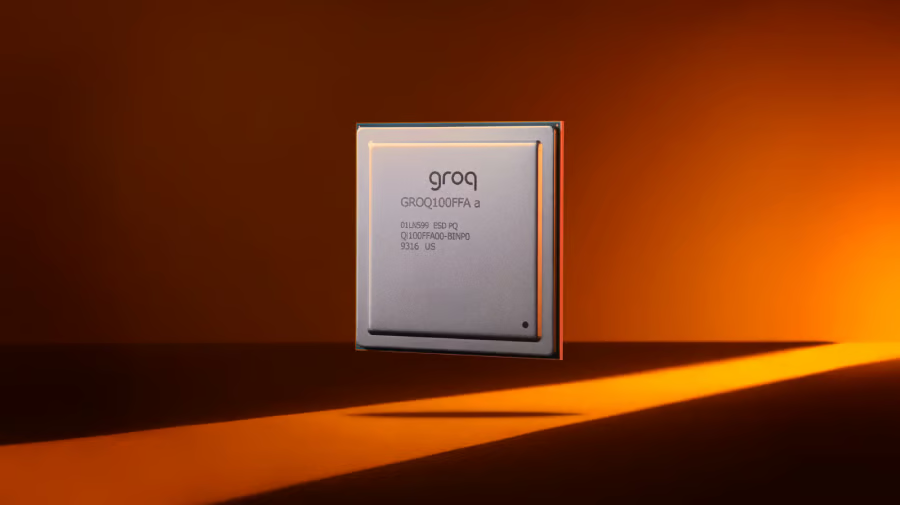


Groq is raising fresh capital for a bigger bet on AI inference.
The San Francisco AI infrastructure company confirmed a $650 million funding round on June 22 to expand its AI inference cloud, roughly six months after Nvidia signed a non-exclusive licensing agreement for Groq technology and hired away several key executives.
The raise puts Groq’s focus squarely on inference, the part of AI computing that runs models after they have been trained.
Groq shifts deeper into inference
Groq announced $650 million in growth capital to accelerate the expansion of its AI inference cloud. The round was led by Disruptive and Infinitum, with participation from investors.
The company said the funding will support the buildout of its global infrastructure, including 13 data centers across North America, Europe, the Middle East, and APAC. Groq highlighted that it serves more than five million developers and thousands of AI-native companies, processing trillions of AI tokens each week.
Groq also said it expects to scale toward 200 MW by the end of 2027.
Alex Davis, Groq chairman and Disruptive CEO, said in an announcement, “Groq has spent years building the technology, infrastructure, and operational expertise required for the next phase of AI.”
The funding comes after a major strategic reset. TechCrunch reported that Nvidia signed a non-exclusive licensing agreement for Groq’s technology in December and hired Groq founder and CEO Jonathan Ross, president Sunny Madra, and other employees. Groq did not disclose its new valuation.
The company was last valued at $6.9 billion after a $750 million round in September.
Inference becomes the prize
Groq’s pitch is that AI infrastructure is shifting from training large models to running them at scale.
Training is the expensive work of building models. Inference is what happens when users ask those models to generate answers, write code, summarize documents, or power real-time AI applications.
As companies transition AI from experiments to production, we anticipate a rapid increase in demand for inference.
Groq said inference will require an estimated 15 to 20 times as much compute as training over time.
“As AI moves from experimentation to production, demand for reliable, cost-efficient inference will continue to grow exponentially,” John Yetimoglu, Groq board member and founder and chief investment officer of Infinitum, said in the company announcement.
That is the market Groq is trying to own. The company said its current strategy began after the Nvidia agreement, when its board, investors, and management sharpened the business around building a leading AI inference cloud.
New leaders join after Nvidia deal
Groq is also rebuilding its leadership bench.
TechCrunch reported that Doug Wightman, who co-founded Groq with Ross, stayed with the company after the Nvidia deal.
Groq’s announcement listed Adam Winter as CEO and Matt Eng as CFO, describing both as long-standing leaders who have scaled the company’s technology, infrastructure footprint, and commercial operations. The company also named Alan Rice as chief operating officer. Rice previously worked at xAI and Meta Datacenters after a career in US Navy nuclear submarine operations.
Starting in July, Groq said it will add Sinclair Schuller as chief technology officer and Rakesh Malhotra as chief product officer. The two previously worked together at Apprenda and later co-founded Nuvalence, which EY acquired in 2024.
Malhotra also spent roughly a decade at Microsoft working on cloud, data center management, and enterprise storage products.
AI cloud competition keeps widening
Groq’s raise shows how much investor attention is moving toward inference as AI tools become everyday infrastructure.
However, the company still faces a difficult competitive environment. Nvidia now has a closer connection to Groq’s inference technology through the licensing deal. Nvidia announced its own Groq 3 LPX inference hardware system at GTC in March.
For Groq, the question is whether a focused inference cloud can stand out as AI companies, cloud providers, and chipmakers all race to lower costs and improve the speed of model execution. The new funding gives Groq more room to try.
It also reflects a bigger shift in AI infrastructure, where the next battleground may be who can run models quickly, reliably, and affordably for millions of users.
Read more: Amazon is reportedly in talks to sell its custom AI chips as demand for alternatives to Nvidia hardware grows.