







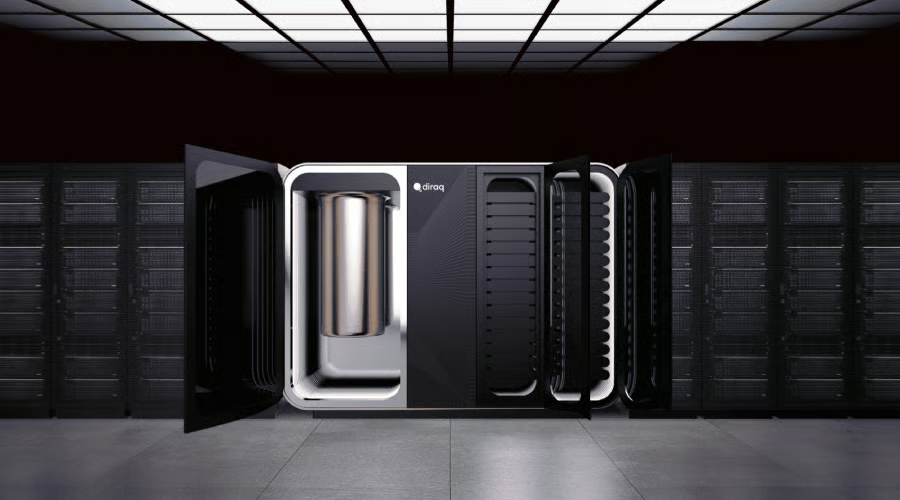
Quantum computers usually bring to mind specialized labs, not the same data centers running cloud and AI workloads. Diraq wants to see whether that separation can start to shrink.
The Australian quantum company plans to install an eight-qubit silicon-spin quantum computer at an Equinix data center in Sydney in October 2026. Diraq calls it the world’s first silicon-spin quantum computer to operate in a shared commercial data center. The project will test how quantum hardware works alongside the CPUs, GPUs, networks, and AI infrastructure enterprises already use.
For enterprises, the deployment could show whether quantum hardware can work within existing data-center operations instead of requiring a separate purpose-built environment.
Inside Diraq’s Sydney quantum deployment
Diraq said the system will contain an eight-qubit silicon chip along with self-contained cryogenic cooling and control electronics. The setup is designed to sit alongside conventional servers while drawing less than 20 kW of power.
The company also said future increases in qubit capacity could require only a replacement of the silicon chip rather than changes to the surrounding power, cooling, or rack infrastructure. Diraq manufactures its spin qubits using existing semiconductor foundries and sees that approach as a path toward much larger systems.
Diraq’s scaling ambitions remain forward-looking. The eight-qubit Sydney system will instead provide an opportunity to see how the technology performs under commercial data-center conditions.
Quantum moves closer to existing enterprise infrastructure
Quantum Computing Report noted that Diraq and Equinix plan to test network connectivity, remote monitoring, security, and interaction between the quantum processing unit and conventional CPU and GPU infrastructure.
Successful integration could support hybrid computing environments where quantum processors handle selected workloads alongside AI and classical systems. Enterprise adoption would also depend on whether quantum hardware can meet existing requirements for connectivity, security, and day-to-day infrastructure management.
“Quantum computing’s future depends not only on breakthroughs in hardware, but on proving how these systems can operate within the digital infrastructure enterprises rely on every day,” Equinix Australia Managing Director Jarrod Nink said, according to The Quantum Insider.
Sydney strengthens Australia’s quantum ambitions
Hosting the deployment in Sydney gives Australia an early opportunity to test quantum hardware inside commercial infrastructure rather than limiting experimentation to research facilities.
Equinix also framed the Sydney deployment as part of Australia’s broader effort to become a global hub for quantum innovation. After testing, Diraq plans to let industry partners and customers see the system in operation and explore potential applications at the Sydney facility, which already supports enterprise data sovereignty, security, and compliance requirements.
For APAC organizations considering future quantum applications, access to a commercially operated system in the region could provide a closer look at how the technology fits alongside existing cloud, AI, and high-performance computing environments.
What eWeek found
The eight-qubit processor gets the headline, but eWeek’s review of the deployment details points to the surrounding infrastructure as the more consequential part of the project.
Diraq is putting forward three practical claims: its cooling and control hardware can be self-contained, the system can operate on less than 20 kW, and future qubit upgrades could be handled by replacing the silicon chip instead of rebuilding the surrounding infrastructure.
Taken together, those features address a basic obstacle to moving quantum computing beyond specialized environments: how to install and operate the hardware alongside systems enterprises already run.
The October deployment will not prove that silicon-spin quantum computing is ready for widespread commercial adoption, nor will an eight-qubit system demonstrate the large-scale applications Diraq envisions. It should provide something more immediate: a real-world test of whether the company’s compact architecture works as described inside an operating commercial data center.
If Diraq can demonstrate that successfully in Sydney, the project could provide an early model for bringing quantum processors into the same infrastructure ecosystem already supporting AI, cloud, and high-performance computing.
AI is starting to play a bigger role in quantum computing. Here’s how Anthropic’s Claude helped automate the laser controls behind one system.