







The Philippines is positioning itself in a new segment of the global robotics industry after authorities registered a company planning what the Philippine Economic Zone Authority (PEZA) describes as the country's first physical AI data factory.
In a Sept. 30 announcement, PEZA identified Physical Intelligence Inc. (PII) of the Philippines as the company behind the proposed facility, which would generate, process, and customize robot motion datasets for international clients. The project could expand the country's role in artificial intelligence beyond traditional digital services and electronics manufacturing.
The development highlights a growing challenge for robotics companies: building machines is only part of the equation. Teaching them to perform useful tasks in unpredictable physical environments requires extensive real-world training data.
Philippines moves into the business of training robots
According to BusinessMirror's Sept. 21 report, PEZA registered PII as an economic zone information technology enterprise, establishing a regulatory foundation for the company's proposed physical AI data facility.
The planned operation would generate, process, curate, and customize robot-motion data for export. It is expected to use imported or locally sourced robots, robotics equipment, AI systems, and related technologies to produce datasets intended for physical AI applications.
PEZA describes the project as the first Philippine facility dedicated to processing and customizing this type of robotics data for international clients.
Unlike conventional AI systems that primarily analyze or generate digital information, physical AI involves machines interacting with their surroundings. Robots must learn to recognize objects, coordinate movements, manipulate equipment, and respond to changes in real-world conditions.
That makes training data particularly important. A robot performing repetitive tasks in a controlled factory may require different capabilities from one that navigates a warehouse, handles unfamiliar objects, or works alongside people.
If established, the Philippine facility could supply robot-motion datasets to developers working on physical AI applications, although its production capacity and commercial prospects remain unconfirmed.
For example, Nvidia, Unitree, and Sharpa have introduced a humanoid robot for physical AI research, highlighting efforts to improve how robots learn and execute tasks.
PEZA has not announced when PII's facility will begin operating. Its registration marks an initial step toward the project rather than confirmation that commercial data production has begun.
Philippines builds a broader robotics industry
The proposed data factory adds to a series of Philippine initiatives aimed at expanding the country's role in robotics and advanced manufacturing.
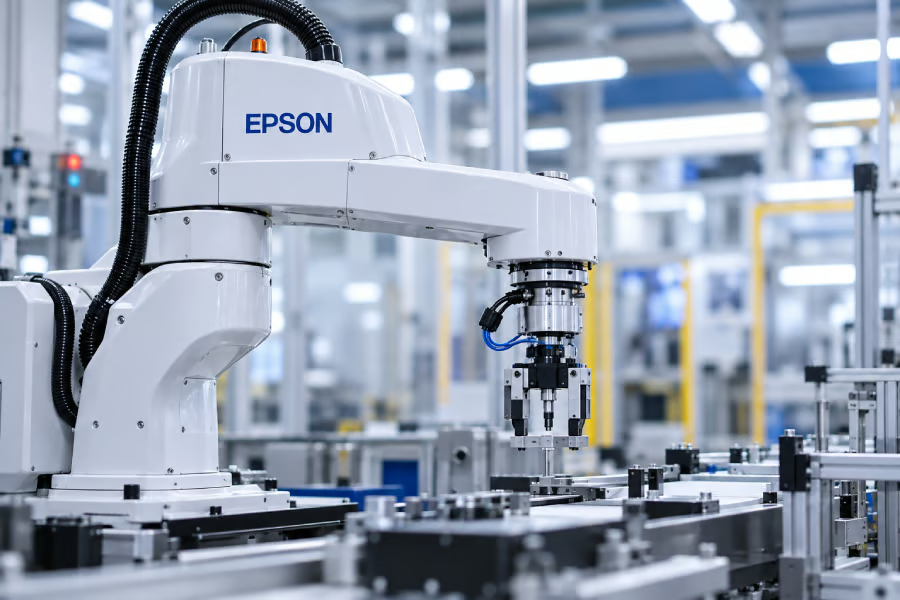
PEZA also registered an expansion project by Epson Precision Philippines in Batangas. The Japanese company's plans include manufacturing industrial robots, including SCARA and six-axis models, as well as components and replacement parts.
According to The Philippine Star, Epson's project involves an investment exceeding 40 million Philippine pesos. Commercial operations are scheduled to begin in March 2027, with approximately 118 jobs expected.
The two projects occupy different parts of the robotics supply chain. Epson's expansion concerns the production of robotic hardware, while PII's proposed operation focuses on generating and processing data for developing physical AI systems.
Other countries in the Asia-Pacific region are pursuing similar opportunities. In Singapore, the Punggol Digital District is scheduled to serve as a real-world testbed for physical AI later in 2026, with proposed applications including delivery, cleaning, and security.
Meanwhile, the Philippines has already demonstrated the potential of robotics in healthcare. According to Philippine health officials, surgeons performed robotic telesurgery between hospitals approximately 1,380 kilometers apart, demonstrating another application of robotics beyond traditional factory automation.
Together, these developments suggest that Southeast Asia is seeking a larger role in the development, manufacturing, and deployment of robotic systems.
What eWeek found: The Philippines is targeting a critical piece of the robotics industry
The Philippines' proposed physical AI data factory highlights an important shift in the global robotics race. As companies develop increasingly sophisticated machines, the data needed to train them is becoming a business opportunity of its own.
Three findings stand out:
- The Philippines is moving beyond traditional electronics manufacturing. While the country has an established role in electronics production, the planned facility would introduce a new capability: generating and processing motion data for training robotic AI systems.
- Robot training data could create a new opportunity. Physical AI developers need data showing how machines interact with real-world environments. Specialized facilities could help supply that information, although PII's ability to attract international customers and produce commercially useful datasets remains unproven.
- Southeast Asia is developing multiple parts of the robotics supply chain. The Philippine data factory proposal, Epson's industrial robotics expansion, and Singapore's physical AI testbeds illustrate how the region is pursuing opportunities in robot manufacturing, training, and deployment.
For robotics developers and enterprise technology leaders, the significance lies in the potential emergence of another regional source of physical AI training data. Whether that translates into faster development, lower costs, or more reliable robots will depend on the quality of the datasets and their performance in real-world applications.
What the physical AI data factory means for businesses and robotics developers
For companies developing robots, the Philippine project points to an increasingly important question: where will the data come from to make physical AI reliable enough for commercial use?
Large language models can learn from enormous collections of text and other digital information. Robots face a different challenge because their training must account for movement, physical contact, changing environments, and the consequences of their actions.
A dataset that captures how a robotic arm grips an object, for example, may help developers improve manipulation capabilities. But performance in one controlled environment does not necessarily translate into success with unfamiliar objects or different equipment. That creates opportunities for specialized data providers capable of collecting and organizing information from physical interactions.
For robotics developers and enterprise technology leaders, several considerations stand out:
- Data quality and compatibility: Training information must be relevant to the robot's hardware, sensors, and intended operating environment.
- Testing and reliability: Developers need evidence that models trained on collected data can perform safely and consistently outside controlled settings.
- Commercial readiness: Companies should distinguish planned data-production capacity from facilities that are already operating and supplying validated datasets.
If the facility becomes operational and produces high-quality datasets, it could provide robotics developers with an additional source of training information.
For manufacturers, logistics operators, and businesses evaluating automation, the distinction matters. Successful robotics deployment depends on hardware reliability, system integration, safety testing, and measurable operational benefits, not simply the availability of training data.
The development could also create opportunities for Philippine workers and technology suppliers involved in data processing, robotics operations, and related technical services. The scale of those opportunities remains uncertain until the project's staffing and operating plans become public.
Ultimately, the Philippines' move into physical AI data production reflects a broader shift in the robotics industry. As companies work to turn experimental machines into commercially useful systems, the infrastructure needed to train those machines may become increasingly valuable.
The next milestone will be whether PII moves from registration to an operating facility with customers, measurable production capabilities, and demonstrated applications. That will provide a clearer indication of how significant the Philippines' new role in physical AI could become.
Also read: For more on how training data and computing infrastructure are shaping robotics development, read how Figure AI committed $3.5 billion to expand its humanoid robot AI capabilities.