







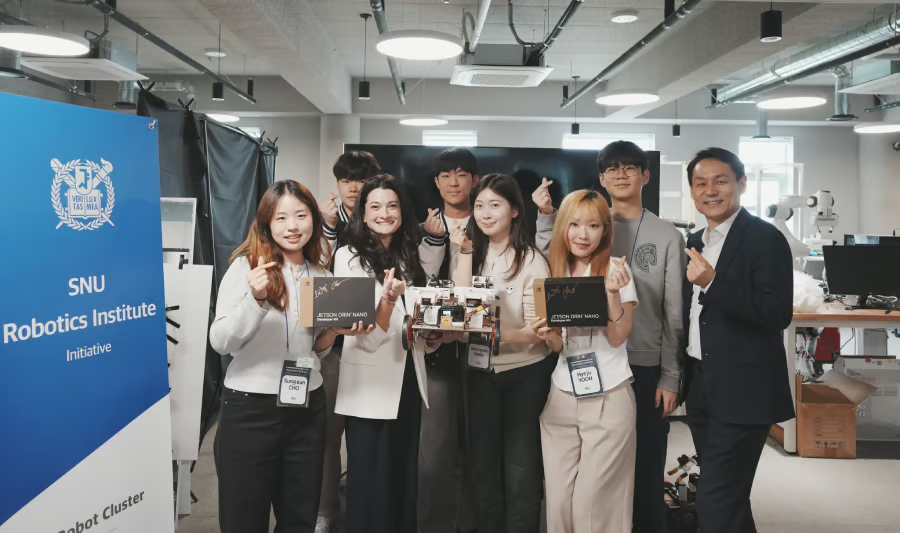
Seoul National University is building a robotics institute around a simple question: Can physical AI make the jump from lab demos to everyday use?
University officials formally opened the Robotics Institute on Aug. 18 at the Gwanak campus in Seoul. Long-term government support gives it time to pursue physical AI research well past the launch.
Researchers now have to prove whether combining robotics with medicine and commercialization can produce machines people will actually use.
Research gets a route outside campus
More than 80 professors are involved, and the institute also has its own technical staff. SNU Hospital is expected to support testing and training for wearable and medical projects.
Students are also meant to work on real robotic systems. Researchers pursuing commercial products can access startup and company-building support. Government backing gives those plans time to develop.
South Korea’s NRL 2.0 program can provide roughly 10 billion won ($7.2 million) annually for up to a decade. Cho Kyu-jin, the institute’s director, told Seoul Economic Daily that visits to Boston and Silicon Valley helped shape his view of how research, talent, and entrepreneurship could operate under one organization.
Intelligence moves closer to the robot
The university’s research plans focus on human-centered physical AI, including designing a robot’s body and intelligence as parts of the same system. One area is distributed intelligence, which lets parts of a robot process some information locally instead of routing every decision through one central system.
Local processing could reduce delays as machines respond to changing surroundings. Similar work across physical AI development tackles a basic challenge. Software can perform well on a screen, while robots have to sense and react in real spaces.
Planned applications include companion robots, wearable systems, and machines intended for diagnosis or treatment inside the body. Progress will still depend heavily on hardware, including robotic hands capable of precise control.
Students and companies need proof outside the lab
South Korean students considering robotics should focus on access, not faculty headcount. Ask whether courses cross departments and whether student prototypes reach clinical or industrial testing environments.
Manufacturers and hospitals should judge the institute by deployment. Bring operations teams into pilot discussions early and find out how prototypes perform around existing workflows. Recent multi-robot warehouse trials in the country offer one example of the complications that appear once robots leave controlled demonstrations.
Employers should involve workers early as well. Hyundai employees have already sought protections around future humanoid deployments, making workforce planning part of the robotics conversation before widespread adoption.
SNU’s real benchmark starts after the ribbon cutting. Watch whether prototypes become products and whether Korean companies keep using them after pilot programs end.
More news on robotics: Unitree’s “Superman” robot reportedly hit 12.66 m/s, slightly faster than Usain Bolt’s peak during his 2009 world-record run.