







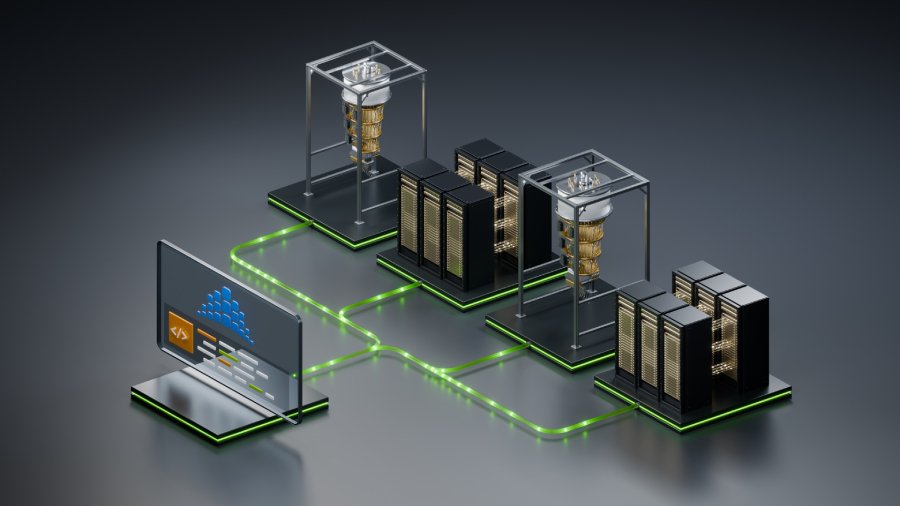
At some supercomputing centers, a researcher can already submit a quantum job through the same queue as a conventional one. Getting the quantum processor to work with that queue has often taken custom software at each site.
At Supercomputing 2026 in Chicago on Nov. 16, Nvidia said Slurm 26.11 will let quantum processor makers reuse device integrations across supercomputing centers. Nvidia expects the production release later this month and named Alice & Bob, IBM, IQM, Pasqal, Quantinuum, and Munich Quantum Software Company (MQSC) as early adopters.
For high-performance computing (HPC) centers, reusable integrations could make it easier to offer researchers access to quantum processing units (QPUs) from more than one vendor.
How Slurm 26.11 Puts QPUs in the Queue
According to IQM’s release, Slurm 26.11 adds plugin support for Hierarchical Resources (HRES), which lets a center describe a QPU as a shared, cluster-level resource and connect it to the software that manages the device. The main pieces:
- Reusable plugins. Open-source plugins built around the Quantum Resource Management Interface (QRMI) and Quantum Device Management Interface (QDMI) connect Slurm to the software that manages quantum devices.
- Existing workflows. Researchers can keep submitting jobs through familiar queues. Administrators still configure device endpoints, which compute nodes can reach them, and local access policies.
- Hybrid applications: Programs built with Nvidia CUDA-Q can run while Slurm coordinates access to processors.
- Open-source orchestration: The MQSC Orchestrator combines HRES with QDMI to schedule IQM systems.
The scheduler extends the hybrid stack Nvidia has been building, including the NVQLink interconnect behind IonQ’s plan to install a QPU at Nvidia’s quantum research center.
Craig Ciesla, chief technology officer at IQM, said in the release: “Quantum computers become useful at scale when they behave like every other resource in a supercomputing center. Slurm is where users meet our systems today.”
Who Is Adopting Quantum Scheduling
IQM says its systems already run at Oak Ridge National Laboratory (ORNL), VTT Technical Research Centre of Finland, the Leibniz Supercomputing Centre (LRZ), and CINECA. Nvidia estimates that quantum processor deployments at supercomputing centers have grown nearly sevenfold over five years.
| Measure | Figure |
| QPU deployment growth at supercomputing centers, past five years | Nearly sevenfold |
| Supercomputing centers deploying QPUs | Nearly 30 |
| QPUs being deployed | More than 50 |
The adopters use different hardware designs, from IQM’s superconducting processors to Pasqal’s neutral-atom systems, so a common interface matters to centers running more than one type.
Why Nvidia’s Role in Slurm Matters
Nvidia acquired SchedMD, Slurm’s lead developer, in December 2025 and said it would keep developing and distributing Slurm as open-source, vendor-neutral software. In its December 2025 acquisition announcement, Nvidia said Slurm ran on more than half of the top 10 and more than half of the top 100 systems on the TOP500 list.
Owning SchedMD gives Nvidia influence over Slurm’s development. For centers that use a mix of vendors, a practical test of Nvidia’s vendor-neutral pledge is how readily they can add another supplier’s quantum processor to the same scheduler.
What eWeek Found: The Test Is How Easily Centers Can Add a Second QPU
Slurm first introduced Hierarchical Resources as a beta feature in version 25.05. Version 26.11 adds plugin support that lets the scheduler check a quantum processor’s availability before starting a job. That can save compute time when a processor is offline or recalibrating.
The update changes how researchers get time on a machine. Improving the processor itself is a separate effort, as with IBM’s plan to link two chips into a 1,040-qubit system in 2027.
MQSC demonstrated the new scheduling capability on IQM hardware. IQM plans to validate it in staging with supercomputing centers as they upgrade. Three things to watch in those trials:
- Integration work. Can a center add a second vendor’s QPU by configuring a reusable plugin, or does it still need custom code?
- Device downtime. Does Slurm hold jobs when a QPU goes offline or recalibrates, so CPU or GPU resources aren’t tied up waiting for it?
- Queue behavior. The QRMI plugin can secure access before a job starts. The QDMI integration leaves device-level queuing to the provider. How much time does a job spend waiting at each stage?
If centers can add a second supplier’s hardware with less custom work and keep jobs moving when a device is unavailable, that would show what the update buys them in day-to-day operations.