







IBM is betting that two quantum chips can do what one cannot, but getting them to work together reliably may be the real test of its 1,000-qubit ambitions.
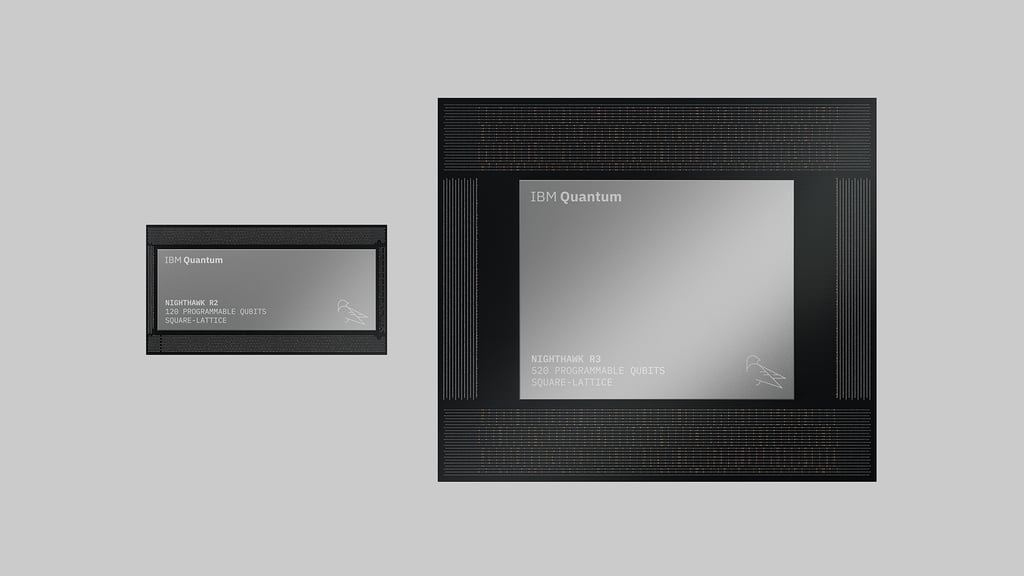
On Nov. 11, IBM announced its next-generation processor, IBM Quantum Nighthawk r3, designed to run 10,000 quantum operations across 520 programmable qubits. Rather than cramming more qubits onto a single piece of silicon, IBM plans to link two r3 chips next year into a single 1,040-qubit machine.
But reaching four-digit qubit counts is only part of the challenge. IBM must also demonstrate that the processors can exchange quantum information reliably and that larger systems can perform useful calculations without errors overwhelming the results.
Speed before scale
Quantum computers generate answers through statistical sampling, meaning each program run produces a single outcome and complex problems require billions of repetitions. IBM's current processor, Nighthawk r2, which launched in September, tackles this bottleneck using dedicated hardware to rapidly clear qubit energy between runs.
According to IBM, customers and partners have executed more than 34 billion circuits on Nighthawk r2, achieving speedups up to 19 times faster than its older Heron processors. German energy firm E.ON saw a 15-fold acceleration in power grid optimization, while Algorithmiq ran material simulations eight times faster.
“Useful quantum computing hinges on whether results can be delivered with accuracy and speed; both are fundamental,” said Jay Gambetta, director of IBM Research.
Rewriting the roadmap
To scale beyond a single chip, IBM is relying on modular interconnects called l-couplers, alongside linked cryogenic refrigerators cooled below 15 millikelvin.
Ars Technica notes that this dual-chip plan quietly reshapes IBM’s previous roadmap. IBM originally aimed to build a 360-qubit system in 2026 by linking three 120-qubit chips, and a 1,080-qubit system in 2027 by chaining nine smaller processors together.
Instead, IBM skipped the 2026 multi-chip system and quadrupled the programmable qubit count on Nighthawk r3, bringing total physical devices on the chip to 2,034, so it only has to connect two processors instead of nine.
What eWEEK found: The missing links to practical quantum
While IBM’s hardware announcements point to rapid throughput gains, digging into the technical disclosures reveals three critical gaps that still separate today’s machines from commercial fault tolerance:
The interconnect fidelity gap
Linking separate quantum processors remains one of the toughest engineering hurdles in computing. IBM reports that connecting earlier Nighthawk r1 processors with four l-couplers yielded a peak quantum state transfer fidelity of 99.3% (and 99.0% on average).
That gap matters because errors introduced when transferring quantum information between chips can accumulate as systems grow, making reliable multi-processor calculations harder to achieve.
Furthermore, IBM Vice President of Quantum Systems Oliver Dial told Ars Technica that the company is still determining how many couplers are needed to effectively connect chips hosting error-corrected qubits.
Unproven hardware and benchmarks
Nighthawk r3 remains a planned 2027 processor rather than a commercially available system. IBM's current performance figures come from earlier hardware, leaving the larger chip's error rates, reliability, and performance under demanding workloads unproven.
The logical qubit deficit
A larger physical qubit count does not automatically translate into more reliable computing power. Fault-tolerant quantum computers combine multiple physical qubits to create error-corrected logical qubits, which are designed to preserve information despite hardware errors.
IBM's Nighthawk roadmap focuses on improving near-term quantum computing through error mitigation, while its separate fault-tolerant roadmap targets systems capable of sustained error correction.
Reaching 1,040 physical qubits would therefore be a scaling milestone, not proof that IBM has achieved fault-tolerant computing.
Enterprise takeaway
For enterprise IT leaders, IBM’s tighter integration of high-performance classical computing with quantum workflows signals that hybrid experimentation is viable today. The approach helped RIKEN and Cleveland Clinic process 608 million biological samples 33 times faster.
However, organizations should treat 2027’s 1,040-qubit system as a research milestone rather than a replacement for classical infrastructure, keeping production timelines anchored closer to IBM's 2029 target for its fault-tolerant Starling system.
In the meantime, businesses exploring quantum computing can focus on identifying workloads where conventional systems face significant computational challenges.
Early experiments in materials science, molecular simulation, and optimization could help organizations determine where quantum capabilities might eventually deliver measurable benefits.
IBM's next challenge is demonstrating that its larger processors can maintain reliable performance when connected.
The success of its revised roadmap will depend not only on reaching higher qubit counts but also on whether those additional qubits can support increasingly complex calculations without introducing prohibitive errors.
Subscribe to the Quantum State newsletter from eWeek to stay ahead of quantum computing and real-world applications shaping the next era of technology.