







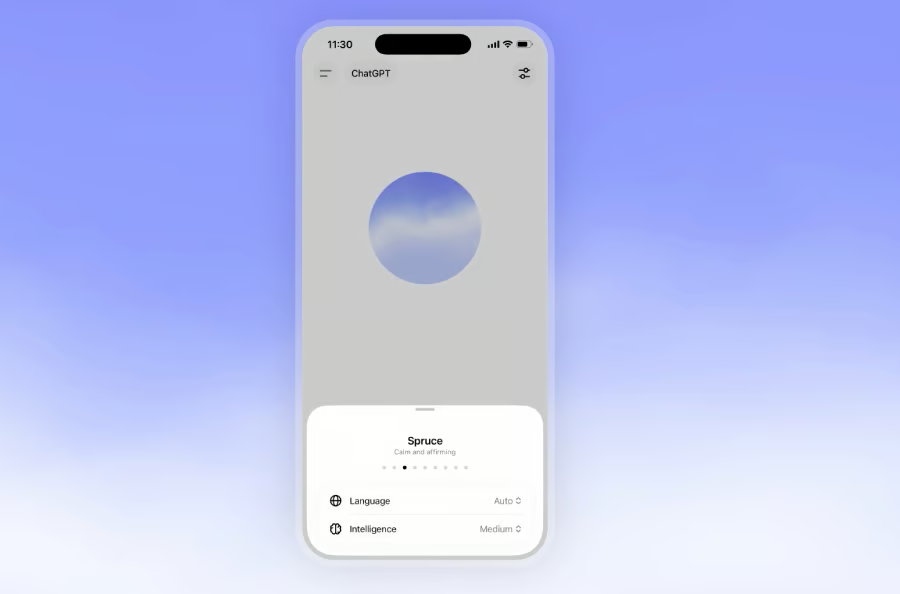
Talking to ChatGPT is about to become a lot less stop-and-start.
OpenAI has launched GPT-Live, a new family of voice models that can listen as users speak and respond without waiting for them to finish. The company says the rollout begins globally this week, with GPT-Live-1 becoming the default voice experience for Go, Plus, and Pro subscribers and GPT-Live-1 mini powering free accounts. The rollout begins globally this week.
The company said GPT-Live replaces the previous Advanced Voice Mode with a full-duplex architecture that continuously processes audio, enabling more natural turn-taking, fewer awkward interruptions, and faster conversations.
While the smoother conversations are the immediate benefit, the larger story is OpenAI's vision for voice as the primary way people interact with increasingly capable AI agents that can search the web, reason through problems, and complete tasks in the background.
Voice stays active while GPT-5.5 handles harder tasks
A key change is how GPT-Live separates conversation from more demanding AI work.
OpenAI said the voice model can hand off requests that require web search, deeper reasoning, or agentic capabilities to its latest frontier model while continuing the conversation.
At launch, GPT-5.5 handles those background tasks before returning the results to the ongoing voice chat.
The company also said GPT-Live can decide multiple times each second whether to speak, pause, continue listening, interrupt, or use a tool. That approach also enables features such as live translation and lets users pause naturally without the assistant mistakenly cutting in.
The bigger bet
OpenAI is positioning voice as a future control layer for AI work generally.
ChatGPT Voice Product Lead Atty Eleti said he has had 30- to 40-minute-long conversations with the voice feature during walks, and argued that voice could become "a kind of primary interface to computing, and to manage increasingly complex long-running agentic work," comparing it to how people already use coding tools like Codex.
That ambition places OpenAI in a crowded field. Apple and Amazon have both upgraded their assistants with better context handling, while startups like Sesame and Monogram are chasing similar ground with more expressive, visually integrated assistants.
Where it still falls short
The system isn't flawless.
During a live demo of Hindi translation, the assistant reportedly spoke with a heavy American accent and used stilted, "bookish" phrasing, a reminder that natural-sounding English doesn't automatically translate to fluency elsewhere. OpenAI hasn't specified which languages received the deepest optimization.
There's also the sensitive question of emotional reliance. OpenAI says it's built-in safeguards for self-harm-related conversations and age-appropriate responses for teens, and insists GPT-Live is meant to be an assistant, not a companion.
As voice assistants get better at sounding human, the line between helpful tool and emotional crutch becomes harder to police, something OpenAI says it will monitor through ongoing safety research.
What users may actually notice
For most users, ChatGPT may feel less like a call-and-response chatbot and more like something that can stay present during an ongoing task.
GPT-Live can acknowledge users with short listening cues, wait through natural pauses, and be told to stay quiet until called on, according to reports on OpenAI’s rollout. It can also support live translation and show dynamic visuals for topics such as weather, sports, and stocks while the conversation continues.
Those details matter because they point to a different kind of AI interaction. Instead of forcing users to stop, type, wait, and restart, GPT-Live is designed for moments when people are walking, driving, cooking, troubleshooting, translating, or juggling multiple tasks at once.
Also read: GPT-5.6 rumors point to OpenAI’s broader push toward agents, tool use, and workflow-focused AI.