







Tesla’s Cybercab is moving from the stage demo to street testing.
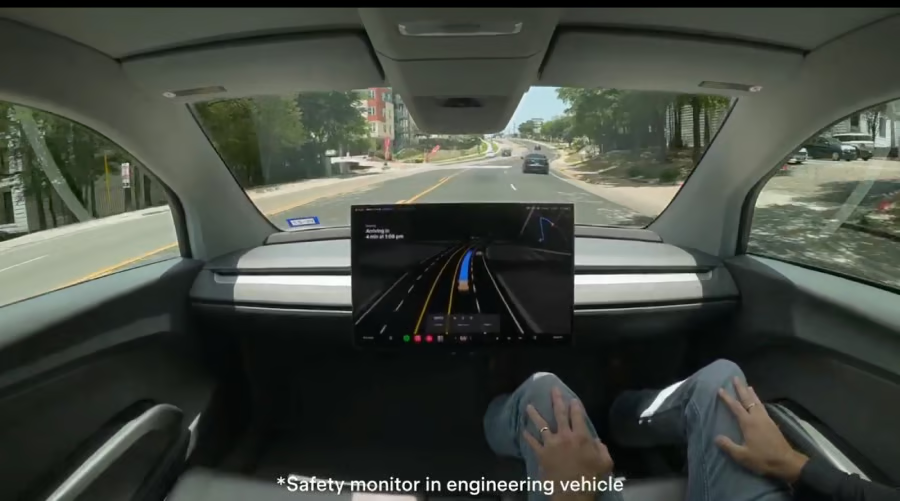
The company has started testing a production version of the autonomous vehicle in Austin, Texas, according to a video Tesla posted on X. The vehicle shown has no steering wheel or pedals, though a safety rider appears seated in the right passenger seat during the early rollout.
The rollout comes two years after Tesla unveiled the Cybercab and roughly one year after it started testing its autonomous vehicle system in Austin with Model Y SUVs. It has not been said how many Cybercabs will hit the streets of Austin over the next few weeks.
Larger rollout potentially coming later in the year
A recent proposal by the National Highway Traffic Safety Administration (NHTSA) to no longer mandate brake pedals in autonomous vehicles, which is set to become law later this year, may have prompted Tesla to begin testing vehicles without manual controls.
There have been reports of hundreds of Cybercabs being built at the Gigafactory in Texas, leading to rumors that Tesla is planning a large-scale rollout. This seems unlikely to happen in the near term, given the mishmash of state laws and the fact that Tesla does not have clearance to accept robotaxi fares in most states.
The automotive manufacturer is still considered behind some of the leaders in the self-driving market, such as Google’s Waymo and Baidu’s Apollo Go, which have clocked millions of fully autonomous rides so far. Waymo is also rolling out its robotaxi service to more than 20 new cities this year.
Tesla, like other automakers, believes it can scale much faster than these pure-play self-driving software providers due to the millions of miles clocked by Autopilot and Full Self-Driving, as well as the scale of its manufacturing business.
It has struggled to reach the same level of autonomy as its rivals, however, amid a series of crashes in Austin and allegations that it uses human drivers to operate remotely when its autonomous functionality fails.
Cybercab has struggled to meet deadlines
The Cybercab has been delayed for so long that reports suggested Tesla had revived its affordable electric vehicle strategy. Musk had previously spurned the idea of a $25,000 Tesla — stating that the company’s focus was on Cybercab and its Optimus robots — but declining vehicle sales and robotaxi delays appear to have forced Tesla to reconsider cheaper models.
Even though the production vehicle is finally hitting the road, there is still no exact timeline for when customers will be able to hire one without a safety rider. That may come later in the year, but regulatory hurdles or safety concerns could also delay it.
For now, the Cybercab test appears to be more proof point than full rollout. Tesla has shown the vehicle can operate on public roads with a safety rider present, but the harder milestone will be proving it can run safely, legally, and at scale without one.
The Cybercab was one of the main features of Musk's most recent Master Plan Part 4, so even if attention shifts to a potential SpaceX-Tesla merger to become a $3 trillion giant, a robotaxi rollout should still be a major part of the company's plans.