







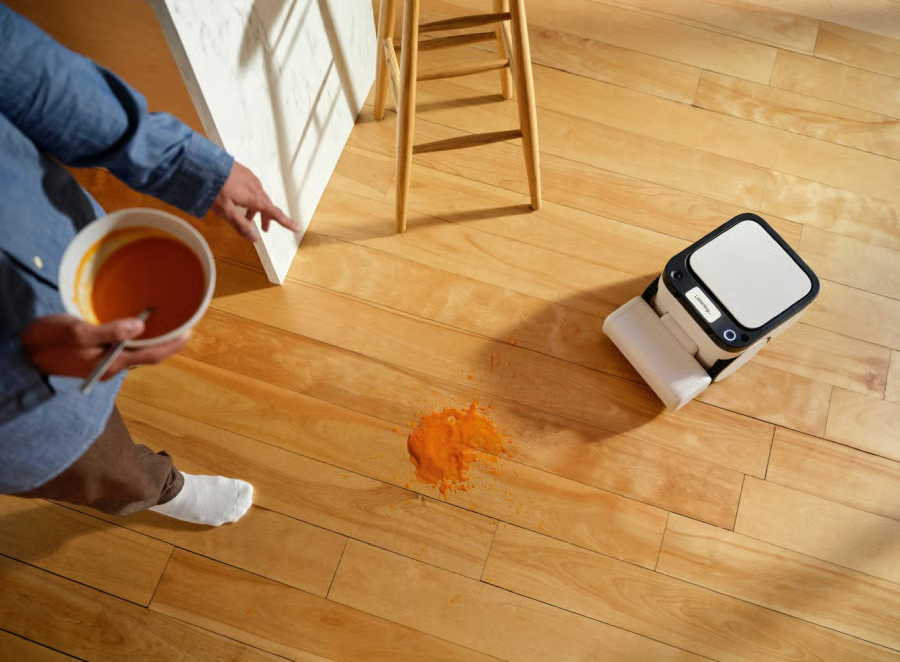
"Hey Matic, clean this" is now all it takes.
Matic Robots Inc. began rolling out a firmware update Thursday that transforms how its $1,245 robot vacuum operates. The new feature, called Matic Cues, lets users control the device through natural voice commands in more than 70 languages or by simply pointing at a mess and saying "clean this."
The Mountain View, California-based company, founded by former Google Nest engineers Mehul Nariyawala and Navneet Dalal, has been working toward this moment for nine years. "When we started, we wrote down on a piece of paper that we’re never going to get acquired," Nariyawala told Bloomberg. "It's good to finally ship what we dreamed about almost nine years ago."
The robot responds to the wake word "Hey Matic," turns toward the speaker, and can follow commands like "clean the kitchen," "come here," or "follow me." Users can even chain instructions, such as asking the robot to vacuum one room and mop another in a single sentence.
How it works
Unlike competing models that rely on smart home platforms like Alexa or Google Home, Matic's voice control is built directly into the robot itself. Gesture detection uses the device's five onboard cameras to see where a user is pointing, something the company says is impossible for lidar-only systems that "see nothing."
"A truly intelligent robot that is intuitive to use should learn how humans naturally communicate, instead of asking families to learn yet another new interface," Nariyawala said in a company announcement. "That is the only way a robot can truly belong inside a home and become part of a family."
Privacy considerations
Matic has built its reputation on privacy, processing visual data on the device rather than in the cloud. With Matic Cues, the company maintains that approach for the wake word and gesture detection—both handled entirely on the robot. However, voice commands are sent to Google's Gemini API for parsing, meaning the feature requires cloud connectivity.
"We anonymously send the Gemini model your command," the company explained in a blog post. "No user info is sent." Microphones are off by default, and users must opt in to enable the feature. Matic says it plans to develop a smaller on-device model for the most common commands in the future, potentially eliminating the cloud dependency.
Business context
The update arrives at a pivotal moment for the US robot vacuum industry.
iRobot Corp., the pioneer behind Roomba, filed for bankruptcy late last year, while Chinese competitors like Roborock and Dreame have captured market share with lower-priced models, Bloomberg reported. The FCC's recent addition of foreign-produced "advanced robotic devices" to its Covered List could restrict new models from China entering the US market.
Matic, which designs and assembles its robots in California, has sold over 13,000 units to date. The company announced $60 million in new financing in January, bringing total funding to $115 million. A price hike to $1,495 is scheduled for early September, which the company attributes to rising component costs, according to Bloomberg.
What Matic has demonstrated with Cues is that the most advanced home robot isn't necessarily the one with the most sensors or the fastest processor; it's the one that disappears into the background and responds to us the way we already talk to each other.
Additional reading: For more on how robots are mastering increasingly complex real-world tasks, see how Figure 03 autonomously climbed a ladder without human control.