







- The Top 10 Worst Internet Proposed Laws in the U.S.
- NEW JERSEY: Social Networking Police
- CALIFORNIA: Social Networking Police
- CONNECTICUT: Taxing Web 2.0 Advertising
- NORTH CAROLINA: Discriminatory Internet Tax
- CONNECTICUT: Discriminatory Internet Tax
- FEDERAL: Unfairly Targeting Online Sellers
- NEVADA: One-Size-Fits-All Tech Standards
- TEXAS: Turning Standards into Mandates
- NEW YORK: Discriminatory Internet Taxes
- NORTH CAROLINA: Discouraging Green Downloads
The Top 10 Worst Internet Proposed Laws in the U.S.
by Roy Mark
NEW JERSEY: Social Networking Police
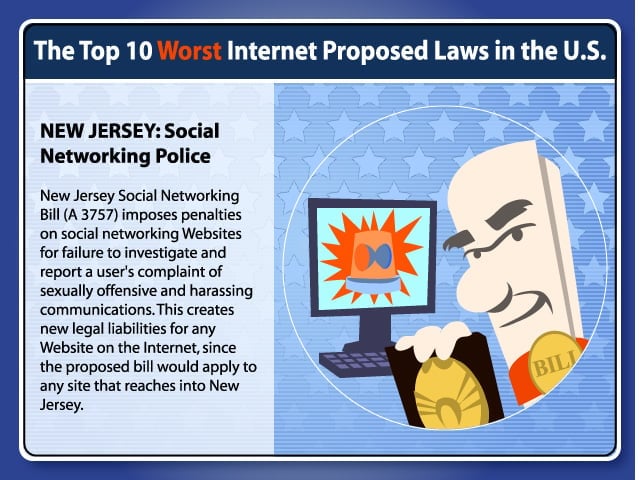
New Jersey Social Networking Bill (A 3757) imposes penalties on social networking Websites for failure to investigate and report a user’s complaint of sexually offensive and harassing communications. This creates new legal liabilities for any Website on the Internet, since the proposed bill would apply to any site that reaches into New Jersey.
CALIFORNIA: Social Networking Police
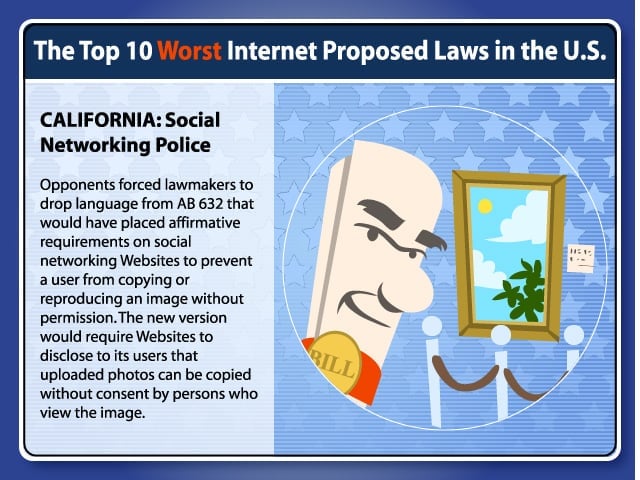
Opponents forced lawmakers to drop language from AB 632 that would have placed affirmative requirements on social networking Websites to prevent a user from copying or reproducing an image without permission. The new version would require Websites to disclose to its users that uploaded photos can be copied without consent by persons who view the image.
CONNECTICUT: Taxing Web 2.0 Advertising
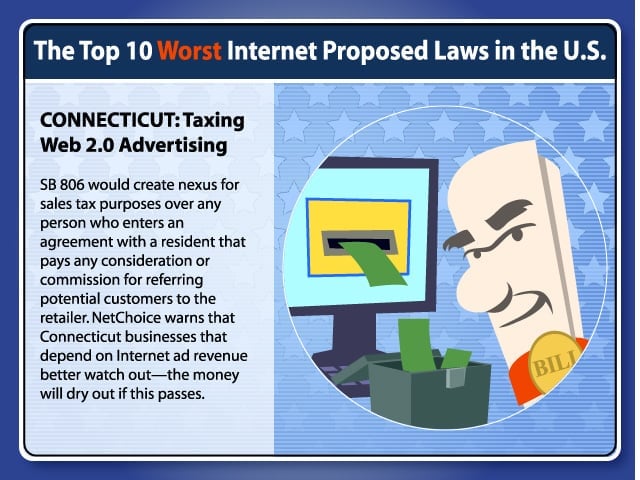
SB 806 would create nexus for sales tax purposes over any person who enters an agreement with a resident that pays any consideration or commission for referring potential customers to the retailer. NetChoice warns that Connecticut businesses that depend on Internet ad revenue better watch out—the money will dry out if this passes.
NORTH CAROLINA: Discriminatory Internet Tax
SB 99 would tax the Internet resale of tickets in contradiction of The Internet Tax Freedom providing a moratorium on any “multiple or discriminatory taxes on electronic commerce.” This law bars federal, state and local governments from imposing discriminatory Internet-only taxes.
CONNECTICUT: Discriminatory Internet Tax
An amendment to SB 1002 requires Internet sellers to maintain an elaborate record-keeping system whenever they purchase and resell goods obtained from someone who is “not regularly engaged in the business of dealing in such goods.” The bill requires that the physical location of these records be open to the public for inspection.
FEDERAL: Unfairly Targeting Online Sellers
The Combating Organized Retail Crime Act (S 470), the Organized Retail Crime Act (HR 1173) and the E-Fencing Enforcement Act (HR 1166) collectively would mandate online and offline marketplaces to investigate suspicious sales. The bills would force online sellers to collect information that law enforcement can use to prosecute those who fence goods on their Websites.
NEVADA: One-Size-Fits-All Tech Standards
SB 227 prohibits any business from (1) transmitting personal information outside of the secure system of the business or (2) moving any data storage device beyond the logical or physical boundaries of the business, unless secured by encryption. Moreover, this bad boy is the only bill on the list that has actually become law.
TEXAS: Turning Standards into Mandates
The bill transforms business and technology standards into legislative mandates, harming innovation and the next generation of security technology. It seeks to impose Payment Card Industry (PCI)-like data security standards and, in the event of a security breach, liability on businesses that fail to meet such data security standards.
NEW YORK: Discriminatory Internet Taxes
New York claims that online job-seeking and resume services may be subject to sales taxation. However, online companies fulfill the traditional role of a “headhunter” (which is a nontaxable service) only using nontraditional means. The fact that information is provided or utilized digitally does not change that.
NORTH CAROLINA: Discouraging Green Downloads
HB 558/S 487 would impose sales tax on film, music and software downloads. While that’s perfectly legal, it discourages the greenest way to purchase music and other content. The bills would also place local businesses in those states selling these goods at a disadvantage to out-of-state competitors.