







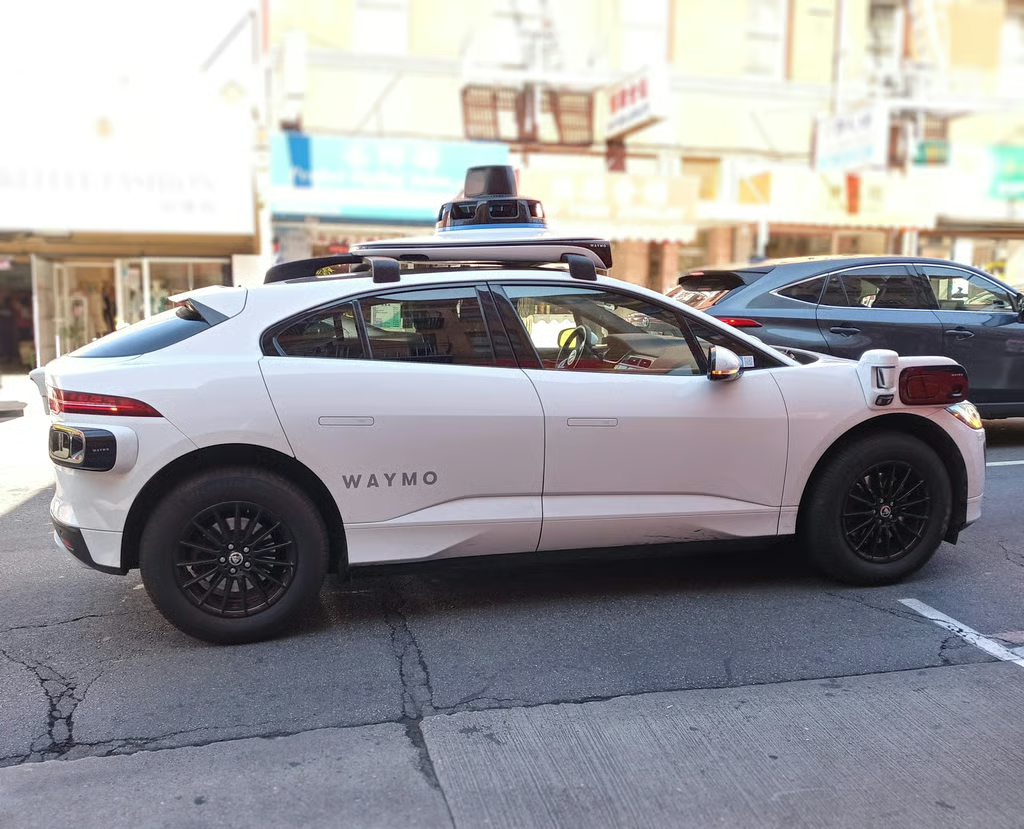
Waymo has won approval to expand its paid robotaxi territory across additional California counties, potentially bringing the service to millions more residents.
The California Public Utilities Commission approved Waymo's request to expand its paid passenger service, although the company said deployment will take time as it establishes depots, charging facilities, and other local infrastructure.
Where Waymo Can Expand Next
Waymo also received approval to offer paid rides across a wider service territory encompassing the Bay Area and Los Angeles, as well as Sacramento and San Diego. Its previous authorization covered more limited areas, with highway operations approved separately.
The expanded territory includes Alameda, Contra Costa, Marin, Napa, San Mateo, Santa Clara, Santa Cruz, Solano, Sonoma, and Yolo counties in Northern California, along with Orange, Riverside, San Bernardino, and Ventura counties in Southern California. Regulatory approval does not mean rides will become available throughout those counties immediately.
Waymo began as Google’s self-driving-car project and is now an Alphabet subsidiary. Its driverless vehicles operate at Level 4 automation within defined geographic and environmental conditions, rather than at Level 5, which would require operation under all conditions in which a human could drive.
Acceleration in scale to reach one million paid rides
Waymo's expansion across most of California, already its most mature market, could bring it closer to its ambitious goal of one million weekly rides. The company said it reached 500,000 paid rides per week in March 2026 and plans to expand its presence to more than 20 cities during the year. Its international plans include London, while its work in Tokyo has begun with testing and data collection rather than a commercial robotaxi launch.
Even with this acceleration, Waymo is taking care not to expand too quickly. People are still hesitant to try autonomous vehicle rides, with the majority of people in the US unwilling to take one. News of accidents involving autonomous vehicles also tends to attract far more public attention than accidents between human-driven cars.
Even non-fatal accidents attract significant media attention. A series of incidents involving Waymo vehicles entering construction zones led to a recall of almost its entire fleet, alongside a temporary ban on highway operations while the operator addressed the issue.
Gap between Waymo and competitors increasing
Waymo has extended the gap between itself and the competition over the past year. Tesla is, for the most part, still operating its taxi service with a safety rider in the front seat, and its robotaxi operations remain nascent. Rumors of a large-scale launch in Miami or Houston have not come to pass, although it has recently added Starlink integration to its Cybercab fleet.
This lead may give Waymo's backers more confidence that the operator can become the first nationally available robotaxi service. It was valued at $110 billion in February, but that could be a fraction of what it is ultimately worth if it can take meaningful market share from Uber and other ridehailing operators.
For the wider robotaxi market, Waymo's California expansion is another sign that autonomous ridehailing is moving beyond limited pilots and toward becoming a genuine competitor to traditional ridehailing services.
Read more: Waymo’s $16 billion funding round is fueling an aggressive robotaxi expansion as the company targets more than 20 cities and one million weekly rides.